


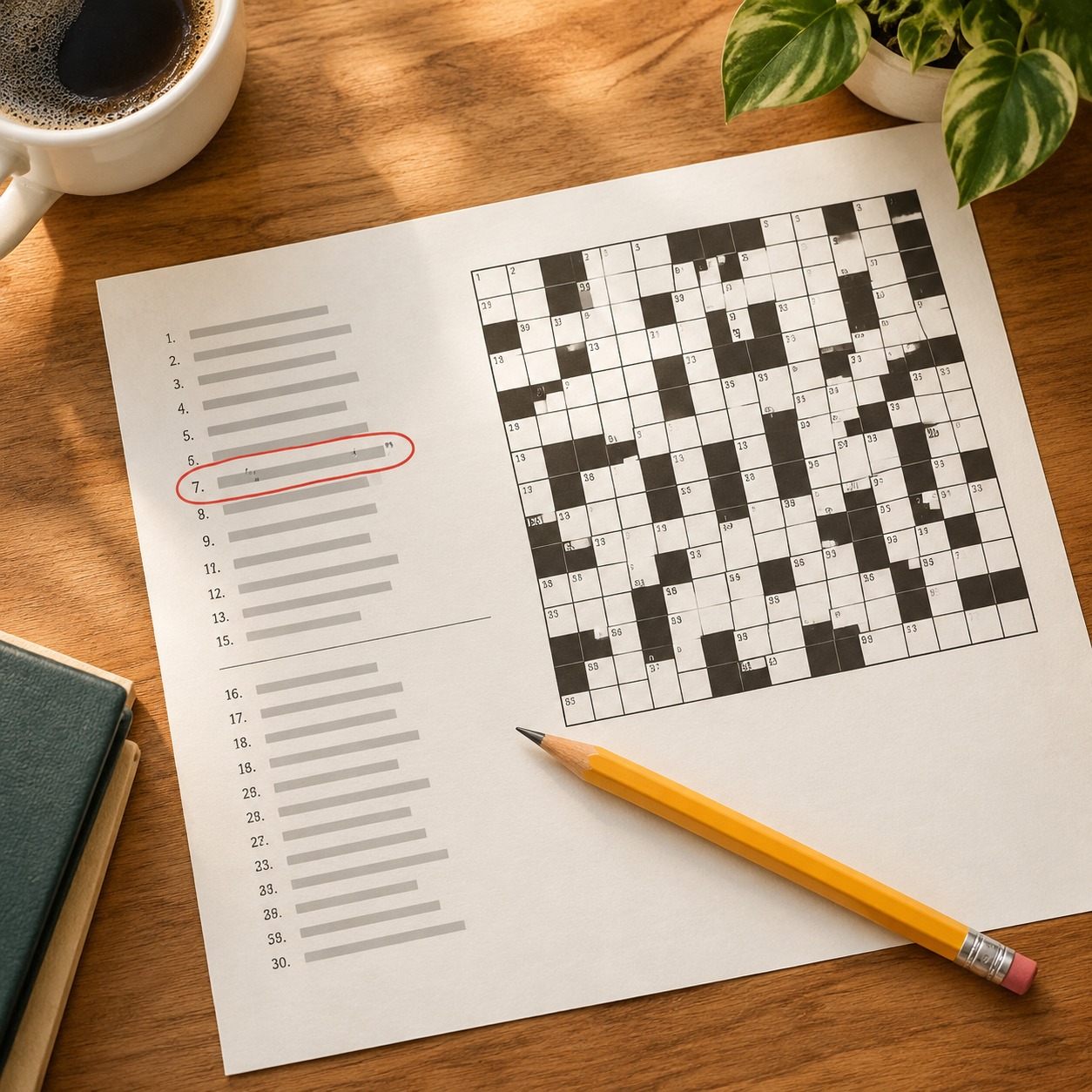
Crossword quoted clues can look almost too friendly. A clue in quotation marks feels like a voice popping out of the grid, as if the puzzle is suddenly talking instead of defining.
That friendliness is useful, but it is also a trap.
When a crossword clue is written like `"Not again!"` or `"I knew it!"`, the answer usually is not a dictionary definition. It is more likely to be something a person might say, a short reaction, a bit of dialogue, or a phrase that matches the tone of the quote.
That makes crossword quoted clues fun. It also makes them dangerous. The first phrase that sounds right may be one letter too long, one tense off, or just a little too casual for the crossing answers around it.
If you want a quick place to practice, open Easy Daily Puzzle and treat every quoted clue as a small acting prompt. Do not only ask what the words mean. Ask who would say them, in what mood, and how many letters the grid will allow.
Crossword quoted clues ask you to hear the answer
A normal clue often points straight at a definition. "Small songbird" might lead to WREN. "Before, in poetry" might lead to ERE. The puzzle is still clever, but the clue is mostly asking for a word.
Crossword quoted clues work differently.
Quotation marks turn the clue into speech. The answer may be a reply, a sound, a slogan, a warning, or a quick phrase that fits the situation. The clue is not only pointing at meaning. It is asking for tone.
That is why `"That's enough!"` might suggest STOPIT, NOGOOD, or ENOUGH, depending on the grid. `"Who knew?"` could lean toward ILLBEDARNED in a long slot, or GOSH in a short one. A quoted clue gives you the emotional room, but the grid decides the exact furniture.
The best first question is simple: what kind of sentence is this?
Is it a complaint? A greeting? A command? A surprised reaction? A courtroom line? A sports shout? A polite refusal?
Once you know the type of speech, your guesses become smaller and cleaner.
The quotation marks are not decoration
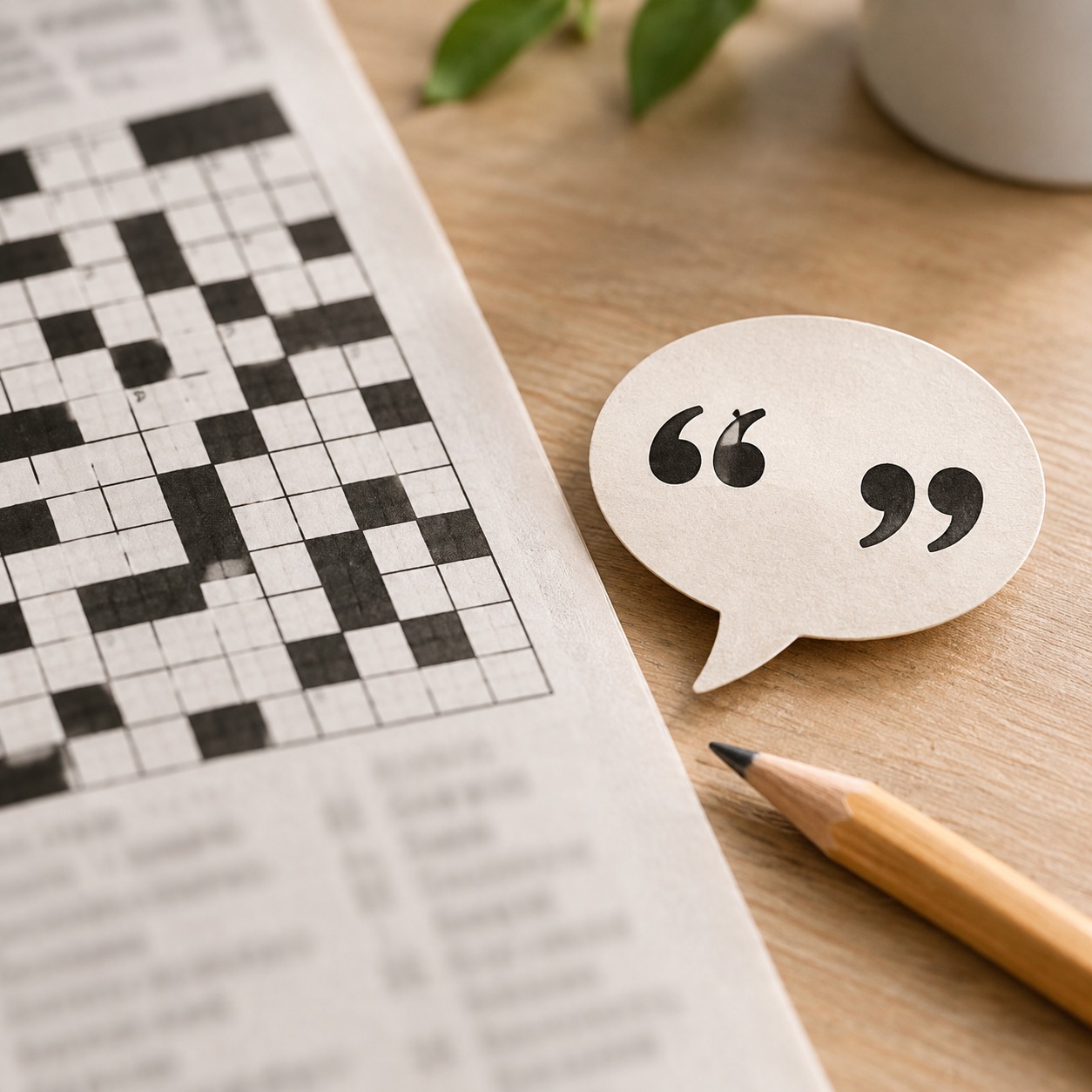
In a crossword, punctuation usually earns its place. A question mark may hint at wordplay. Parentheses can narrow context. Abbreviations point toward abbreviated answers. Quotation marks are just as intentional.
They tell you to stop reading the clue like a flat label.
For example, if a clue says `"Move it!"`, the answer might not be SPEED. It might be GO, HURRY, CMON, or STEPONIT. The quoted phrase creates a scene. Someone is urging someone else forward. The answer has to sound like speech, not just describe speed.
This is where many solvers get caught. They translate the phrase into an idea, then enter a word for the idea. But crossword quoted clues often want the line itself, or another line that could replace it.
Read the clue out loud once.
That may sound childish, but it works. Spoken clues reveal whether your answer feels natural. If the clue is `"I'm shocked!"`, an answer like APPALLED might define the feeling, but a shorter conversational answer like GASP or OHNO may fit the puzzle better.
The quote asks for a mouth, not only a meaning.
Let the answer length control the performance
The answer length is the quiet director of crossword quoted clues.
Before you fall in love with a phrase, count the boxes. A three-letter slot and a nine-letter slot are not asking for the same kind of speech.
A three-letter quoted answer is often a burst: WOW, UGH, AHA, EEK, YES, or HEY. A medium answer might be SORRY, NEVER, OKAY, ASIF, or ISEE depending on style and crossings. Longer answers can carry whole phrases: DONTASK, THATSODD, or YOUWIN.
The exact entries will depend on the puzzle, but the habit is the same.
Short slot: think reaction.
Medium slot: think common phrase.
Long slot: think a full line someone might say.
This one habit keeps you from forcing a dramatic answer into a tiny space. It also keeps you from wasting a long entry on a word that only describes the situation.
Crossings keep quoted answers honest
Quoted clues invite guessing because they sound familiar. That is the danger.
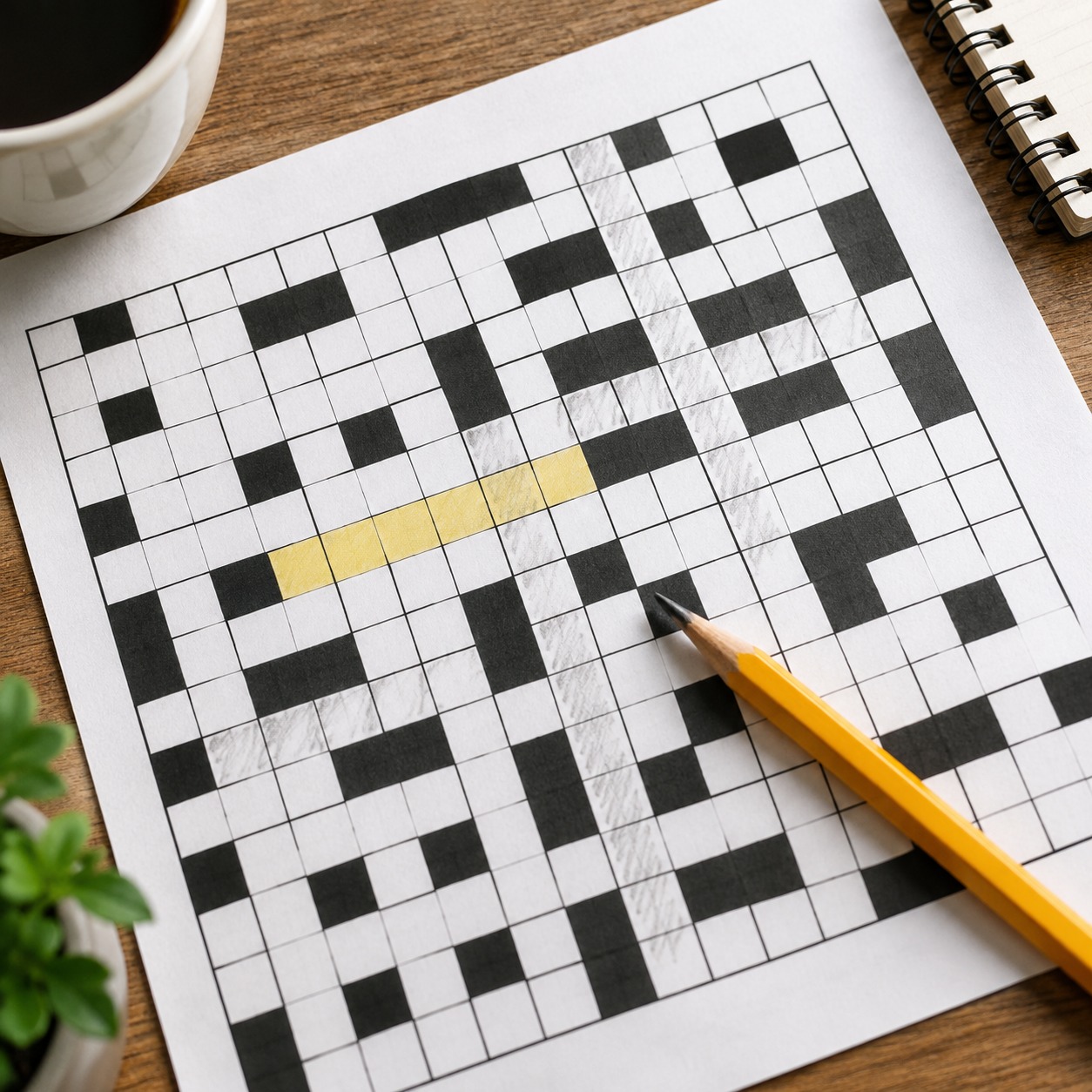
If the clue is `"No chance!"`, your brain may immediately offer NOWAY. If the slot has five letters, that feels perfect. But the crossings might demand NEVER, ASIF, or FATNO. Familiar speech is flexible, so crossings are not optional.
Use a two-step rule.
First, enter the quoted answer lightly in your head.
Second, ask whether every crossing supports the same tone.
If the crossing letters fight the phrase, do not argue with the grid. The puzzle may be using a different register. A clue that sounds modern might take an older phrase. A clue that sounds formal might want slang. A clue that sounds like an exclamation might want a quieter reply.
Crossword history is full of this kind of compression. The American Crossword Puzzle Tournament's brief history notes that Arthur Wynne's 1913 puzzle looked different from modern grids, but the basic pleasure was already there: words fitted into a pattern. Modern clueing adds another layer. The answer must fit the pattern and the voice.
That is what makes quoted clues satisfying. You are not only solving vocabulary. You are matching a line to a space.
Watch for clue voice, not only clue meaning
A quoted clue usually has a speaker hidden inside it.
Imagine these clue moods:
`"Careful there!"`
`"My mistake!"`
`"You first."`
`"That explains it!"`
Each one suggests a different speaker. The first sounds like a warning. The second sounds like an apology. The third sounds polite, maybe cautious. The fourth sounds like sudden understanding.
If you ignore the voice, the answers blur together. If you listen to the voice, you can sort the possibilities quickly.
For `"My mistake!"`, the answer may lean toward OOPS, SORRY, or IERR. For `"That explains it!"`, you might consider AHA, ISEE, or NOWIGETIT. The point is not to memorize every possible entry. The point is to make the phrase behave like a person talking.
This is also why [more crossword articles on Easy Daily Puzzle](https://easydailypuzzle.com/?s=crossword) should not only teach word lists. Stronger solving comes from noticing the tiny instructions built into the clue.
A small practice pass for crossword quoted clues
Try this on your next puzzle.
Before filling any quoted clue, make four quick checks.
First, identify the speech type. Is it a greeting, refusal, warning, apology, reaction, or command?
Second, count the slot. A tiny slot wants a tiny sound. A longer slot can hold a real phrase.
Third, read the clue in a real voice. If your answer sounds like a dictionary word instead of something someone would say, pause.
Fourth, wait for at least one crossing unless the answer is completely obvious.
This slows you down by a few seconds, but it saves cleanup later. Quoted clues are easy to overtrust because the clue already sounds complete. The trick is remembering that the quote is only the setup. The answer still has to survive the grid.
Why this tiny clue signal makes crosswords feel alive
Crosswords have always been part language game, part pattern game. The Wikipedia overview of crosswords covers many clue types and grid traditions, but a solver feels the variety most clearly in small moments: a question mark, an abbreviation, a theme entry, a quote.
Crossword quoted clues are one of those small moments.
They let the puzzle borrow a human voice. For one entry, the grid stops sounding like a list and starts sounding like a scene.
That is why they are worth practicing. Not because they are rare or advanced, but because they teach a bigger crossword habit: read the whole clue, including the punctuation. The answer is often hiding in the way the clue asks, not only in what the clue says.
Next time a clue appears in quotes, do not rush to the first phrase that pops up. Hear it. Count it. Cross it. Then let the right voice land in the grid.