



Crossword tournament pressure is a funny idea if you mostly solve alone. At home, a crossword can be slow and private. You can leave it on the table, come back after lunch, erase a bad corner, and pretend the wrong answer was never there.
Put that same grid in a ballroom with a clock running, and the puzzle changes shape.
The clues are still clues. The crossings are still crossings. But now every hesitation feels louder. A three-letter answer that would be easy on a lazy Sunday suddenly has teeth.
That is why crossword tournaments are worth writing about even for casual players. They reveal what the game really tests when the quiet is taken away.
Crossword tournament pressure starts with newspaper history
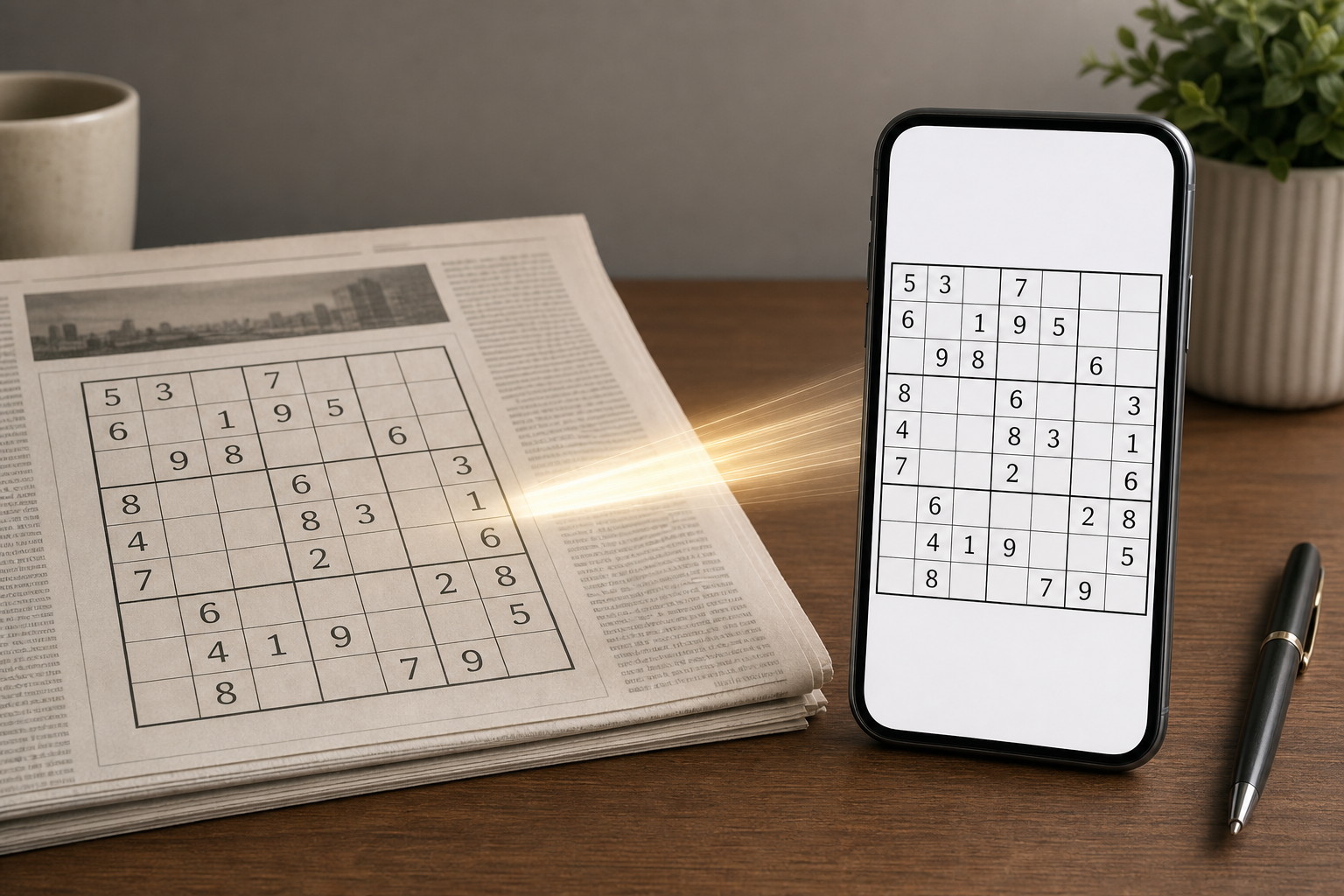
The modern crossword has always belonged partly to newspapers. The American Crossword Puzzle Tournament's own history page credits Arthur Wynne, a Liverpool-born journalist, with the first known published crossword-style puzzle in the New York World on December 21, 1913. It was called a "Word-Cross" puzzle, and it looked different from the clean blocked grids solvers know now.
Still, the habit was there from the beginning: a reader, a printed page, a set of clues, and a grid asking to be filled.
Over time, crosswords became part of daily newspaper identity. Some readers turned first to the front page. Others turned to the puzzle. Constructors developed styles, editors developed standards, and regular solvers developed little instincts that are hard to explain until you watch someone work quickly.
That is the foundation tournament solving builds on. It takes a newspaper habit and makes the habit visible.
If you want a softer version of that habit, you can browse word and puzzle games on Easy Daily Puzzle or start from the Easy Daily Puzzle game library . A timer is optional. Curiosity is not.
What changes when the clock is running
Most casual crossword players think speed means knowing more answers.
It does, partly. A strong solver has a huge store of crossword vocabulary: common abbreviations, old names, rivers, currencies, opera roles, compass points, and the little glue words that hold grids together. That knowledge helps.
But crossword tournament pressure is not only about knowledge. It is also about recovery.
A tournament solver has to notice when an answer is almost right but not quite. They have to keep moving without letting one stubborn clue poison the next five minutes. They have to decide whether a half-filled corner is worth fighting now or better left for later crossings.
That is where the sport appears.
The physical act matters too. Solvers use paper at the American Crossword Puzzle Tournament. That means handwriting, erasing, scanning, and keeping the grid legible enough for judges. In a normal online solve, a typo can be corrected instantly. On paper, a messy correction can steal seconds and confidence.
Tournament pressure makes small crossword habits visible. Do you read clue tense carefully? Do you trust crossings too early? Do you write lightly when unsure? Do you abandon a clue before it eats the whole solve?
Those questions matter at home too. The clock just exposes them faster.
The American Crossword Puzzle Tournament gives the game a stage
The American Crossword Puzzle Tournament, often shortened to ACPT, is the best-known event in this world. The official lists Erik Agard as the winner of the 48th tournament. The tournament's capsule history records 803 contestants for 2026 and notes that the first prize increased to $7,500, with a $15,000 prize pool.
Those numbers help explain the atmosphere. This is not a tiny private club in a back room. It is a room full of people who care enough about crosswords to spend a weekend measuring themselves against the same grids.
What makes the event interesting is not only who wins. It is the range of people in the room. Some are elite speed solvers. Some are constructors. Some are fans who know they will not win but want to be around the puzzle culture. Some come for the competition, some for the community, and some probably come because they want to see whether their daily habit holds up under lights.
That mix is charming. Crossword solving can look solitary from the outside, but tournaments show a social side: shared jokes about awful corners, post-puzzle debates, constructor admiration, and the weird comfort of sitting near hundreds of people who also know too many three-letter rivers.
What casual solvers can steal from tournament players
You do not need to chase a trophy to learn from tournament solving.
The first lesson is to separate "I do not know it" from "I cannot solve it yet." Those are different problems. A clue may be impossible alone but easy after two crossings. Tournament solvers do not take every blank personally. They keep the grid moving.
The second lesson is to respect clue grammar. If the clue is plural, the answer probably is too. If the clue is in past tense, the answer may be as well. If a question mark appears, expect wordplay. That small discipline prevents many almost-right answers.
The third lesson is to protect momentum. In a timed solve, spending too long on one clue can make the whole grid feel stuck. At home, the same thing happens emotionally. One bad corner can convince you that the puzzle is harder than it is.
Try this during your next crossword: if a clue does not open after ten seconds, move. Give it letters from neighboring answers. Come back when the grid has more to say.
That is not giving up. That is solving like the puzzle is connected.
Why crossword tournament pressure is fun, not just stressful
The best part of crossword tournament pressure is that it proves a crossword is not only a knowledge test.
Yes, facts help. Vocabulary helps. A long memory for old crossword answers helps more than anyone wants to admit.
But the bigger skill is judgment. When should you trust an answer? When should you wait? When should you erase? When should you guess because the crossings are strong enough?
That is why watching fast solvers is so satisfying. They are not simply dumping facts into boxes. They are managing risk at high speed.
A casual solver can enjoy the same feeling at a slower pace. The little rush when a corner opens. The relief when a wrong answer finally comes out. The tiny snap when a clue that looked impossible suddenly becomes obvious.
Crossword tournament pressure just turns up the volume on that feeling.
You can keep the softer version. Pick a puzzle, set a gentle timer if you want, and notice what happens when you stop wrestling every clue in order. The grid will start to feel less like a test and more like a conversation.
That is the real lesson from the tournament room: a crossword is quiet, but it is not asleep.