



Cryptic crossword clues can feel unfair until someone shows you the trick. The clue is not only asking for an answer. It is usually giving you two ways to reach the same answer, then hiding the join.
That is why a cryptic puzzle feels different from a regular crossword. A standard clue may point straight at a synonym, fact, phrase, or bit of trivia. A cryptic clue behaves more like a small machine. One part defines the answer. Another part builds it through wordplay.
Once you know that, the puzzle becomes less mysterious. Still hard, yes. But not random.
If you already enjoy crossword-style puzzles on Easy Daily Puzzle , cryptic thinking is a good next step because it trains a different muscle: reading the clue twice, in two different moods.
Cryptic crossword clues usually have two parts
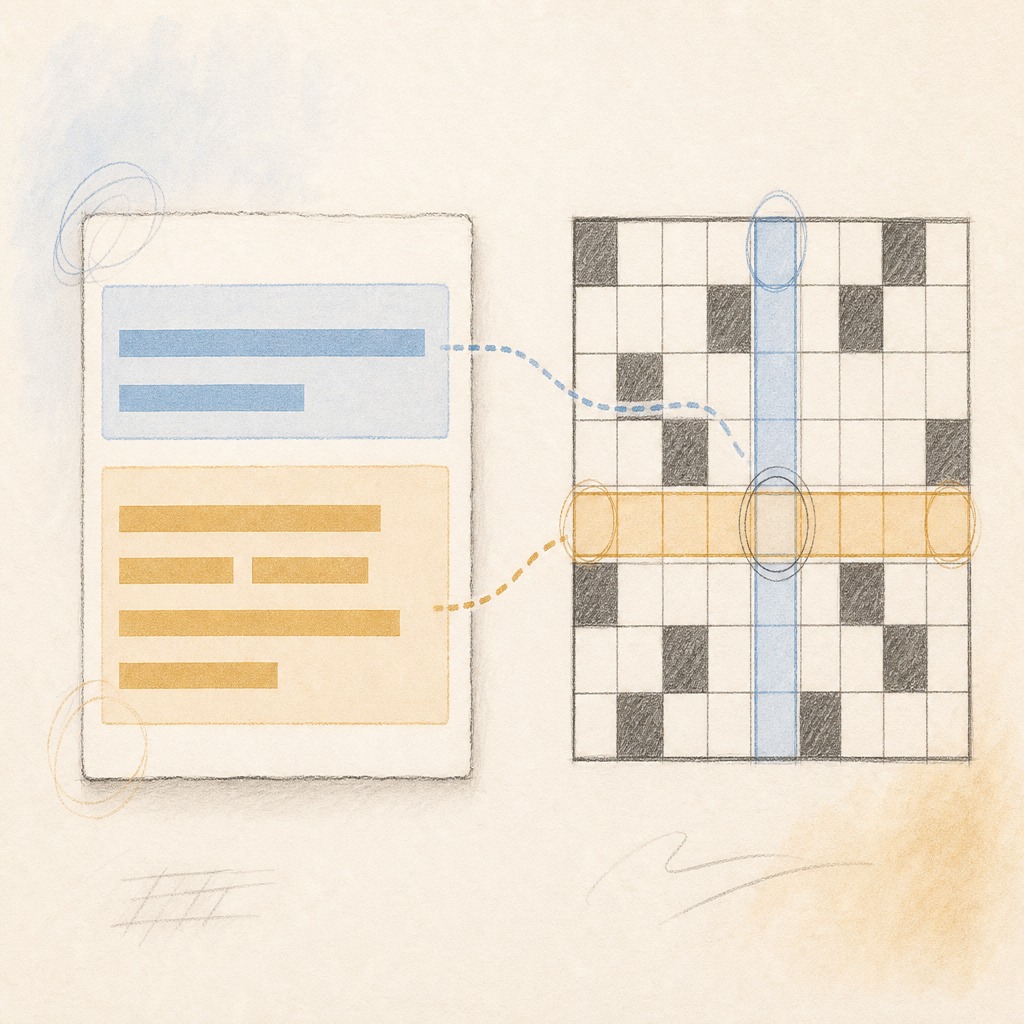
The Wall Street Journal's guide to cryptic crosswords puts the basic rule plainly: cryptic clues usually have a normal definition plus an extra wordplay hint. The definition may come first or last, and the clue may not mark the boundary for you.
That boundary is where beginners get lost.
Take a made-up clue like this:
Tired actor rearranged trade (5)
The answer could be "tared" if we only scramble letters, but that is not a useful word for most puzzles. The better lesson is not the answer. It is the reading habit. Which part is the definition? Which part is wordplay? Which word signals an operation?
In cryptic crossword clues, words like "rearranged," "broken," "wild," "odd," "heard," "inside," "back," "headless," and "around" may not be decorative. They may be instructions.
A clue is no longer a sentence. It is a sentence wearing a tool belt.
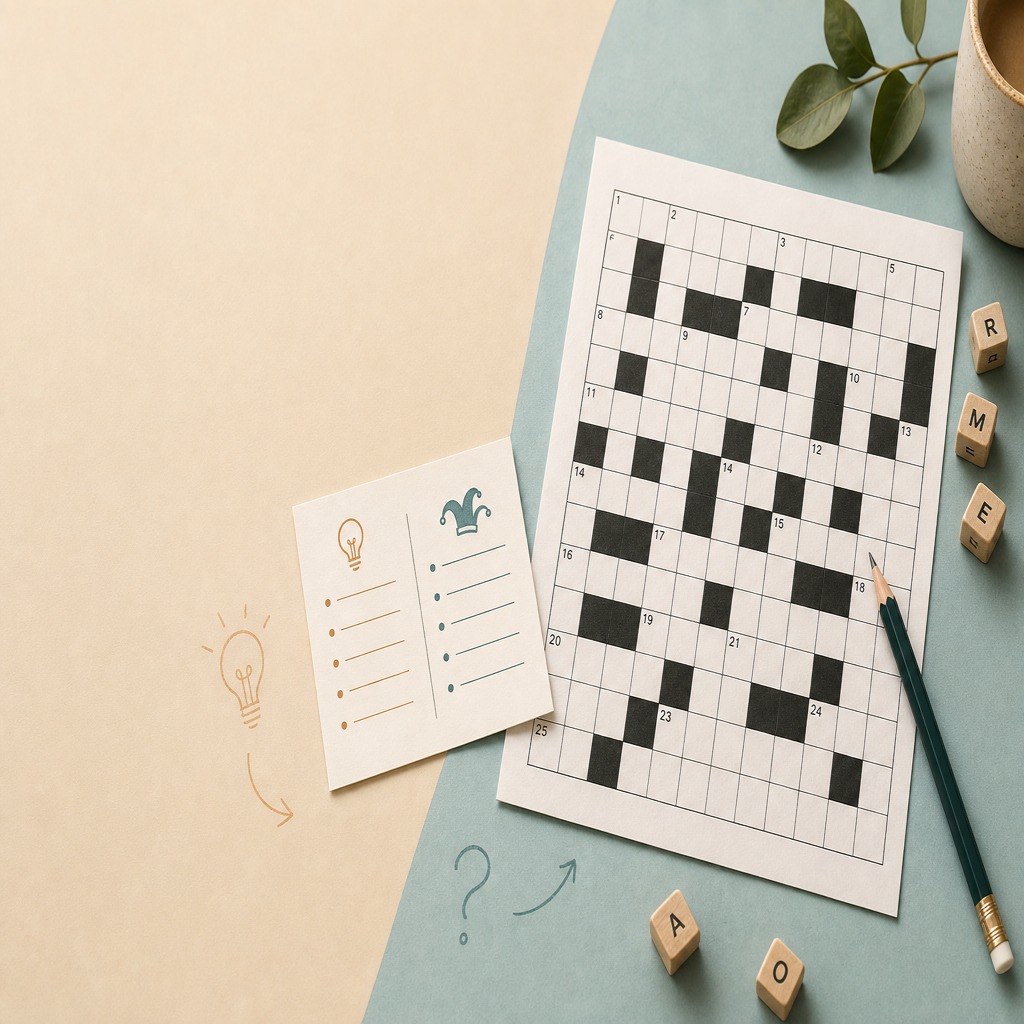
Why cryptic clues feel strange to American solvers
The New Yorker's cryptic crossword guide explains the difference neatly: American-style crossword clues are often synonyms or trivia prompts, while cryptic clues are small puzzles by themselves. That is why a cryptic can feel chewy, even when the answer is an ordinary word.
The surface reading is the trap. It is the normal-sounding sentence your brain wants to believe.
For example, a clue about a "flower" may not mean a blossom. It may mean something that flows, such as a river. A clue about "heard" may not be about listening to a story. It may signal a homophone. A clue about something being "broken" may be telling you to anagram letters.
This is where cryptic crossword clues become fun rather than cruel. The clue is trying to mislead you, but it is also trying to be fair. The answer should be reachable if you spot the grammar of the trick.
That is the key difference between a bad guess and a solved clue. A guess feels lucky. A solved cryptic clue clicks because both doors open to the same room.
The first beginner habit: look at the ends
In many cryptic crossword clues, the definition sits at the beginning or the end. Not always, but often enough to help beginners start.
So before you wrestle the whole clue, check both ends.
Ask:
Could the first word or phrase define the answer?
Could the last word or phrase define the answer?
What remains in the middle?
Does the remaining text look like an anagram, hidden word, container, reversal, soundalike, or deletion?
This habit gives the clue shape. It stops you from reading the sentence as one smooth piece of prose. That smoothness is usually the disguise.
The New Yorker's guide lists common cryptic clue types, including anagrams, hidden words, homophones, double definitions, reversals, containers, and deletions. You do not need to master all of them in one sitting. Start by recognizing the loudest signals.
"Mixed" or "broken" may point to an anagram.
"Heard" or "we say" may point to a homophone.
"Inside" or "held by" may point to a hidden or container clue.
"Back" or "returned" may point to a reversal.
"Endless" or "headless" may point to removing letters.
That is enough to begin.
A small way to practice cryptic crossword clues
Do not start with a full hard cryptic if you are new. That is like learning chess by sitting down against someone who has been playing since childhood and refuses to explain why your queen disappeared.
Start with one clue at a time.
Read the clue normally. Let the surface meaning happen.
Then distrust it.
Circle the possible definition at the start or end. Underline any signal word. Look for letter counts if the puzzle gives them. Write down the operation before you chase the answer.
For example:
If the clue contains a word like "scattered," ask what letters might be scattered.
If the clue contains "heard," say the possible answer out loud.
If the clue feels like it has two plain meanings, test whether it is a double definition.
If a word looks oddly placed, check whether part of the answer is hidden inside neighboring words.
This is slower than ordinary crossword solving at first. It should be. You are learning a second reading system.
If you want lighter word practice between cryptic attempts, browse crossword puzzles on Easy Daily Puzzle . Regular grids still train crossings, clue grammar, and answer shape, which all help when you return to cryptics.
Why cryptic clues age well
One reason cryptic puzzles stay interesting is that they rely less on daily trivia. Some American-style crosswords age quickly because celebrity names, brands, and current references can turn stale. Cryptics can still contain culture, but the main pleasure often comes from the clue mechanics.
A hidden word is still a hidden word.
A reversal is still a reversal.
A clever definition still has to be fair.
That makes cryptic crossword clues feel oddly durable. You can solve an old cryptic and still enjoy the machinery, even if a few references have gone dusty.
There is also a social pleasure to them. Cryptic solvers like explaining clues after the fact because the explanation is part of the reward. A finished clue can be retold like a small magic trick:
"See, this word meant this, and then those letters went inside that word, and the whole thing also meant the answer."
That sentence sounds absurd until the clue clicks. Then it feels precise.
What regular crossword players can borrow
You do not have to become a full cryptic solver to benefit from cryptic habits.
Regular crossword players can borrow the suspicion.
Read small words carefully.
Treat punctuation as less important than clue grammar.
Check whether the clue asks for a noun, verb, plural, abbreviation, sound, or phrase.
Let crossings test your first idea before you commit.
Most of all, stop assuming that the first meaning is the only meaning.
That single habit helps across many word puzzles. Mini crosswords, standard crosswords, cryptics, clue hints, and even word games all reward flexible reading.
How to start without getting annoyed
Pick one cryptic clue and give it five minutes. Not a whole puzzle. One clue.
If nothing moves, read an explanation of that clue. Then look back at the original wording and ask where the signal was hidden.
That review is not cheating. It is how the clue language becomes visible.
Cryptic crossword clues are not friendly in the way easy clues are friendly. They are friendly in a stranger way. They promise that the answer is inside the clue somewhere, if you can learn how to read the lock.
The first time one opens, the puzzle changes.
You stop seeing a clue as a question.
You start seeing it as a little door with another door behind it.