



Diagonal Sudoku rules look almost too small to matter. The grid is still 9 by 9. The rows, columns, and 3x3 boxes still need the numbers 1 through 9. The pencil still hovers over a square while you ask the same old question: what can go here?
Then you notice the X.
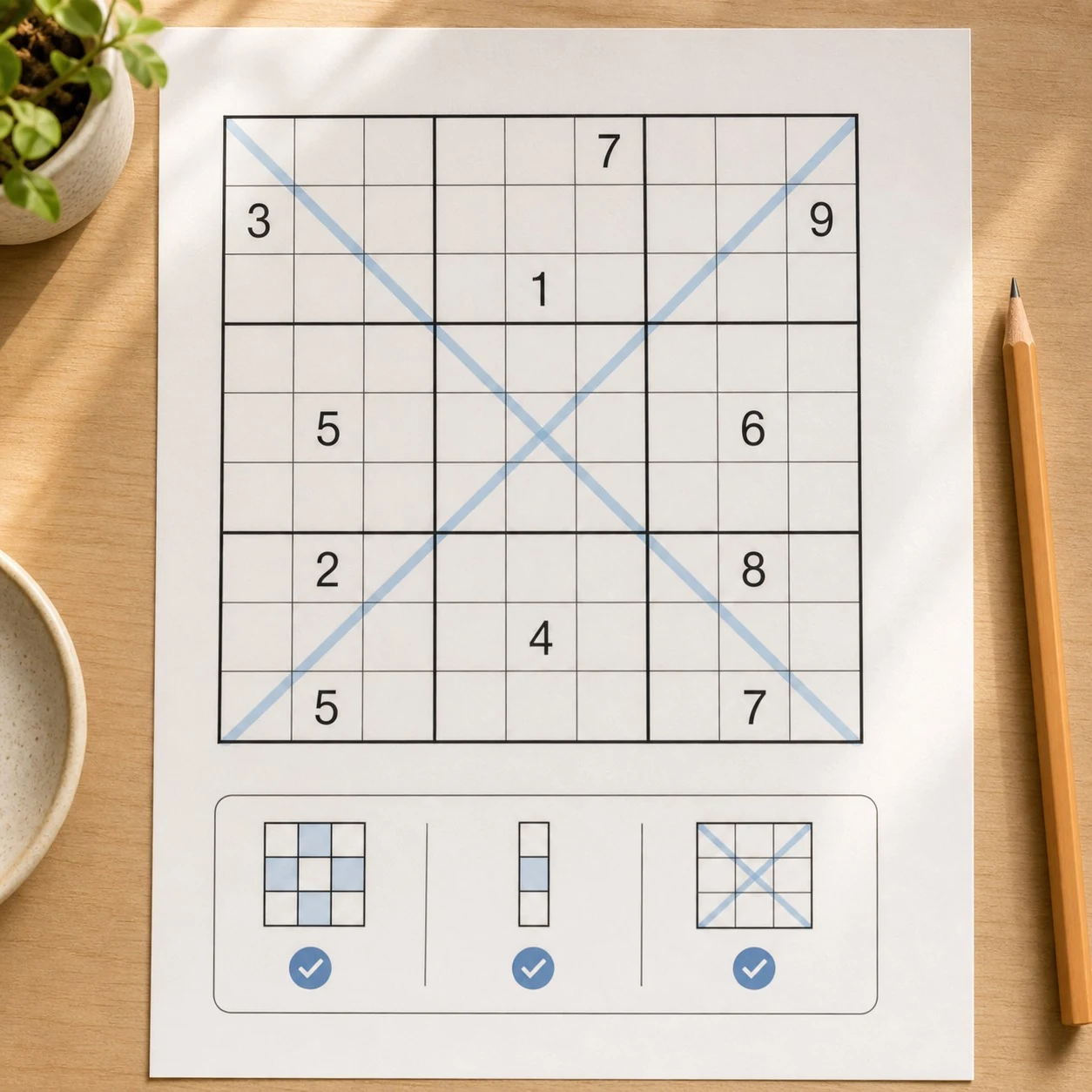
In Diagonal Sudoku, also called Sudoku X, the two long diagonals are treated like extra houses. Each diagonal must contain 1 through 9 once, with no repeats. That is the whole twist. It is not a new game so much as a familiar room with two extra beams of light crossing through it.
That small change is why the variant is good for casual players. It gives you more information, but it also punishes lazy scanning. If you only read rows, columns, and boxes, you miss clues sitting in plain sight.
If you want a standard grid before trying a variant, start with the Easy Daily Puzzle Sudoku page . If you want a different kind of break after a number puzzle, the Easy Daily Puzzle game library is the safer main hub to return to.
Suggested image placement: Insert the featured image after this opening section. Use alt text: "diagonal Sudoku rules shown on an X-shaped Sudoku grid".
Diagonal Sudoku rules in one sentence
The normal Sudoku rules still apply: every row, column, and 3x3 box must contain the digits 1 through 9 once. Diagonal Sudoku rules add two more lines to check: the diagonal from the top-left corner to the bottom-right corner, and the diagonal from the top-right corner to the bottom-left corner.
Those two lines share the center cell. That middle square is easy to underestimate. In a classic puzzle, it belongs to one row, one column, and one box. In Sudoku X, it also belongs to both diagonals. That means the center can carry a lot of pressure very early.
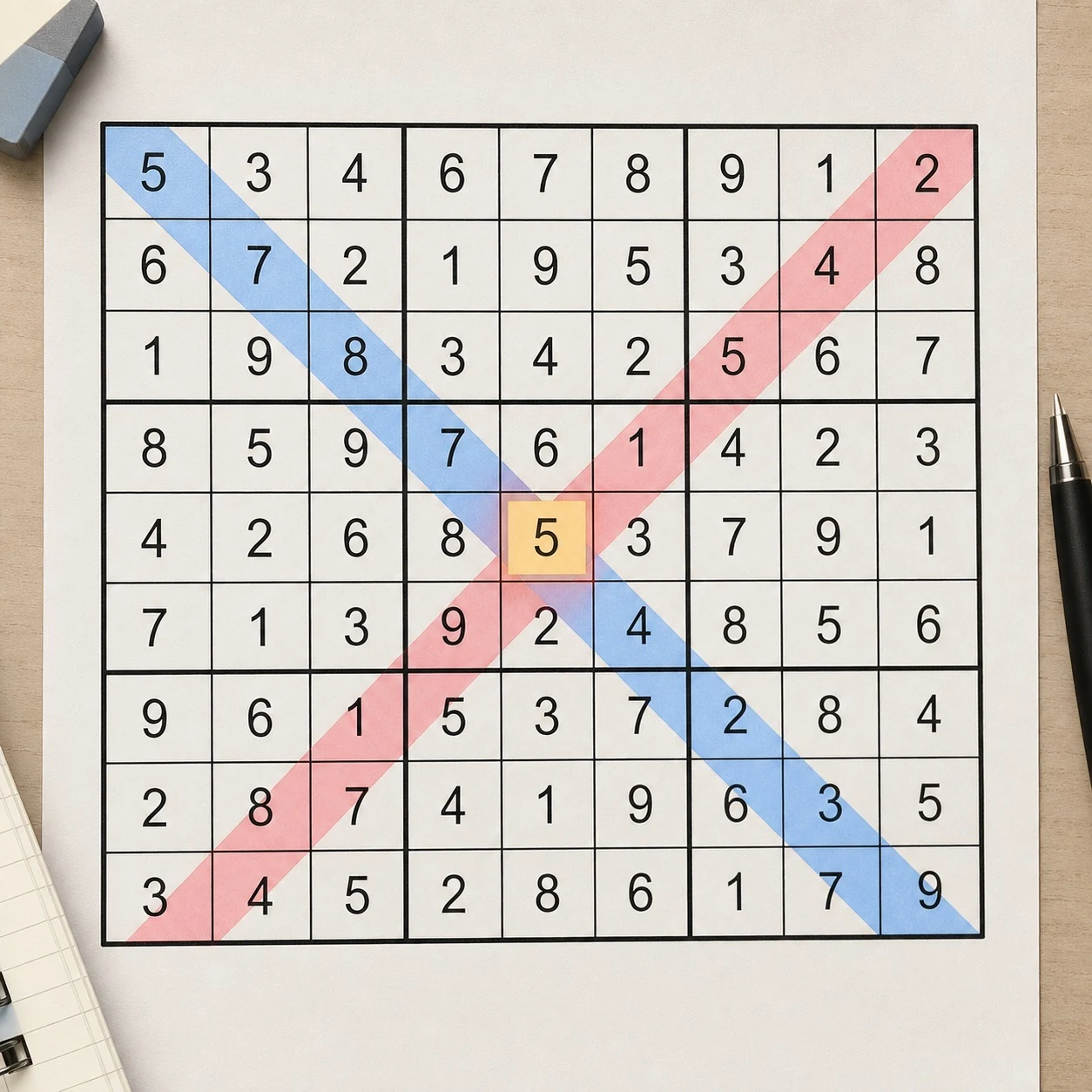
Sudoku a Day's Diagonal Sudoku guide explains the two diagonal paths clearly, including the way the highlighted diagonals form the X shape. SudokuWiki's Sudoku X strategy page also notes that normal solving methods still work, but the diagonals become extra places where eliminations can happen.
That is the part worth remembering. The variant does not ask you to throw away standard Sudoku skills. It asks you to use them in two more directions.
Why the X makes the grid feel different
At first, extra rules sound like extra difficulty. Sometimes they are. But diagonal Sudoku rules can also make the early solve feel friendlier because the grid gives you more restrictions to use.
In classic Sudoku, a number can be blocked by its row, column, or box. In Sudoku X, a number can also be blocked by a diagonal. If a 7 already sits on the top-left to bottom-right diagonal, every other cell on that diagonal can stop considering 7. That is not advanced logic. It is just another scan.
The catch is that players forget to scan it.
Most people are trained by classic Sudoku to move their eyes horizontally, vertically, and inside boxes. The diagonals cut across that habit. They ask your eye to travel through corners, through the center, and back toward another corner. It feels odd for a few minutes, then it becomes useful.
There is also a nice psychological trick here. The diagonals give beginners a new place to look when the board stalls. Instead of staring at the same box until every candidate looks suspicious, you can ask a simple question: what is missing from the X?
The first scan should include the diagonals
A good Diagonal Sudoku start is not complicated. Before writing notes everywhere, scan the two diagonals as if they were special rows.
First, count what each diagonal already has. If the top-left diagonal contains 1, 3, 5, and 8, say those numbers out loud in your head. Then look for the missing set: 2, 4, 6, 7, 9. Now test those missing numbers against the rows, columns, and boxes that cross the diagonal cells.
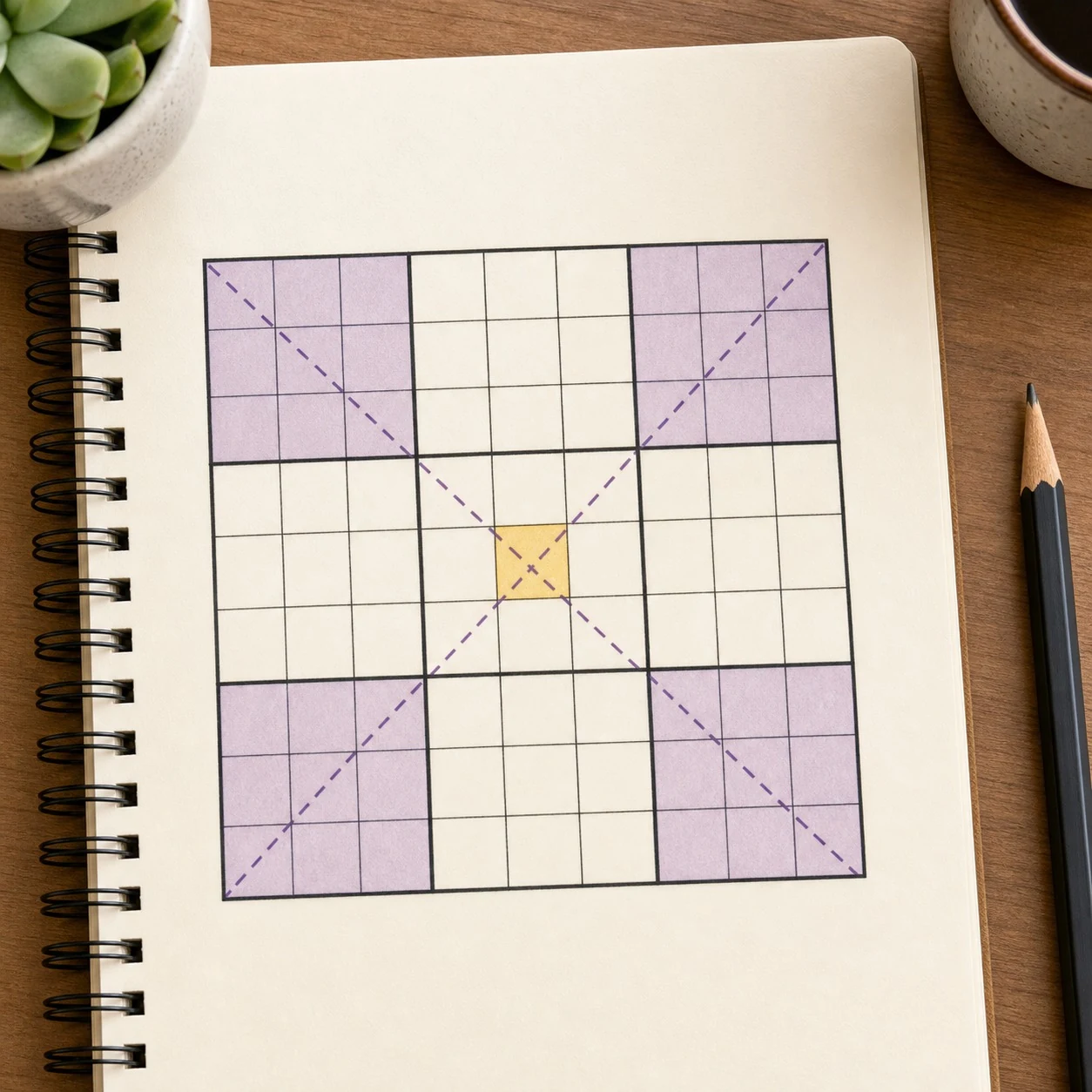
Second, watch the corner boxes. Each corner box touches one of the long diagonals in three cells. That gives you a compact place to make eliminations. If a digit already appears in the top-left box, it cannot appear again in that box, and it also cannot repeat on the diagonal. The overlap is where easy progress often hides.
Third, keep an eye on the center. The center square sees both diagonals, which makes it unusually restricted. You do not need to force it early, but you should not ignore it either. If both diagonals have already ruled out several digits, the center may become much easier than it looks.
A small example without a full puzzle
Imagine the main diagonal already has 1, 2, 4, 6, 7, and 9. That leaves 3, 5, and 8 for the remaining diagonal cells.
Now suppose one of those empty diagonal cells sits in a row that already contains 5 and a box that already contains 8. That square can only be 3.
Nothing magical happened. You used the diagonal as another house, then checked the row and box as usual. The move feels satisfying because it looks like a variant trick, but it is really standard Sudoku logic with one extra line.
That is why Diagonal Sudoku is a useful bridge for improving players. It feels fresh without becoming alien.
What beginners usually get wrong
The first mistake is overusing the new rule. A player sees the X and starts treating every diagonal square as urgent. That can make the puzzle feel busier than it needs to be.
Use the diagonals as a scan, not as an obsession. Rows, columns, and boxes still do most of the work. The diagonal rule is strongest when it joins those older checks instead of replacing them.
The second mistake is forgetting that the two diagonals share only one cell. They cross at the center, but a number placed on one diagonal does not automatically control every cell on the other diagonal. It only affects the shared center if that number is a candidate there.
The third mistake is making notes too early. Diagonal puzzles can create extra candidates if you mark every possibility before reading the obvious lines. Spend the first minute scanning. Notes should clean up the puzzle, not make it look like a spreadsheet.
A simple Diagonal Sudoku routine
Use this routine for the next Sudoku X grid:
1. Scan normal rows, columns, and boxes for obvious singles.
2. Scan the top-left to bottom-right diagonal.
3. Scan the top-right to bottom-left diagonal.
4. Check the four corner boxes where diagonals pass through three cells.
5. Check the center cell after both diagonals have some information.
6. Add notes only after the board stops giving easy placements.
This routine is not flashy. That is the point. Diagonal Sudoku rewards the player who notices an extra line, not the player who tries to invent a new solving personality.
Why Diagonal Sudoku still feels like Sudoku
Nikoli's Sudoku background page describes the classic puzzle as simple to learn and rich in logic situations. Diagonal Sudoku keeps that promise. It does not add arithmetic, trivia, spelling, or hidden symbols. It adds two clean constraints to a grid people already understand.
That makes it a good second step after classic Sudoku. You get a slightly sharper puzzle without needing a rulebook beside you.
The best way to try it is simple: play one classic grid, then play a diagonal one and notice where your eyes want to move. The first solve may feel strange. By the second or third, the X starts to feel less like decoration and more like a quiet extra tool.
When that happens, the grid opens in a new direction.