



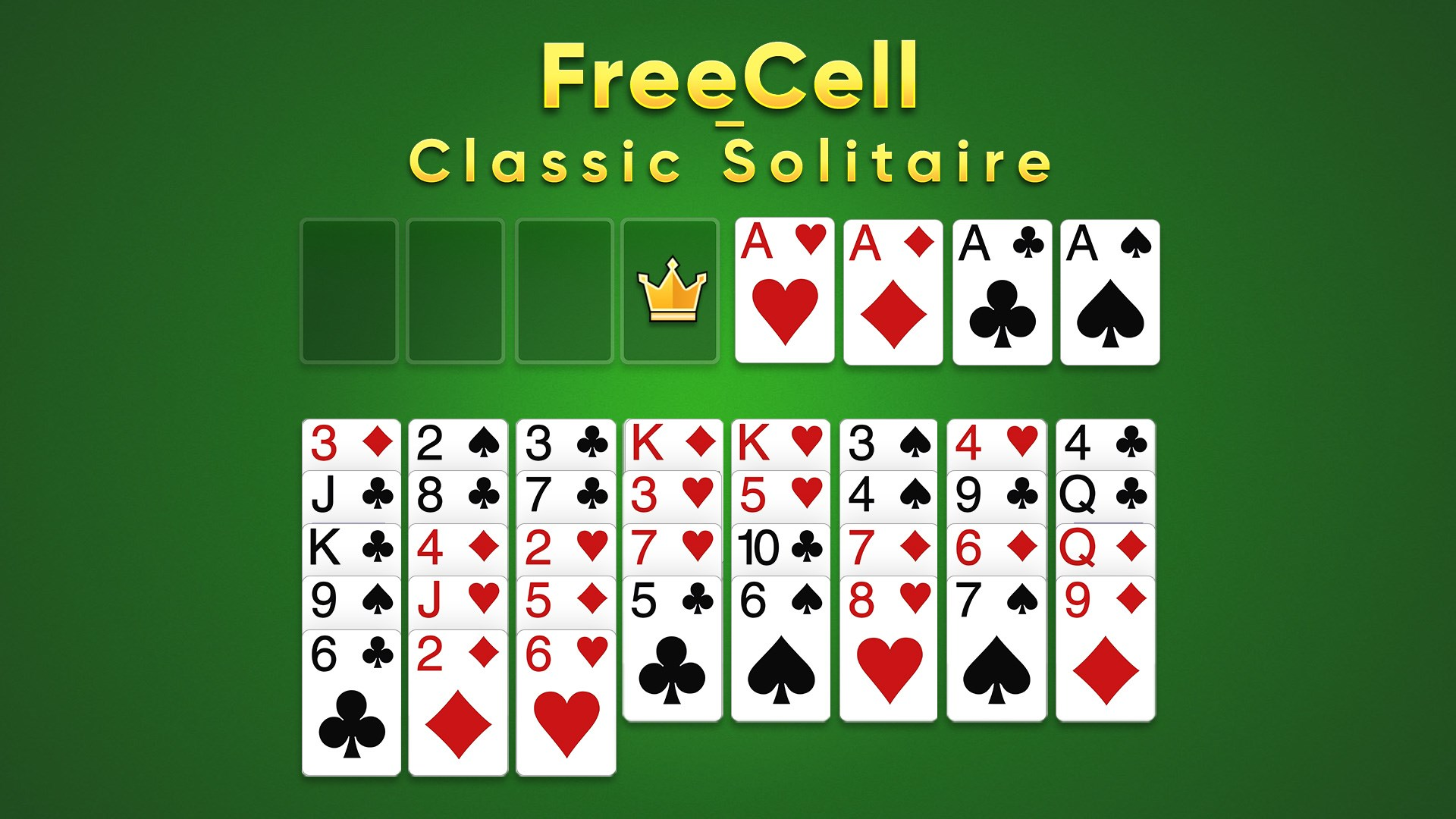
FreeCell, with its distinctive layout of cascading cards and four empty "free cells," is one of the most recognizable and intellectually engaging solitaire games in the world. Its journey from an obscure, centuries-old pastime to a staple of personal computing is a fascinating tale of digital adaptation and viral popularity.
Obscure Origins: The 18th Century Ancestor
Contrary to popular belief, FreeCell is not a modern invention. Its direct ancestor is a game called "Eight Off," which traces its roots back to 18th-century Scandinavia. In "Eight Off," all cards are dealt face-up at the start into eight cascades, with four cells initially empty. The core mechanics—moving cards to build descending sequences alternating in color, utilizing free cells for temporary storage, and aiming to build all suits up to the Aces in foundation piles—were already present. For nearly two centuries, "Eight Off" remained a niche game known primarily to card game enthusiasts and found in specialized solitaire books.
The Digital Catalyst: Microsoft's Inclusion
FreeCell's leap into global fame began in the digital realm. The pivotal moment arrived in 1995 with the release of Microsoft Windows 95. The operating system included a game collection designed to familiarize users with the graphical interface, particularly drag-and-drop mechanics. Among these games was Microsoft FreeCell, a polished, digital version of "Eight Off."
Microsoft's version, developed by programmer Jim Horne, made several crucial contributions:
- The Deal Number: Every game was assigned a unique number (from 1 to 32,000), allowing players to replay or share specific, winnable deals.
- Perfect Solvability: It was famously claimed that "all games are winnable," except for Deal #11982, which was later proven to be unsolvable. This promise was a powerful motivator.
- Undo Function & Automation: Digital features like unlimited undo and automatic card movement lowered frustration and opened strategic exploration.
- Default Entertainment: Bundled with the world's most popular operating system, it had an instant, massive audience.
Office workers and home users alike found it to be the perfect blend of logic puzzle and card game, providing a compelling, discreet escape. Its popularity skyrocketed, making it arguably the most played computer solitaire variant of the late 1990s.
Evolution and the Internet Age
The internet fueled FreeCell's next evolutionary phase. Enthusiasts created online communities and databases to catalog solutions. The discovery that most Microsoft deals were solvable led to intense analysis and the development of advanced strategies and software solvers.
New variants emerged:
- Challenge FreeCell: Using a single suit or other restrictions.
- Double FreeCell: Played with two decks, doubling the challenge.
- Baker's Game: A strategic variant where free cells can only hold one card, and sequences must be built in suit.
The game also became a benchmark in the field of Artificial Intelligence. Its defined rules and clear win-state made it an ideal testbed for search algorithms and machine learning techniques. AI programs have since solved the original 32,000 Microsoft deals and can calculate the solvability of random layouts with high efficiency.
A Lasting Legacy
Today, FreeCell's legacy is secure. It remains a default application on modern Windows systems, is available on every major mobile platform, and is a featured game on countless websites. It successfully bridged the gap between a classic card table puzzle and the digital age, transforming from "Eight Off" into a global touchstone of casual gaming. Its enduring appeal lies in its perfect balance: it is a game of pure skill and logic, offering a satisfying, cerebral challenge that is always one clever move away from victory. From Scandinavian parlors to the screens of billions, FreeCell has truly solved its way into history.