



Jigsaw corner piece myth starts with a tiny victory. You find the first corner. Then another. Maybe all four. For a moment, the puzzle feels obedient.
Then the table goes quiet
The border is not wrong. Corners are useful. Straight edges are useful. A frame gives the eye a place to land. The problem is the habit that follows: many players treat the four corners as proof that the whole puzzle must begin from the outside.
Sometimes that works. Sometimes it builds a perfect rectangle around an empty, confusing middle.
The jigsaw corner piece myth is not that corners are useless. It is that corners are always the best first clue. In many online jigsaw puzzles, the more useful opening is not a corner at all. It is a red umbrella, a face, a line of windows, a bright flower, or one strange patch of shadow that only appears in one part of the picture.
If you enjoy visual puzzles on Easy Daily Puzzle, this is a good habit to test in your next session. You can also browse more jigsaw puzzle topics on Easy Daily Puzzle when you want another picture-based break.
Jigsaw corner piece myth comes from a useful habit
The old advice has a reason behind it. Edge pieces are easier to identify because one side is straight. Corner pieces are even clearer because two sides are straight. When a player is staring at hundreds of loose pieces, any certain category feels comforting.
That comfort has history behind it. The Strong National Museum of Play has written about John Spilsbury's 1766 dissected map, widely accepted as an early jigsaw puzzle. It was made as a geography teaching tool, with a map pasted onto wood and cut along borders. The puzzle started with meaningful edges because the borders were the lesson.
That origin still shapes how people think about jigsaws. Find the boundaries. Build the outside. Work inward.
It is a sensible instinct. It is just not a universal rule.
Modern jigsaw puzzles are not always maps. They can be clouds, water, flowers, fabric, cartoons, shelves, city streets, and abstract color fields. In an online puzzle, the pieces may also be small on the screen, and repeated edge color can make the border slower than expected.
That is where the jigsaw corner piece myth starts costing time.
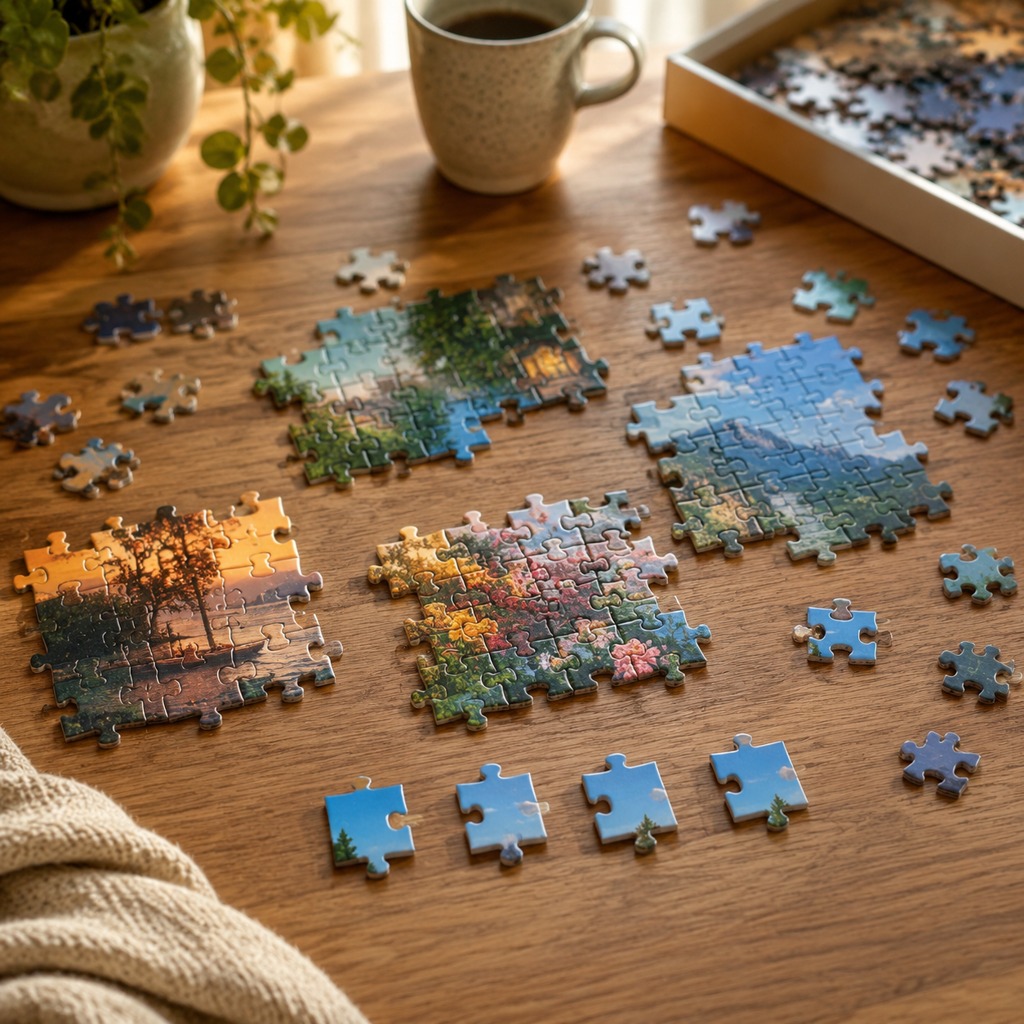
When corners are weaker than color
Imagine a puzzle with a blue sky, blue water, and a blue border. You find the four corners quickly, then spend ten minutes testing pale blue edge pieces that all look like cousins. Nothing feels wrong. Nothing feels fast either.
Now look at the middle of the image. Maybe there is a yellow boat. Maybe there is a black railing. Maybe there are three windows with dark frames. Those pieces have more information than the border.
A good first move is not the most traditional move. It is the move with the most evidence.
Color is one kind of evidence. Texture is another. Line direction can be even better. A slanted roof, a tree trunk, a stripe on a shirt, or the edge of a book can tell you where a piece belongs long before the outer frame is ready.
The jigsaw corner piece myth makes beginners overvalue category. Corner, edge, middle. Better players value information. Unique color, repeated texture, line, object, gap shape, neighboring piece.
That sounds fussy on paper. On the table, it is simple: build the parts that are easiest to prove.
A better first ten minutes
Try this opening routine on the next online jigsaw.
First, collect the corners. Do it quickly. They are still useful anchors, and finding them gives the board a sense of direction.
Second, sort the obvious edges, but do not force the full border yet. If the edge pieces are varied, build the frame. If half of them are the same sky or grass, set them aside and move on.
Third, pull out high-information pieces. Look for strong colors, text-like shapes, faces, animals, flowers, doors, windows, horizon lines, and shadows with a clear direction. These pieces are easier to confirm because the picture gives them context.
Fourth, build small islands. A jigsaw island is a small solved patch that does not touch the border yet. It might be five pieces of a flower or twelve pieces of a roof. That is progress. Do not distrust it just because it floats in the middle.
Fifth, connect islands to the border when the picture starts explaining the route.
This is the opposite of random guessing. It is a cleaner way to use the picture.
What speed puzzling teaches about the myth
Competition jigsaw puzzling makes this lesson visible. The World Jigsaw Puzzle Championship rules describe timed individual, pairs, and team formats where players assemble hidden puzzles under strict time limits. In that setting, wasting the first minutes on low-information pieces is expensive.
Casual players do not need championship pressure. A puzzle break should still feel like a break. But the speed table teaches a useful idea: the best start is the one that reduces searching.
That may be the border. It may not.
On a clean illustration with bold edges, corners and frame pieces can be excellent. On a photo with repeated leaves, ocean, sand, snow, or sky, the frame can become a polite trap. It keeps your hands busy while the easier evidence waits in the middle.
This is especially true on a phone or laptop. Screen space changes the way a jigsaw feels. If every piece is small, the clearest color clusters may be easier to handle than long, similar edge runs.
For a broader set of puzzle breaks, Easy Daily Puzzle lets you move between pictures, words, numbers, and cards without making the session feel like homework.
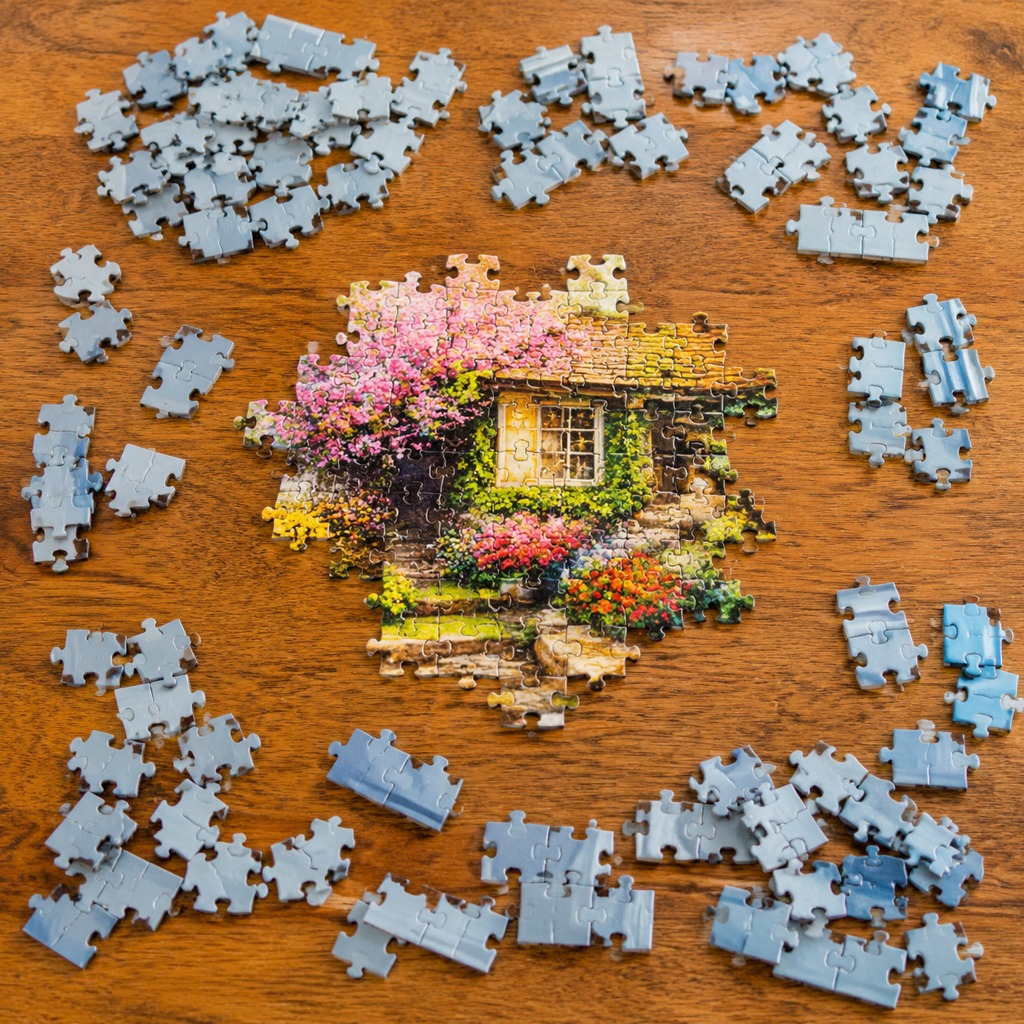
How to tell if the border should wait
The border should wait when too many edge pieces look alike.
It should wait when the picture has one or two obvious objects in the middle.
It should wait when you keep trying the same edge pieces against each other and none of the joins feel certain.
It should wait when a bright color group is already begging to be built.
This does not mean abandon the border. It means stop letting the border own the whole opening.
A useful test is tension. When two pieces really fit, the image usually relaxes. A line continues. A texture matches. A shadow makes sense. When two pieces only almost fit, your eye keeps asking questions.
Trust that discomfort. False fits are quiet time thieves.
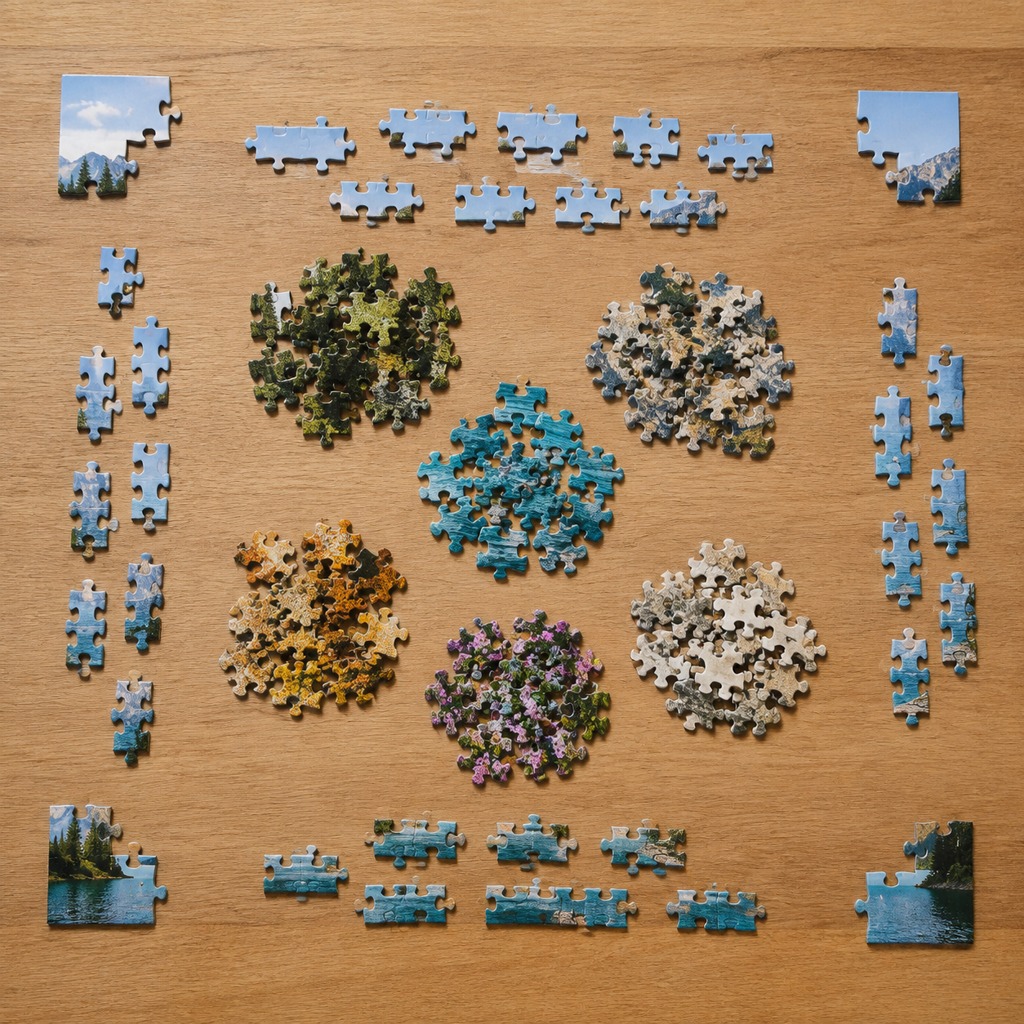
Keep the corners, lose the superstition
The four corners still matter. They give the puzzle a map. They help with scale. They are satisfying in the way small certainties are satisfying.
Just do not ask them to solve a picture they cannot explain.
The next time a puzzle begins, find the corners and then look away from them. Ask which pieces carry the most information. A red sleeve. A white window frame. A dark branch. A face. A curve of a cup. Build that.
The jigsaw corner piece myth fades once the picture starts answering back. The frame can come later. The important thing is not where the piece sits on the final board. It is how much truth it gives you right now.