



Jigsaw edge-first trap begins with a very reasonable habit: find the straight pieces, build the frame, then fill the middle.
Most of the time, that habit works. It gives the puzzle a boundary. It clears pieces from the pile. It makes the table feel less chaotic. There is a small pleasure in seeing the rectangle appear before the picture does.
Then you open a puzzle full of pale sky, ocean, grass, snow, or soft shadows, and the border turns into a slow little swamp.
If you want to test a different start on a fresh image, open the Easy Daily Puzzle home page or browse more jigsaw puzzle articles on Easy Daily Puzzle.
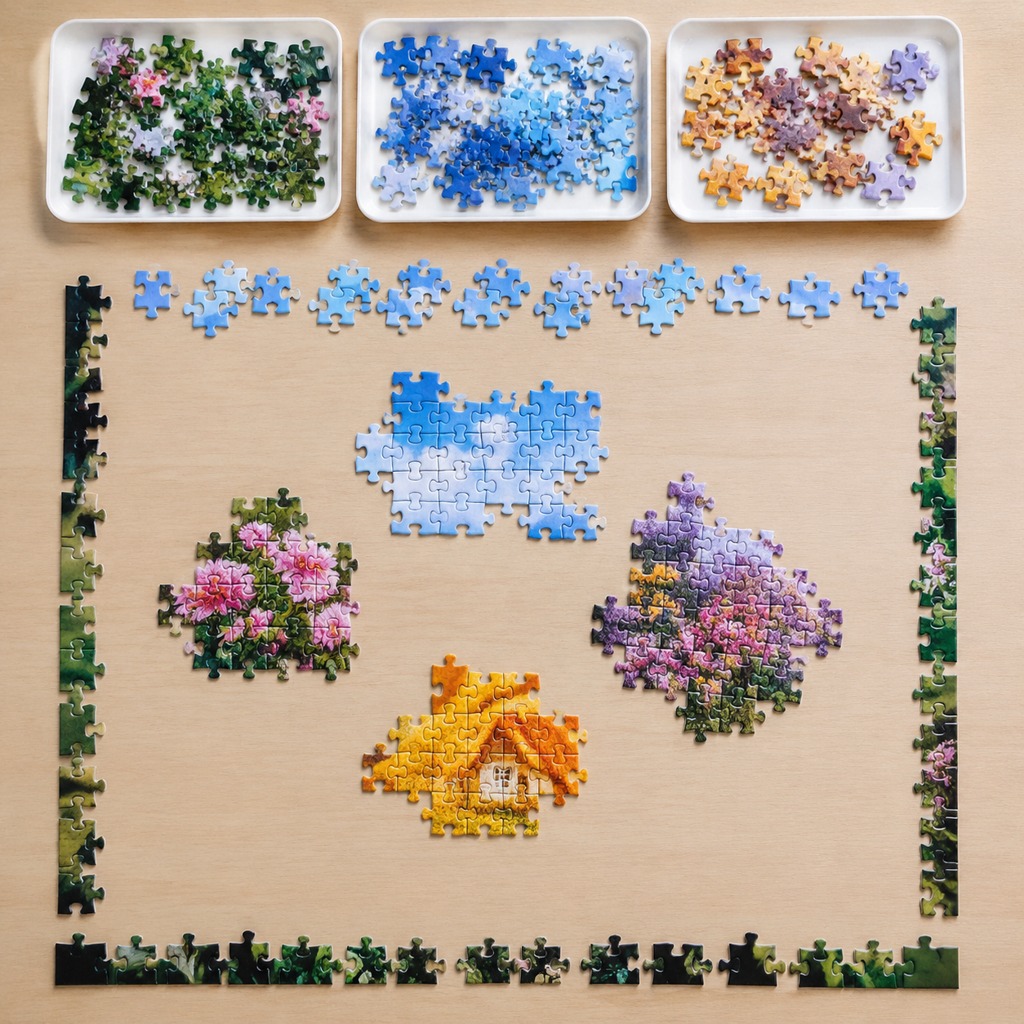
Jigsaw edge-first trap starts with a good habit
The jigsaw edge-first trap is not that edge pieces are bad. Edge pieces are useful. The trap is treating the border as mandatory even when the picture is telling you to start somewhere else.
The border-first habit makes sense because physical jigsaw puzzles have clear limits. Straight edges are easy to identify. Corners feel like anchors. On a busy image with signs, buildings, animals, or strong color zones, building the frame first can be a fast way to create order.
The habit also has history behind it. The Strong National Museum of Play traces early jigsaw puzzles to around 1760, when English mapmaker John Spilsbury pasted a map to a board and cut along borders. Those dissected maps were about geography. The edges and boundaries were the lesson.
That origin still echoes in how many people solve. We like boundaries. We like knowing where the puzzle stops.
But a modern photo puzzle is not always a map. A border full of blue sky may contain twenty pieces that all look related and none that give much information. You can spend ten minutes nudging almost-right edge pieces while the most useful part of the image sits untouched in the center pile.
Why the border can be slow online
Online jigsaw puzzles make the jigsaw edge-first trap more visible.
On a table, you can spread pieces across a large surface. You can leave a half-built border alone while your hands sort color. On a screen, space is tighter. Pieces overlap. Zoom level matters. If rotation is turned on, even straight edges can hide in the wrong direction.
The result is familiar: you build half the frame, hit a vague section, and keep trying because the border feels unfinished. Meanwhile, pieces with logos, faces, windows, flowers, text, or hard shadows are waiting. Those pieces could form islands that tell you where the picture actually lives.
Speed puzzlers understand this pressure. The official World Jigsaw Puzzle Championship 2026 rules list individual rounds where players assemble 500-piece puzzles under a time limit, with competitors advancing by speed. In that kind of format, spending too long on low-information pieces is expensive.
Casual players do not need to race anyone. Still, the lesson travels well. A piece that tells you a lot is worth more early attention than a piece that only tells you "I am somewhere on the outside."
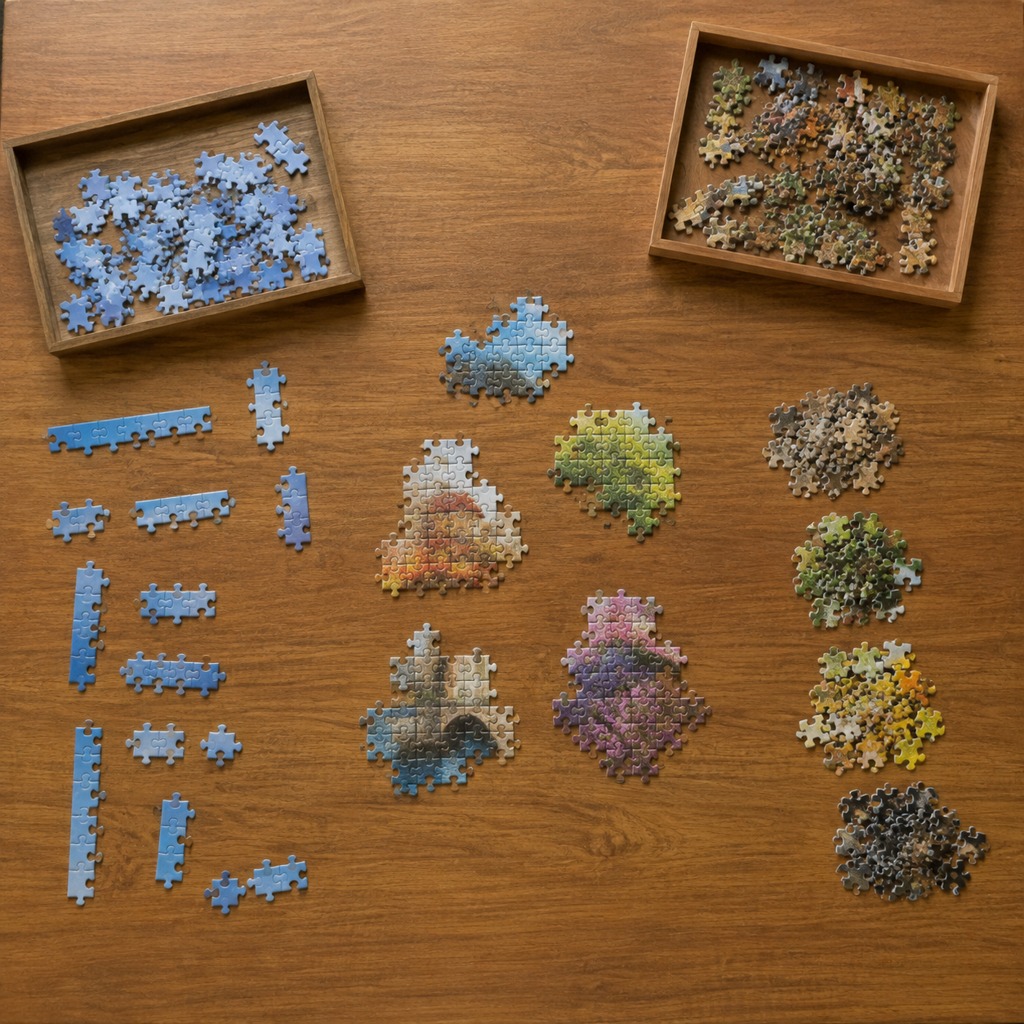
Start with high-information pieces
Instead of asking, "Where are all the edges?", ask, "Which pieces can teach me the most?"
High-information pieces are the pieces with obvious identity. Text. A face. A bright red umbrella. A window frame. A bird's eye. A plate edge on a table. A thick black line. A flower with a clear center. A patch of color that appears only once in the image.
These pieces are useful because they point to a specific area of the picture. You do not need the whole border to know that a cluster of yellow petals belongs near the flower. You do not need every edge piece to build the dark roofline against a white wall.
In many online puzzles, the first five minutes should be a hunt for these anchors.
Group edge pieces, yes, but do not let them monopolize the session. Pull the corners aside. Pull straight pieces into one zone. Then move your attention to the picture's loudest information.
This is especially helpful for photos with repeated textures. Sky edges look alike. Water edges look alike. Grass edges look alike. A single boat mast, shirt sleeve, fence rail, or printed sign may give you more progress than twelve nearly identical border pieces.
A ten-minute jigsaw edge-first trap routine
Use this routine when the border starts feeling sticky.
Spend the first two minutes flipping and spreading pieces. If rotation is on, orient obvious edge pieces as you see them, but do not chase every straight side yet.
Spend the next two minutes pulling corners and unmistakable edges into a loose border zone. Loose is the key word. You are sorting, not making a contract.
Then shift to high-information pieces. Build small islands: text with text, faces with faces, hard lines with hard lines, one-time colors with matching colors. Let the picture start in several places instead of forcing one rectangle to carry the whole solve.
After that, return to the border. The islands you built may reveal where certain edge colors belong. A blue border piece near the sky is easier to place once the roofline, cloud shape, or horizon is partly visible.
This routine keeps the border useful without letting it take over.
When edge-first still works
The jigsaw edge-first trap does not mean you should abandon the border forever.
Edge-first works well when the puzzle has a distinctive frame. A city scene with dark buildings on one side and bright sidewalk on another. A poster-style image with colored borders. A map. A cartoon scene with clear outlines. A food photo where the plate edge is visible around the picture.
It also works when you want a relaxed session and do not care about speed. Some players simply enjoy the frame. That is a good enough reason.
The trap appears when habit overrides evidence. If the border is easy, build it. If the border is mushy and the middle has better clues, start in the middle.
Good jigsaw solving is less about a sacred order and more about asking what the image is offering today.
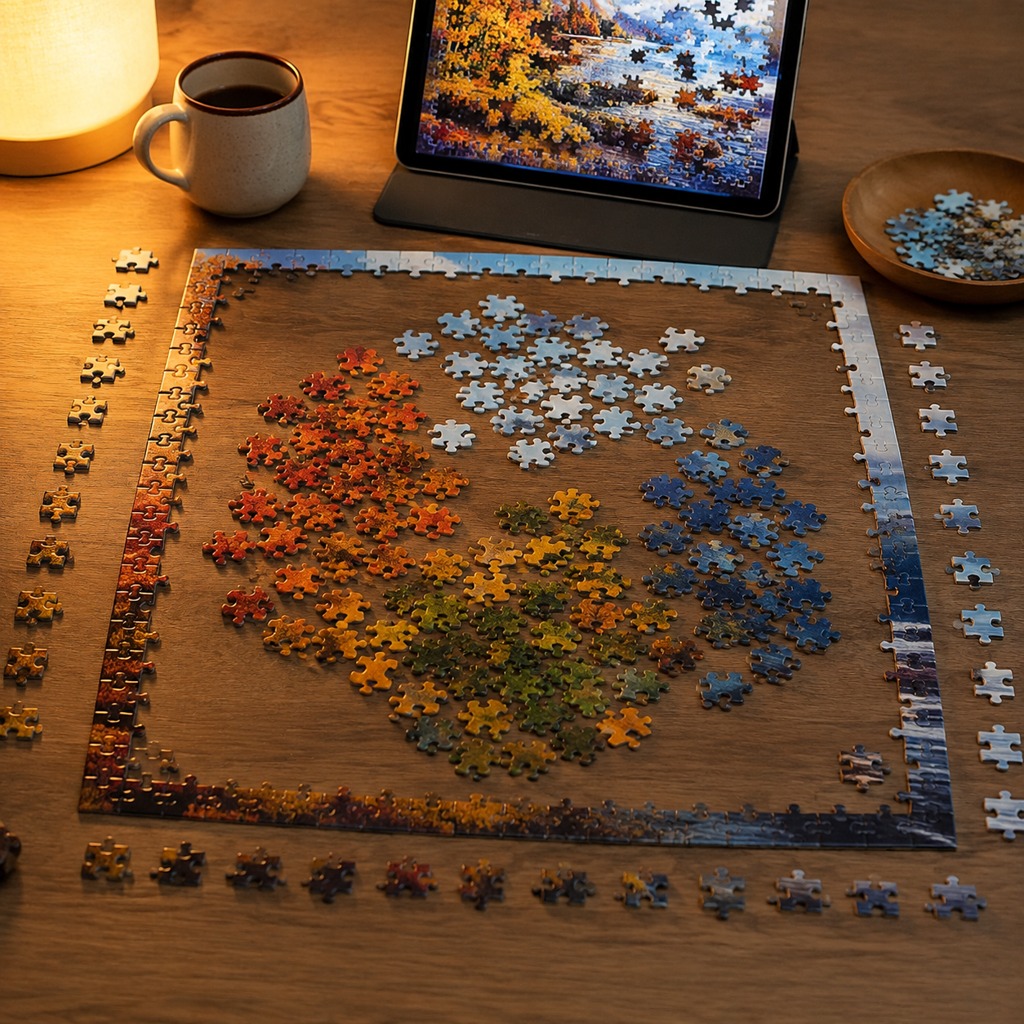
A better first move for tricky pictures
The next time an online jigsaw opens with a pile of pale blues and greens, do not let the straight edges bully you.
Collect them. Respect them. Then look for the pieces that have a personality.
A tiny red door. A slice of lettering. A hard shadow under a chair. A line where water meets land. Those pieces give the puzzle a voice before the frame is finished.
The border will come. It usually does. But it does not have to come first.