



Jigsaw map origins sound almost too practical to be true. Before the hobby became cozy tables, missing corner pieces, and online picture puzzles, it was a geography lesson with sharp edges.
A child did not begin with a castle, a kitten, or a mountain lake. They began with a map. If the pieces were cut along borders, putting the puzzle back together meant learning where countries, counties, or states belonged. The picture was not decoration. The picture was the lesson.
That is the part of jigsaw history worth keeping in mind when you play a daily puzzle on Easy Daily Puzzle. A good jigsaw is still teaching the eye to read place, shape, and relation. It just does it more quietly now.
Jigsaw map origins started with dissected maps
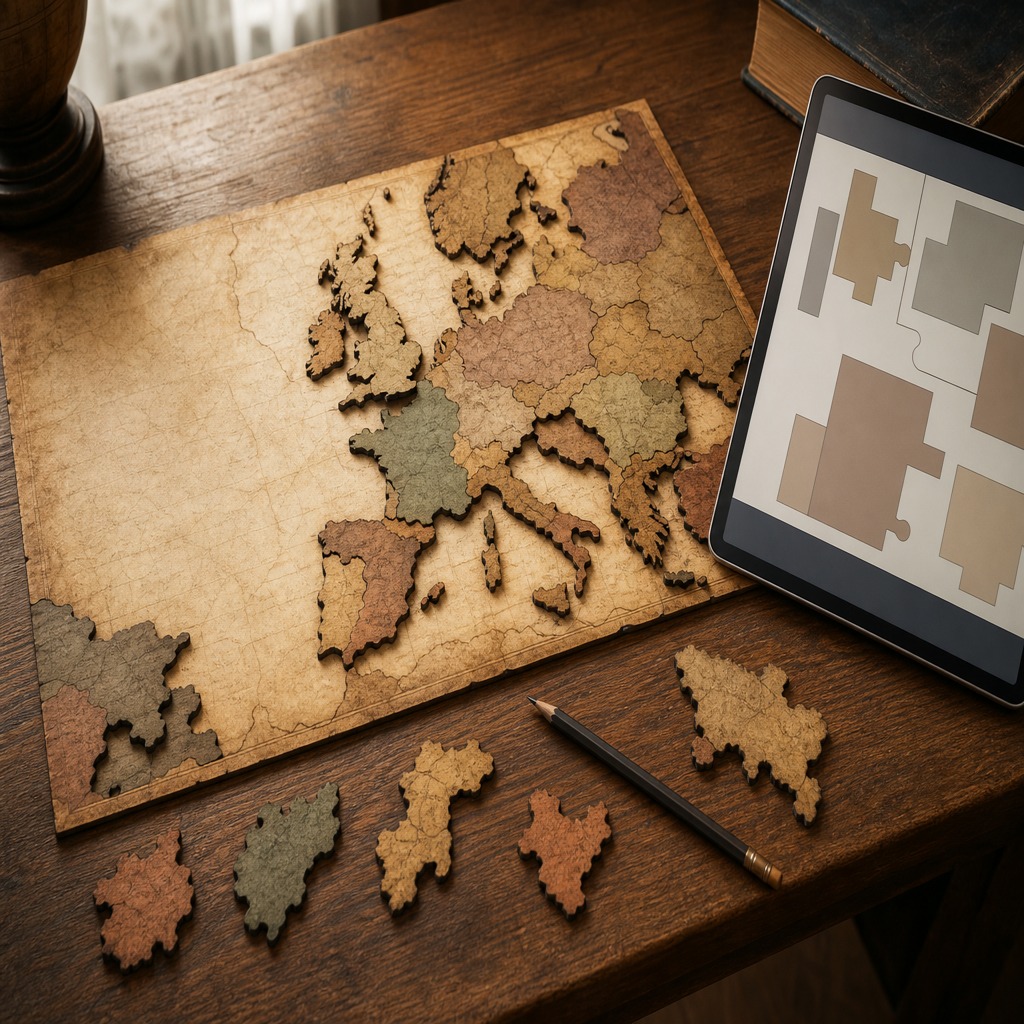
The early version of the jigsaw puzzle was usually called a dissected map. Historic Geneva's history of dissected maps says European mapmakers were pasting maps onto wood and cutting them into pieces in the 1760s, and that British cartographer and engraver John Spilsbury is credited with making a first jigsaw-type puzzle in 1767. The pieces were not yet called jigsaws. They were map lessons with seams.
History Today's note on Spilsbury gives the story a useful physical detail: Spilsbury mounted maps on thin mahogany boards and cut along county or border lines so children could put the geography back together. That matters because the cut was not random. It followed the meaning of the map.
In other words, the first puzzles did not ask, "Does this tab fit this blank?" They asked, "Does this country belong beside that one?"
That is a different kind of thinking. It is closer to reading than guessing.
Why a map made such a good puzzle
A map already has everything a puzzle needs. It has edges. It has shapes. It has names, coastlines, borders, rivers, and neighboring pieces that make sense only when they sit in the right place.
Modern puzzles often hide that structure under photography or art. A blue sky may stretch across half the image. A forest may blur into green texture. A pile of puzzle pieces may feel like visual static until the first few anchors appear.
Maps were less forgiving. A border was a clue. A coastline had a rhythm. A country could be wrong even when the wooden shape almost fit.
That is why jigsaw map origins still matter for modern players. The old map puzzle teaches one habit that never got old: do not look only for a physical fit. Look for a reason.
When a jigsaw feels stuck, ask what the picture knows. A red roof has neighbors. A shoreline bends. A window frame has a direction. A patch of sky changes shade near a horizon. A piece is rarely alone.
From school tool to home-table hobby
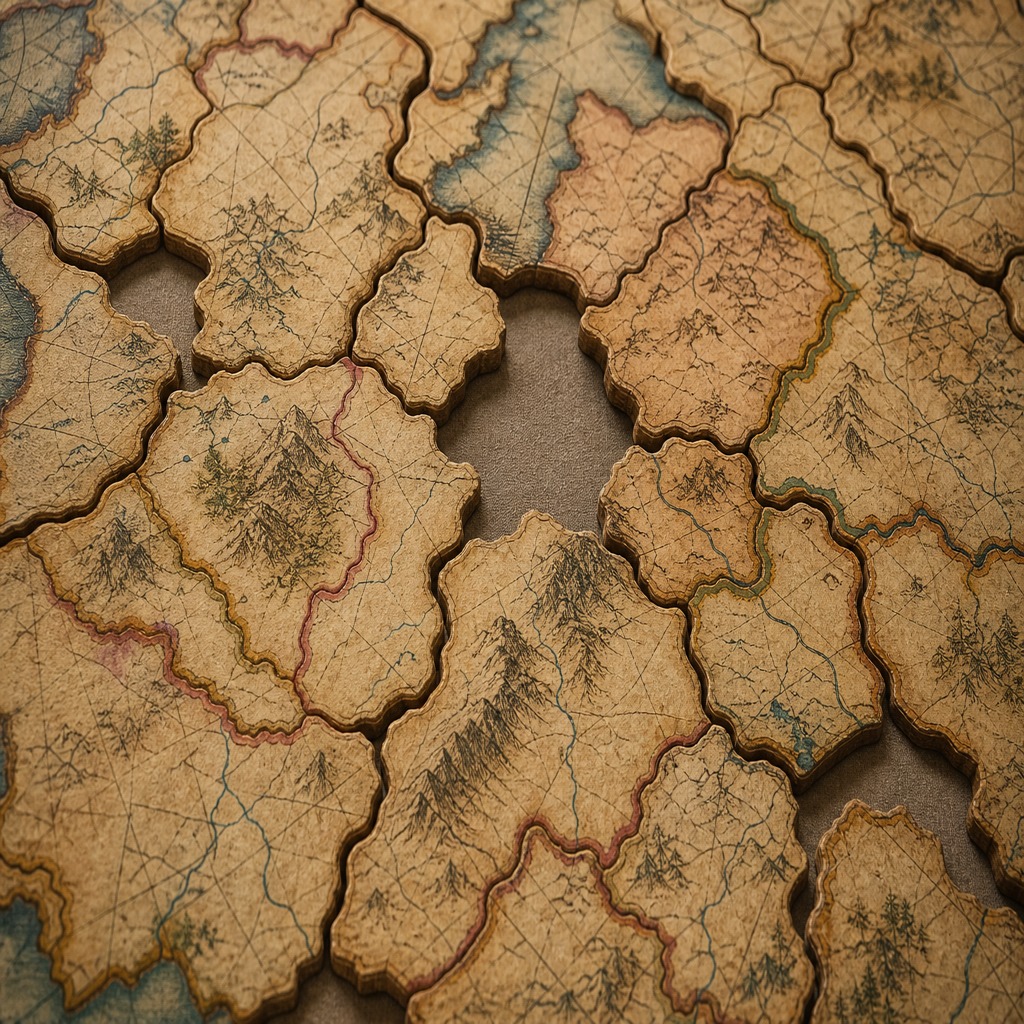
Dissected maps were not cheap little toys at first. Historic Geneva notes that Spilsbury made and sold maps of the world, continents, and European countries, and that the products were expensive for ordinary workers of the time. These were educational objects for families who could pay for them.
Then the idea spread. Other makers used the same dissected format for history, religion, moral lessons, and later advertising. History Today notes that the word "jigsaw" was not applied to these puzzles until 1909. The name arrived long after the habit.
That is a funny reversal. The puzzle existed before the word most players now use for it.
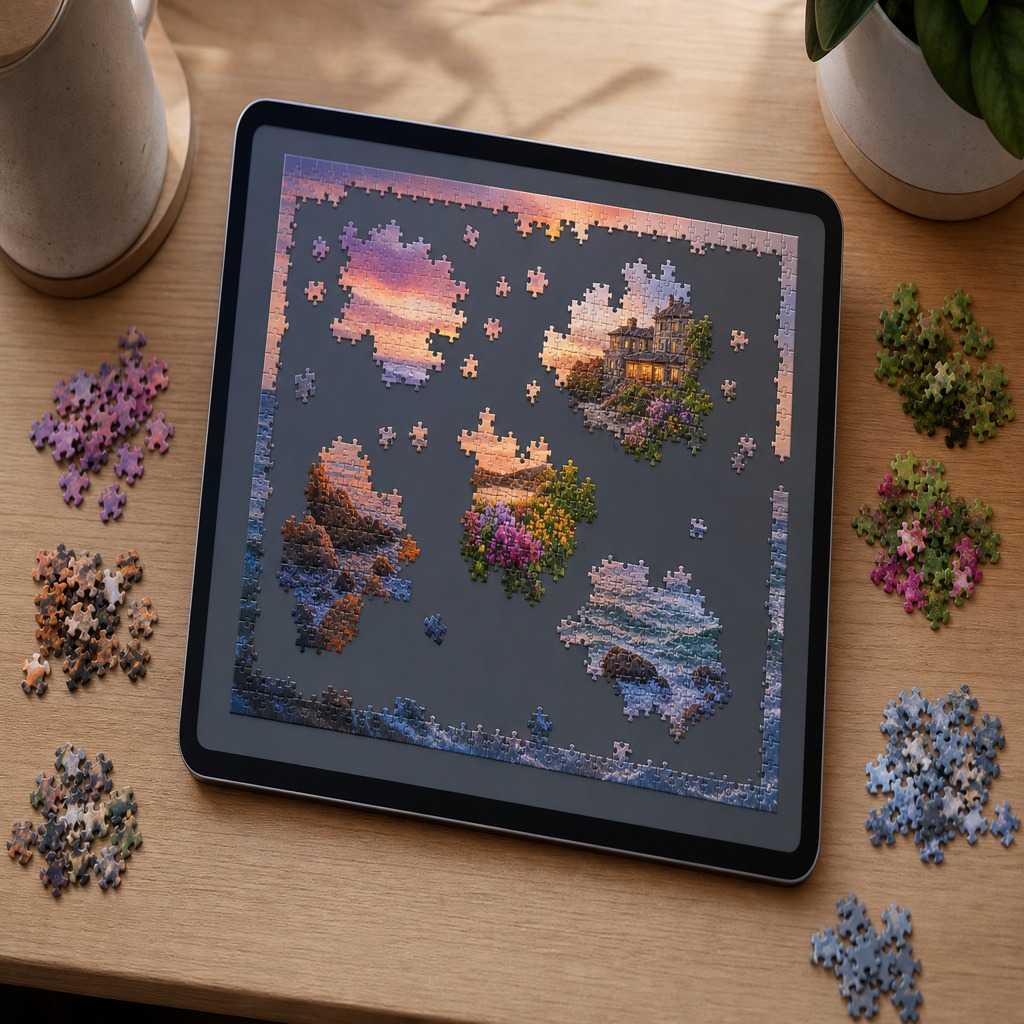
The hobby also changed as pictures changed. A map puzzle has one kind of satisfaction: order restored. A landscape has another: a scene slowly coming into focus. A modern online jigsaw adds a third: the pleasure of doing all of that without clearing the dining table.
If you want that modern version, browse jigsaw puzzles on Easy Daily Puzzle . The screen changes the surface, but not the small decisions underneath.
What jigsaw map origins teach online players
The most useful lesson is simple: build meaning before border.
Many players start every puzzle by hunting edge pieces. That often works, especially with clean rectangular puzzles. But it is not always the best first move online. Some images have huge areas of similar border color. Some digital layouts make scale harder to judge. Sometimes the border becomes a slow, fussy trap.
Map puzzles suggest another method. Start with pieces that explain each other.
Find a strong color patch.
Find a line that continues across several pieces.
Find an object with a hard edge, like a window, road, table, flower stem, or coastline.
Find two pieces that belong together because the image says so, not because the knobs happen to look close.
This is the same reason "color anchors" work so well. A color anchor is a small island of certainty. Once you build one, it gives the rest of the picture something to attach to.
In old dissected maps, the anchor might be a coastline or a country border. In a photo puzzle, it might be a red umbrella, a blue door, or the bright eye of an animal.
Different image, same mental move.
Why the story makes the hobby more interesting
Knowing the origin does not make every puzzle easier. A thousand-piece sky will still test your patience. A pile of nearly identical grass pieces will still make you question your life choices for a minute.
But jigsaw map origins make the hobby feel less random. The first puzzles were built around relationship. One piece meant something because of where it touched another piece. That idea survived the move from mahogany boards to cardboard boxes to browser games.
It also explains why jigsaws feel calmer than many fast games. The puzzle does not shout. It waits for the eye to notice one small relationship, then another.
A good online jigsaw session can still borrow the mapmaker's mindset:
Look for borders, but do not worship them.
Trust image logic before shape logic.
Build small islands when the full picture feels too large.
Use color, direction, and texture together.
Stop forcing pieces when the picture has not given enough evidence yet.
A better way to start your next jigsaw
Try this on the next puzzle. Before you touch the border, give yourself one minute to find the strongest "map" inside the picture.
Maybe it is a line of rooftops.
Maybe it is the curve of a shoreline.
Maybe it is a patch of yellow flowers, a face, a wheel, or the edge of a table.
Build that first. Let the picture teach you where the rest of the pieces want to go.
That small shift turns the puzzle from a pile of shapes into a set of relationships. Which, if you follow the story back far enough, is exactly where the hobby began.