



Jigsaw puzzle championship sounds almost impossible if your idea of jigsaw puzzles is a quiet Sunday table. At home, you can leave the blue sky pieces until tomorrow. You can make tea, lose a corner under the box lid, and pretend the border is "almost done" for an hour.
In a competition room, the table does not forgive that kind of wandering.
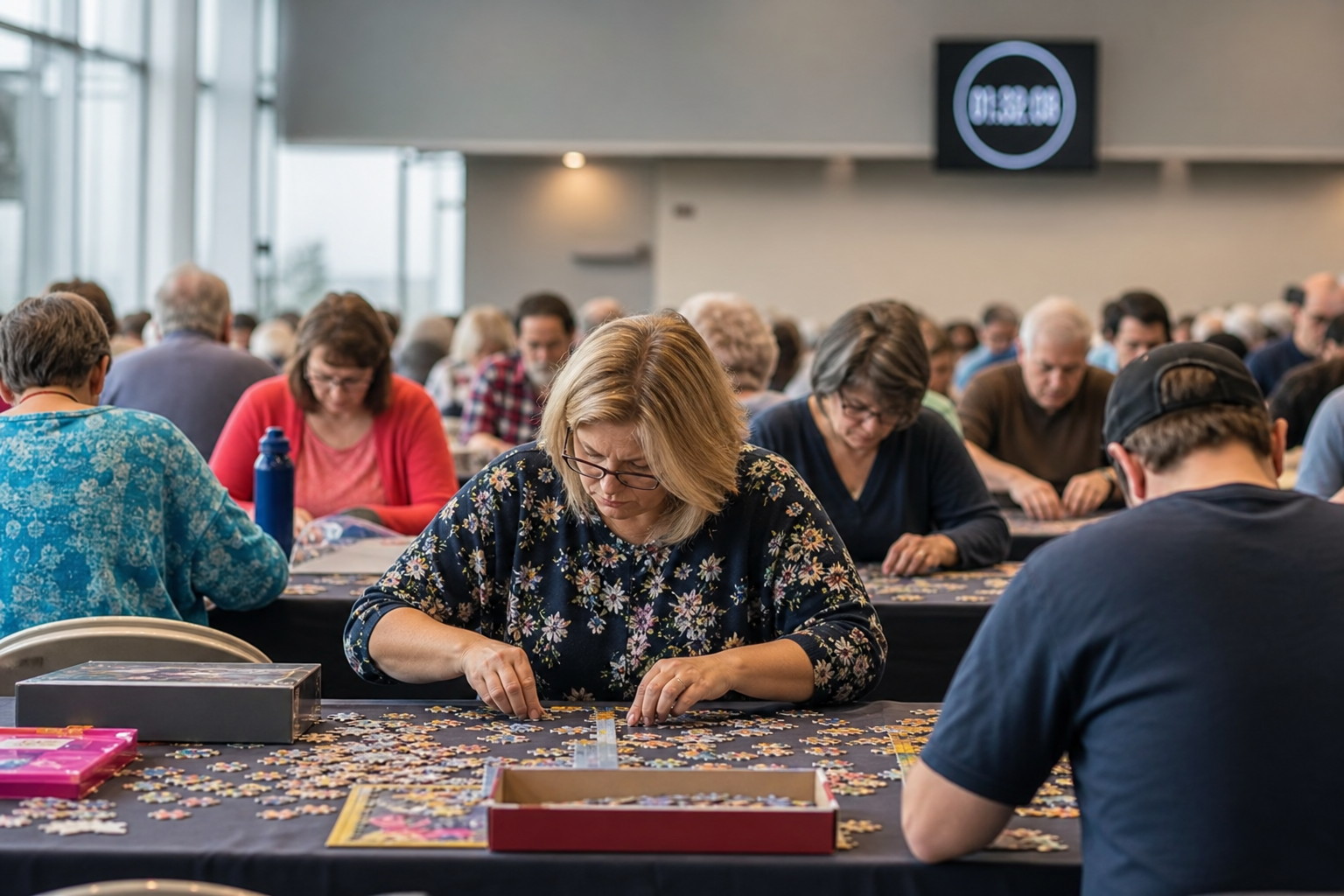
The World Jigsaw Puzzle Championship makes that contrast obvious. The 2025 individual final in Valladolid, Spain, listed a 500-piece puzzle, a 75-minute maximum time, and a winner, Weronika Huptas of Poland, finishing in 39:44. That is not a relaxing afternoon. That is a pair of hands making hundreds of tiny decisions before most casual players have finished sorting the edge pieces.
That is what makes the subject interesting for Easy Daily Puzzle readers. A jigsaw puzzle championship does not make the hobby less calm. It shows which parts of the calm are actually skill.
If you want the slower version, start with jigsaw puzzles on Easy Daily Puzzle or browse the Easy Daily Puzzle game library . No stopwatch required.
Jigsaw puzzle championship pressure starts before the first piece
The most surprising thing about speed puzzling is that the race begins before anyone "solves" anything.
At home, many people begin by hunting for corners. That is fine. It feels orderly. In competition, though, the first minute is a sorting problem. The player has to decide what the picture is made of before building it: flat color, sharp line, repeated texture, lettering, faces, water, fabric, sky, shadow, frame.
The official WJPC 2025 rules show how structured the event is. The individual category has multiple phases, and the final asks 180 players to assemble an unpublished 500-piece puzzle in the shortest possible time, or to place the most correct pieces if time runs out.
That detail matters. The image is not familiar. Players cannot practice the exact puzzle. They practice the method.
Good speed puzzlers do not wait for inspiration. They make the table readable fast.
The old jigsaw story still matters
A jigsaw puzzle championship feels modern, but the game has old bones.
Jigsaw puzzles are often traced back to dissected maps. John Spilsbury, an English cartographer and engraver, is commonly credited with making educational map puzzles in the 1760s, though puzzle historians also discuss earlier map-learning materials. Either way, the original purpose was practical. A child learned geography by taking a map apart and putting it back together.
That origin still shows. A jigsaw puzzle is not just "matching shapes." It is learning a picture by rebuilding it. A player notices where a coastline turns, where a road changes direction, where one patch of green is grass and another is tree shadow.
The championship version strips away the lazy parts but keeps the old lesson: look closely, sort intelligently, and let the picture teach you what belongs together.
That is also why jigsaw puzzles moved so easily from boxes to browsers. The table changed. The work of seeing did not.
What the best speed puzzlers do differently
A strong speed puzzler is not simply faster with their hands. The real difference is triage.
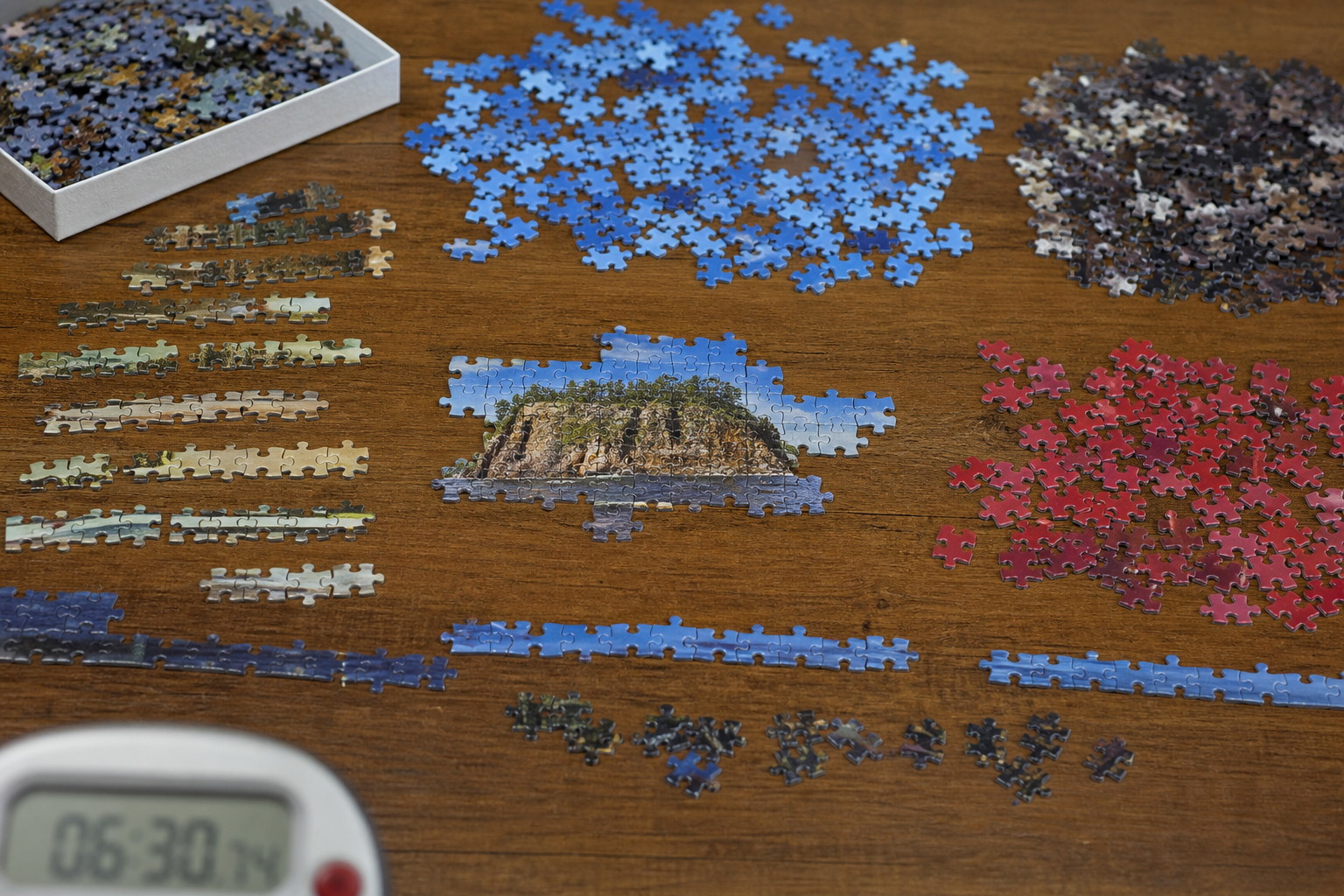
They do not give every piece equal attention. They pull out the pieces that can explain other pieces. A face, a red stripe, a window edge, a flower center, a hard black line, a corner with two clear colors. These are anchors. Once an anchor grows, nearby pieces become easier to recognize.
They also avoid the border trap.
That may sound rude to anyone who loves starting with the frame. The border is useful when it is obvious. But some puzzles have long runs of similar edge pieces that burn time. In a timed setting, a half-built border can become a very tidy mistake.
Try borrowing this from the competition room during a casual puzzle:
- Sort high-contrast pieces first.
- Build two or three small islands before forcing the whole frame.
- Keep sky, water, and shadow separate even when the colors look similar.
- Look for line direction, not only color.
- Stop testing random pieces when your eyes are tired.
That last one is underrated. Random testing feels productive, but it often means the table has not been sorted well enough.
Why teams make the table even more interesting
Jigsaw competition becomes a different sport in pairs and teams.
The WJPC rules describe pairs and team formats as separate categories. Pairs work through 500-piece and 1000-piece rounds, while teams can face two 1000-piece puzzles. The team category requires coordination as much as speed. If four people all reach for the same section, they get in each other's way. If nobody watches the border, the table loses structure.
The best team table probably looks less frantic than you expect.
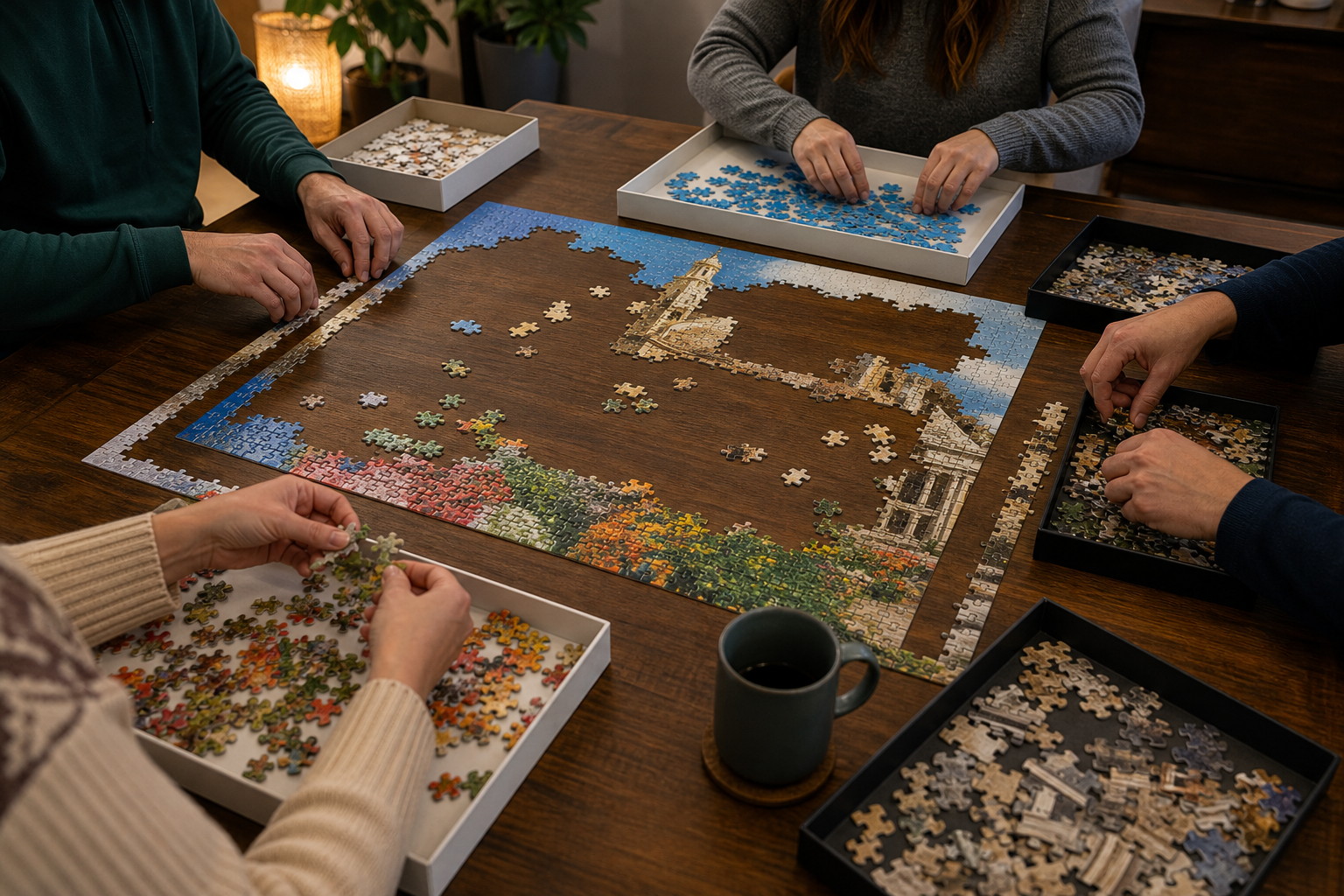
One person may own the edge. Another may sort color. Another may build a distinctive object. Someone else may keep scanning for pieces that connect two islands. The work is social, but not chatty in the ordinary sense. It is more like a kitchen during a busy service: hands moving, short signals, no wasted reach.
That gives casual players a useful family tip too. If you are puzzling with someone else, divide the picture before dividing the pieces. "You take sky, I will take the red cabin" works better than everyone poking at the same pile.
What a jigsaw puzzle championship teaches casual players
Most readers do not need championship speed. That is fine. The useful lesson is not "go faster." It is "make the table easier to read."
A casual online jigsaw puzzle can feel messy because the screen compresses the space. Pieces overlap. Similar colors look flatter. It is tempting to drag pieces around until something clicks.
A better first move is to create zones.
Put edge pieces together, but do not worship them. Pull out any color that appears in only one part of the image. Group repeated textures. If the puzzle has a building, separate straight architectural lines from natural lines. If the puzzle has animals or people, collect eyes, fur, clothing, and skin tones early.
You are not trying to finish immediately. You are trying to stop the puzzle from looking like noise.
That is the quiet bridge between a championship table and a five-minute online break. The champion needs the method because the clock is brutal. The casual player needs the method because it makes the puzzle more pleasant.