



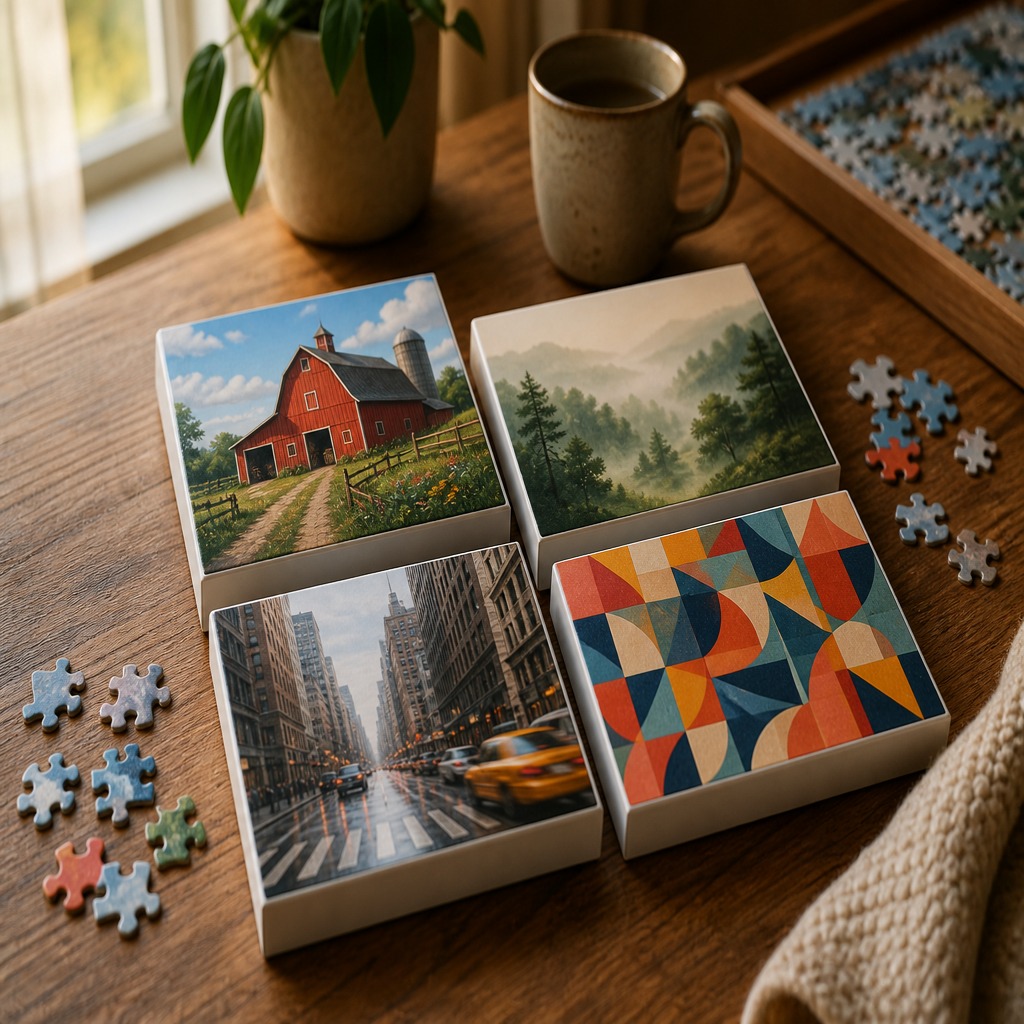
Jigsaw puzzle image choice decides more than most players admit. Two puzzles can have the same piece count and feel completely different. One has a red barn, blue sky, white fence, and clean shadows. The other has fog, grass, water, and a thousand pieces that all seem to be the same quiet green.
The second puzzle is not morally superior. It is just a different kind of afternoon.
That is the useful thing to know before you begin. Piece count matters, but the picture is the hidden difficulty setting. If you choose the wrong image for the mood you are in, the puzzle can feel stubborn before you have even sorted the edges.
For more casual games after this, open the Easy Daily Puzzle home page or browse jigsaw puzzle ideas on Easy Daily Puzzle.
Jigsaw puzzle image choice starts before sorting
The old history of jigsaw puzzles begins with images that had a job. The Strong National Museum of Play traces early jigsaw puzzles to educational dissected maps, including John Spilsbury's map puzzles in the eighteenth century. Those puzzles were not just pretty pictures. The image told children where countries, borders, and shapes belonged.
That old map lesson still applies online. A good jigsaw image gives the eye places to go. A coastline, a roofline, a face, a window, a strong shadow, a patch of flowers, or a sharp color change can become a starting point. A weak image gives the eye very little to hold.
This is why jigsaw puzzle image choice should happen before you look at piece count. A 500-piece puzzle with clear zones can feel easier than a 300-piece puzzle made of mist, sand, or repeating leaves.
The picture is not decoration. It is the puzzle's instruction manual.
Color zones make a puzzle friendlier
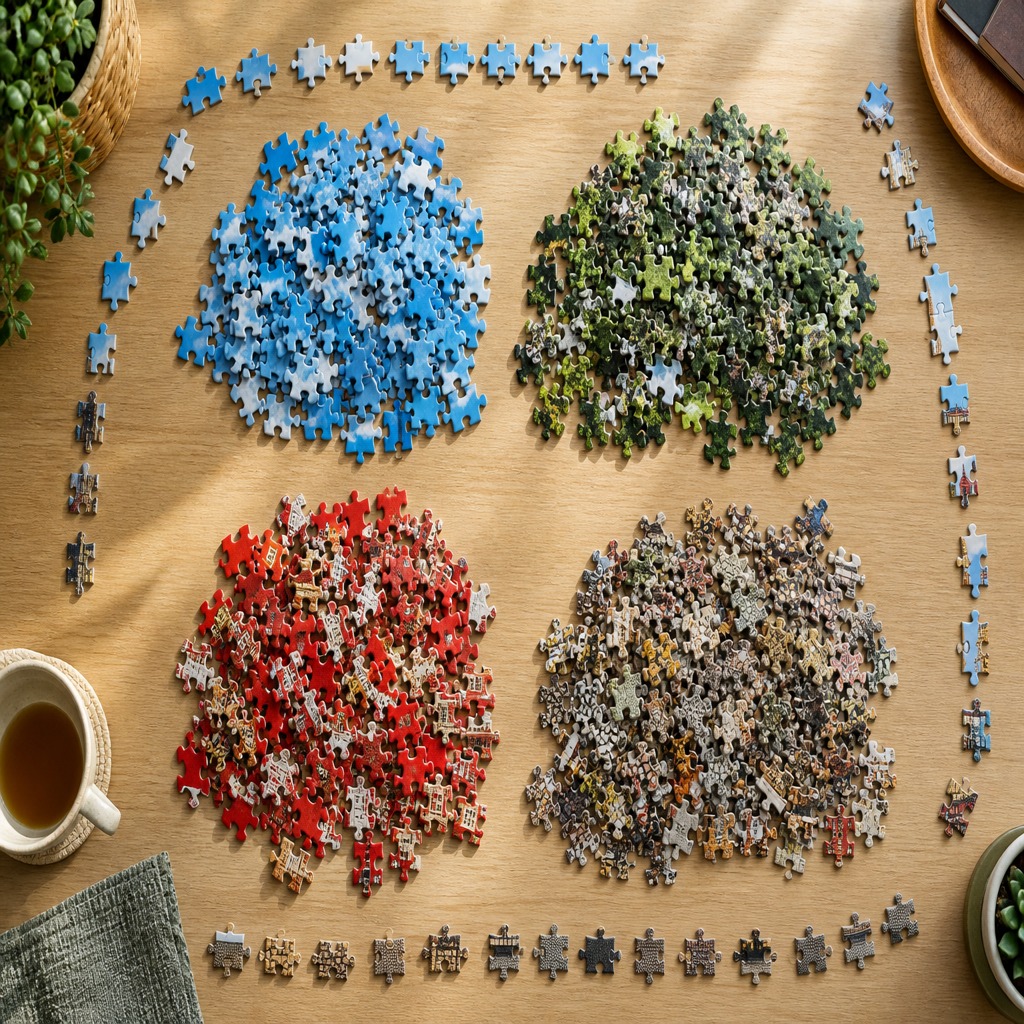
Color is the first thing most players notice, and for good reason. It lets you create piles before you understand the whole image.
A friendly image has obvious color zones. Blue sky. Red building. Dark tree trunk. Yellow flowers. White clouds. These zones do not solve the puzzle for you, but they reduce the first mess. Instead of facing 500 unrelated pieces, you get five or six smaller hunts.
Harder images blur those zones. A beach scene with pale sand and pale sky can look peaceful in the preview and punishing on the table. A forest can become a green carpet. A snow scene may turn into white, gray, and slightly different white.
None of those are bad choices. They just ask for patience. If you want a relaxing ten-minute online puzzle break, choose an image with clear color neighborhoods. If you want a longer challenge, choose soft gradients and repeated tones on purpose.
Texture is the second difficulty setting
After color, texture takes over.
A brick wall has lines. A cat has fur direction, whiskers, eyes, and shadow. Water has ripples that may repeat in annoying little ways.
Good jigsaw puzzle image choice means asking what the texture will feel like as pieces. Smooth areas are harder because the pieces give fewer clues. Repeated textures are harder because many pieces look almost right. Strong textures are easier because a small fragment can carry a lot of information.
This is why food, city streets, bookshelves, colorful rooms, and illustrated scenes often make satisfying casual puzzles. They give the eye many anchors. A blank sky can be beautiful in a photograph and boring as a solve.
If you are choosing a puzzle for a tired evening, avoid images where half the picture is one texture. If you are choosing a puzzle for a focused weekend session, those images can be exactly the right kind of stubborn.

What speed puzzlers can teach casual players
Speed puzzling makes image choice visible because the clock punishes vague pictures.
The World Jigsaw Puzzle Championship rules for 2026 list timed rounds built around 500-piece puzzles, with limits such as 90 minutes for individual first-round solving. In that setting, the image is not a minor detail. A clear picture gives players faster sorting decisions. A muddy picture eats time before the building even begins.
Ravensburger's speed puzzling guide gives the same practical advice in plain language: speed puzzlers often train with 500- or 1,000-piece puzzles and benefit from clear images and sections that make sorting easier.
Casual players do not need to copy the competitive mindset. The lesson is gentler: choose the image that matches the session you actually want.
If you want speed, pick clean contrast. If you want calm, pick a picture with enough variety to keep progress visible. If you want a challenge, pick repeating patterns knowingly.
Faces, objects, and lines help the brain
Some images are easier because they contain things the brain recognizes quickly.
Faces are powerful. So are letters, buildings, animals, tools, food, windows, doors, roads, and horizon lines. A single eye, wheel, cup handle, or roof edge can identify a region before you know where the piece goes.
Abstract images can be lovely, but they remove some of that help. The solve becomes more about color and cut shape. That can be satisfying if you are in the mood for it. It can also become mushy if you wanted a light break.
Lines help too. A fence, road, table edge, tree branch, or shoreline gives direction. Pieces with a clear diagonal or curve are easier to place than pieces from a flat background. Before choosing an online puzzle, look for lines that travel across the image. They will become little trails once the pieces are scattered.
The no-preview trap
There is an old-school pleasure in solving without looking at the box image. Some wooden puzzle makers even treated the finished picture as part of the challenge. The Strong Museum's writing on elaborate wooden puzzles notes that some serious early puzzles did not include a picture of the assembled image because that was considered part of the difficulty.
That can be fun. It can also be the wrong choice for a casual break.
If you are playing online to relax, use the preview. You are not cheating at leisure. You are choosing the kind of attention you want to spend.
For beginners, a preview helps connect pieces to picture zones. For returning players, it keeps a tricky puzzle from becoming random. The preview is a tool, not a confession.
A simple way to choose your next jigsaw
Before starting, ask four quick questions.
1. Does the image have clear color zones?
2. Does it have varied texture?
3. Does it include recognizable objects or strong lines?
4. Does the piece count fit the time I actually have?
If the answer is yes to most of these, the puzzle will probably feel friendly. If the answer is no, it may still be good, but it is probably a challenge puzzle.
That small check can save a session. It also makes online jigsaw play more honest. You stop blaming yourself for struggling with a picture that was built to be slow. You start choosing difficulty with your eyes open.
Jigsaw puzzle image choice is not about avoiding hard puzzles. It is about picking the right hard. Some days want a clear red barn and a finish before coffee gets cold. Some days want fog, grass, and a table that refuses to hurry.
The picture tells you which day it is.