



Killer Sudoku rules look familiar until the grid starts whispering numbers in a different language. The rows, columns, and 3x3 boxes still matter, but now each dotted cage has a small sum in the corner. A plain empty grid suddenly feels less empty. It has arithmetic tracks running through it.
That is the charm of the variant. Classic Sudoku asks, "Where can this digit go?" Killer Sudoku also asks, "Which group of digits can make this total?" If you already enjoy normal Sudoku on Easy Daily Puzzle, killer cages are a good next step because they change the opening without changing the whole world.
Killer sudoku rules start with the ordinary Sudoku grid
The base is still the same 9x9 Sudoku promise. Each row, column, and 3x3 box must contain the numbers 1 through 9 once. Conceptis explains classic Sudoku in that plain form, then describes Killer Sudoku as the same grid with extra outlined areas whose totals must match the clue in each area. You can see that rule set on the Conceptis Sudoku page .
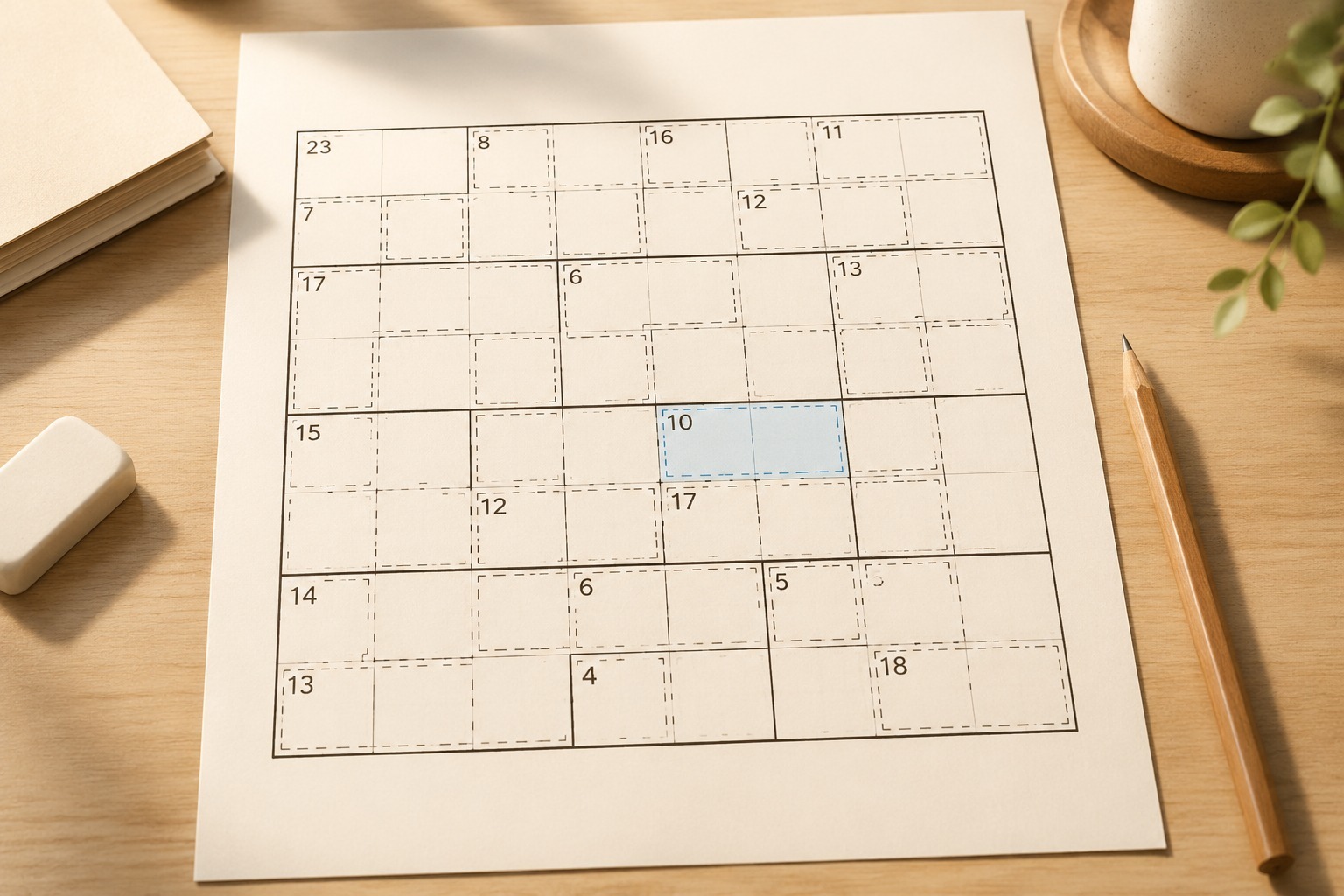
The extra outlined areas are usually called cages. A cage might cover two cells, three cells, or a larger shape that bends around a box boundary. The small number in the cage corner is not a digit to place. It is the total for all cells inside that cage.
So a two-cell cage marked 3 can only be 1 and 2. A two-cell cage marked 17 can only be 8 and 9. A three-cell cage marked 6 can only be 1, 2, and 3. These tiny facts are why Killer Sudoku can feel friendly at the start even when the grid has very few given digits.
The standard form also says that digits do not repeat inside the same cage. Wikipedia's Killer sudoku overview describes that no-repeat cage rule as part of the usual rules. That one sentence matters more than it looks. Without it, a two-cell 4 cage could be 1 and 3 or 2 and 2. With the no-repeat rule, 2 and 2 disappears.
Why one cage can be better than five normal clues
In classic Sudoku, a given 7 is a fixed fact. You know where the 7 is, then you remove 7 from the rest of the row, column, and box.
A Killer Sudoku cage is softer. It gives you a boundary and a total, not the final placement. That makes it less direct, but sometimes more useful.
Take a two-cell cage marked 16. The pair must be 7 and 9. You may not know which cell is 7 and which is 9, but both cells are now limited. If one of those cells sits in a row where 9 is already blocked, the other possibility falls into place. The cage does not solve the puzzle by itself. It gives the normal Sudoku logic something sharper to grip.
This is why killer sudoku rules reward a different kind of first scan. In a normal puzzle, many players sweep rows and boxes looking for missing digits. In Killer Sudoku, the first pass often starts with extreme sums.
Small totals are tight. Large totals are tight. Middle totals are loose.
A two-cell 3 cage is fixed as 1 and 2. A two-cell 4 cage is only 1 and 3. A two-cell 10 cage has several possible pairs. The same pattern happens with larger cages. The more unusual the sum, the fewer combinations you need to consider.
How to read killer sudoku rules without drowning in math
The best beginner mistake to avoid is treating every cage like a school worksheet. You do not need to calculate everything. You need to notice the cages that are already useful.
Start with these habits.
First, circle the tiny cages. Two-cell cages are easy to reason about and often create the first real progress.
Second, mark extreme sums. Very low or very high totals usually have fewer combinations, so they are easier to use.
Third, look for cages that sit entirely inside one 3x3 box. If a cage crosses into another box, it may create an "innie" or "outie" situation later.
Fourth, do not write every possible combination too early. Notes are useful, but a screen full of candidates can make the puzzle feel harder than it is. A cleaner start is to write only forced pairs, forced triples, and obvious exclusions.
Fifth, keep classic Sudoku vision alive. Killer cages are tempting, but the row, column, and box rules still do most of the quiet work. After every cage discovery, scan the related row and box again.
If you want a gentle warmup before trying a harder variant, browse more Sudoku posts and grids through Easy Daily Puzzle Sudoku results . The point is not to become fast right away. It is to get used to seeing totals and placements at the same time.
A simple example of cage thinking
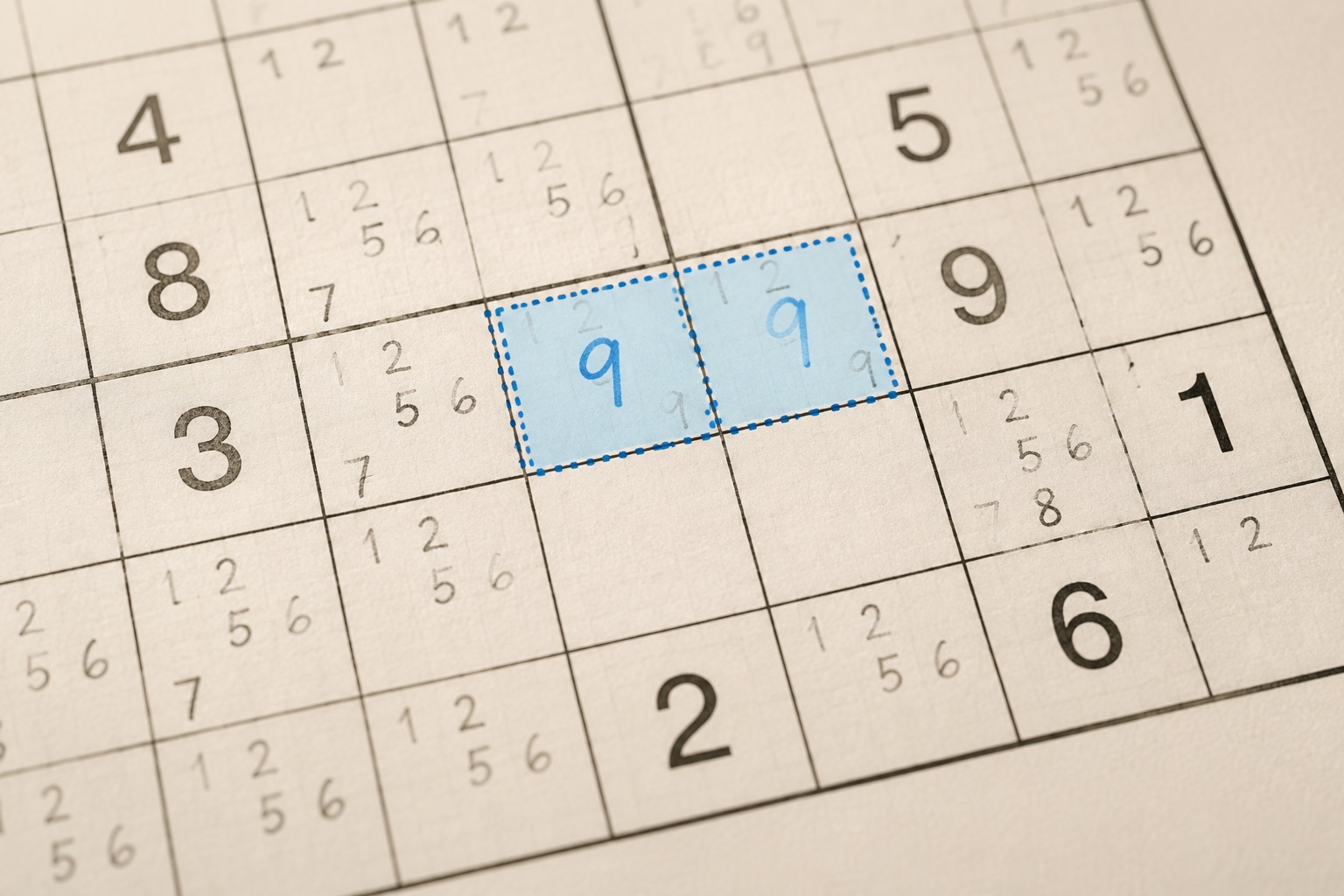
Imagine the top-left 3x3 box has a two-cell cage marked 17. Because digits cannot repeat in a cage, that cage must contain 8 and 9.
Now imagine the same box also has a row where 9 is already impossible because another 9 sits somewhere else in that row. Suddenly one cell in the 17 cage cannot be 9, so it must be 8. The other becomes 9.
That is the Killer Sudoku feeling in miniature. The arithmetic gives you a pair. The ordinary Sudoku rule chooses the order.
There is also a famous total behind every full row, column, and box: the digits 1 through 9 add to 45. In more advanced puzzles, players use that total to reason about cages that almost fill a row or box. If a full box totals 45 and the cages inside it add to 39, the missing outside piece has to explain the difference.
You do not need that technique on your first puzzle. Still, it helps to know why experienced solvers stare at cage borders so carefully. They are not only looking at cells. They are looking at what leaks in and out of a finished 45-total area.
killer sudoku rules make notes feel different
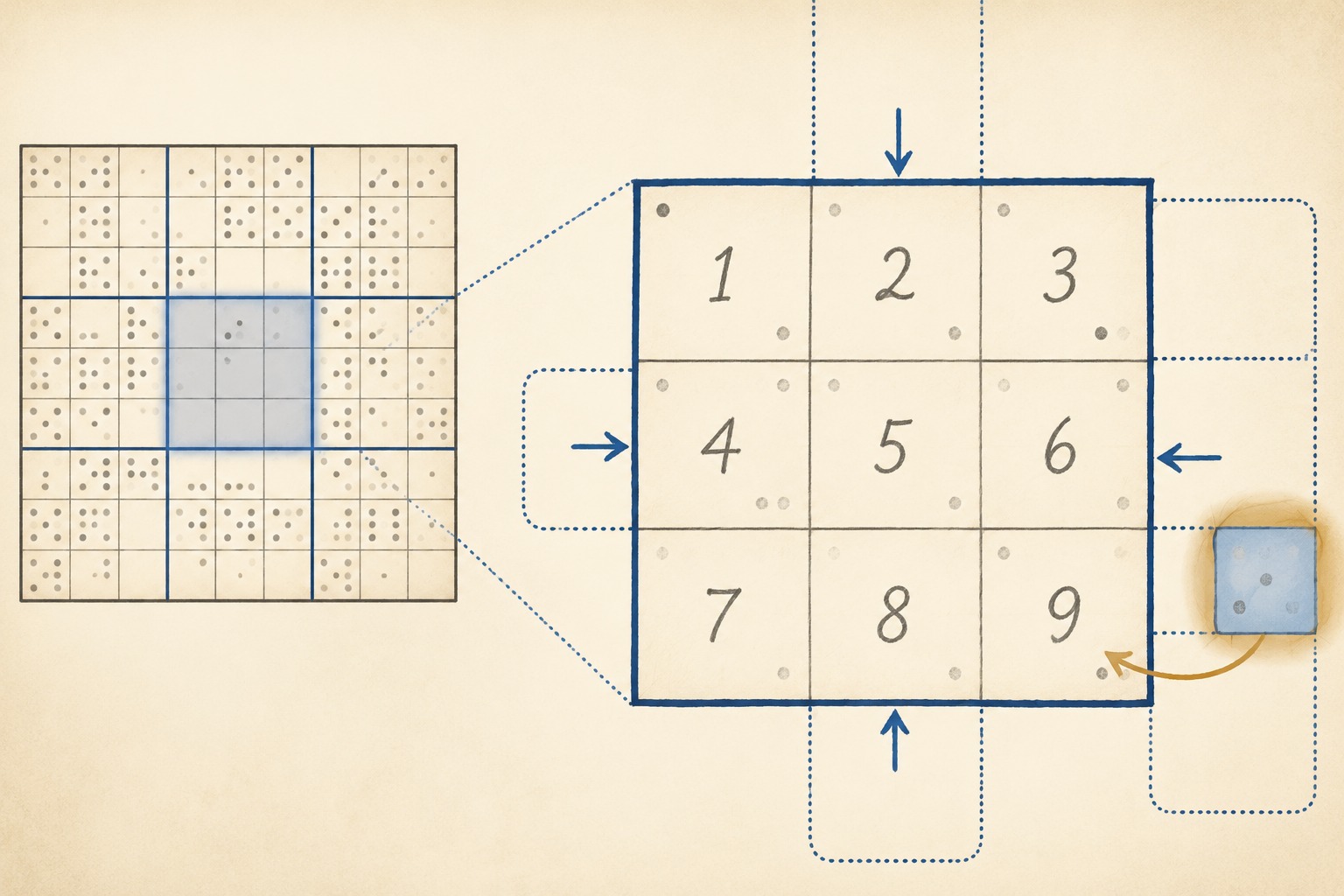
Classic Sudoku notes often ask, "Could this cell be 2, 4, or 8?" Killer Sudoku notes often ask, "Could this cage be 1 plus 6, or 2 plus 5?"
That small shift changes the page. You are not only placing digits one by one. You are testing small teams of digits.
For casual play, keep notes at the cage level as long as possible. If a three-cell cage marked 24 can only use high digits, mark that cage idea before filling every cell with clutter. Once row or box logic narrows one cell, turn the cage idea into normal candidates.
when to try Killer Sudoku
Killer Sudoku is a good choice when normal Sudoku feels too automatic but you still want the comfort of the familiar 9x9 grid. It is not just "harder Sudoku." Some easy killer puzzles are quite approachable because the cage sums replace many missing givens.
Try it when you want a puzzle that asks for slower observation. The best solves often begin with a tiny cage in a corner, a sum that looks too small to ignore, or a box that almost adds to 45. One small arithmetic fact opens a door. Then the old Sudoku habits walk through it.
If you are moving from classic grids, play one round without racing. Read the cages first. Find the obvious pairs. Then go back to rows and boxes. The grid will start to feel less like a blank wall and more like a map.