



A 500-piece puzzle can feel like a pleasant hour with coffee nearby. A 1,000-piece puzzle asks for a little system. A 2,000-piece puzzle is a different animal: more sorting, more similar pieces, more chances to lose the picture inside the pile.
That is why choosing the right piece count matters more than choosing the prettiest image. A beautiful puzzle can become annoying if the count is wrong for the screen, the time available, or the player's patience that day.
If you want to browse puzzles after reading, start at the [Easy Daily Puzzle game library](https://easydailypuzzle.com/) or search for [jigsaw puzzle options on Easy Daily Puzzle](https://easydailypuzzle.com/?s=jigsaw). The better choice is not always the largest puzzle. It is the puzzle you will actually finish.
Suggested image placement: Insert the featured image after this opening section. Use alt text: "online jigsaw piece count comparison with 500 and 2000 piece puzzles".
Online jigsaw piece count is a difficulty setting
Most people talk about jigsaw difficulty as if the image does all the work. A blue sky is hard. A colorful market is easier. A repeating forest is trouble. That is true, but the piece count decides how much of that trouble reaches the player.
At 500 pieces, the picture still tends to speak clearly. A red roof, a white boat, a dog's ear, or a patch of orange sunset can become an anchor quickly. You can sort loosely and still make progress.
At 1,000 pieces, the same picture becomes less forgiving. The red roof may now be 50 small decisions instead of 12. The sky may need its own sorting pass. Pieces that looked different at 500 start looking related.
At 2,000 pieces, the table changes again. The puzzle is no longer just about matching. It is about managing information. You need a place for edge pieces, a place for texture groups, a place for uncertain pieces, and enough patience to stop testing random fits when your eyes get tired.
The [World Jigsaw Puzzle Championship 2026 page](https://worldjigsawpuzzle.org/) shows how formal speed puzzling uses different puzzle sizes across event formats, including 500-piece individual rounds, 1,000-piece pairs finals, and 2,000-piece team puzzles. Competitive puzzlers do not treat those as the same task with bigger numbers. They are different formats.
Casual players should think the same way.
What 500 pieces teaches
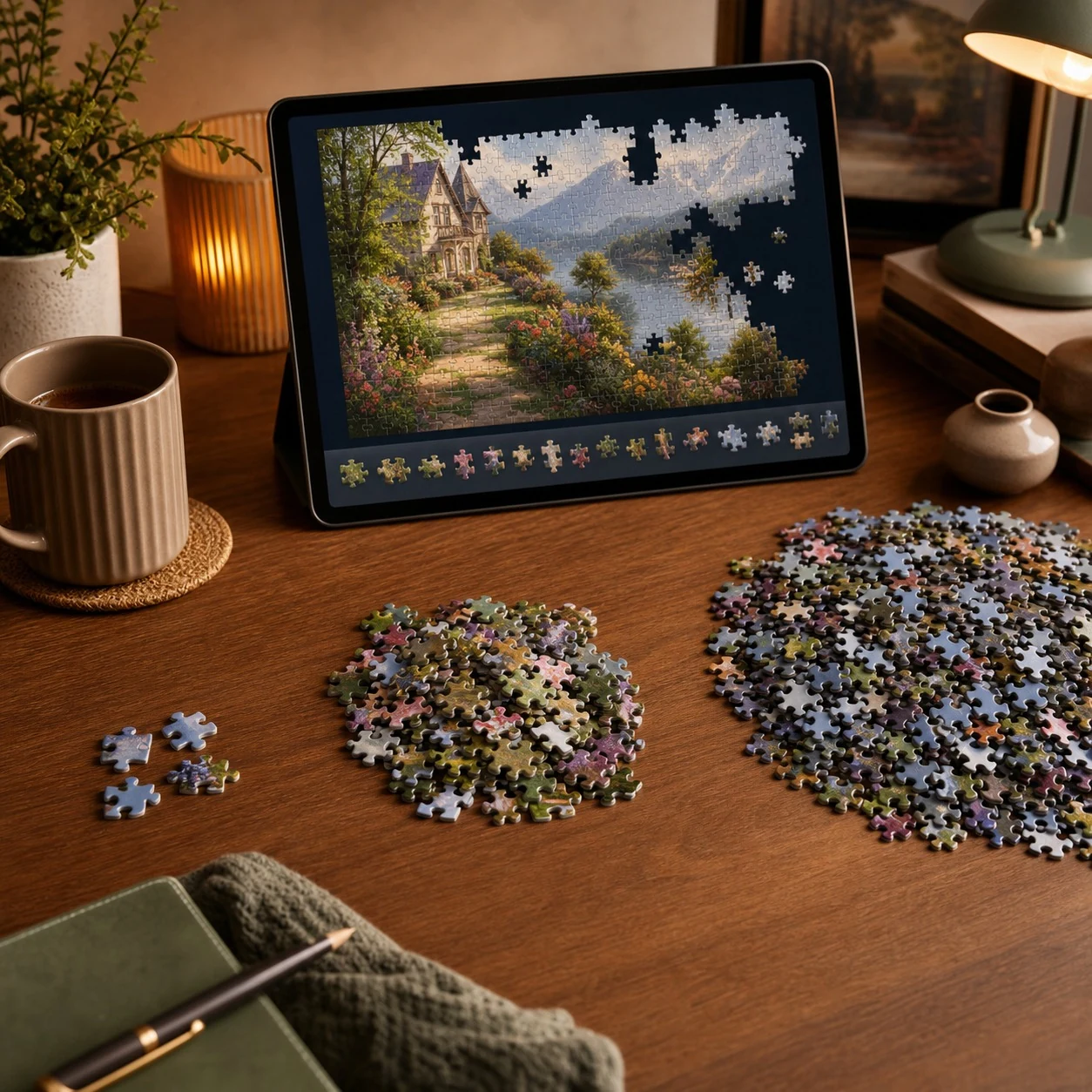
A 500-piece online jigsaw is a good place to practice seeing the image instead of fighting the pile. It is large enough to feel satisfying, but small enough that mistakes do not bury the whole session.
Use 500 pieces when you want a short visual break, a new picture theme, or a puzzle you can finish without turning the evening into a project. It is also the best count for learning a new online interface because you are not battling both the puzzle and the screen at the same time.
The best first move is simple: sort edges, then pull out the loudest colors. Do not spend twenty minutes hunting for every border piece if the picture is already handing you a better anchor. A red umbrella, a yellow window, or a face in the image may create progress faster than a half-built frame.
This is where beginners often learn the wrong lesson. They hear "edges first" and treat it like a law. Edges are useful, but they are not sacred. If the border is mostly white sky, and the center has three obvious color zones, start with the color zones.
What 1,000 pieces teaches
A 1,000-piece puzzle is where sorting becomes more than tidying up.
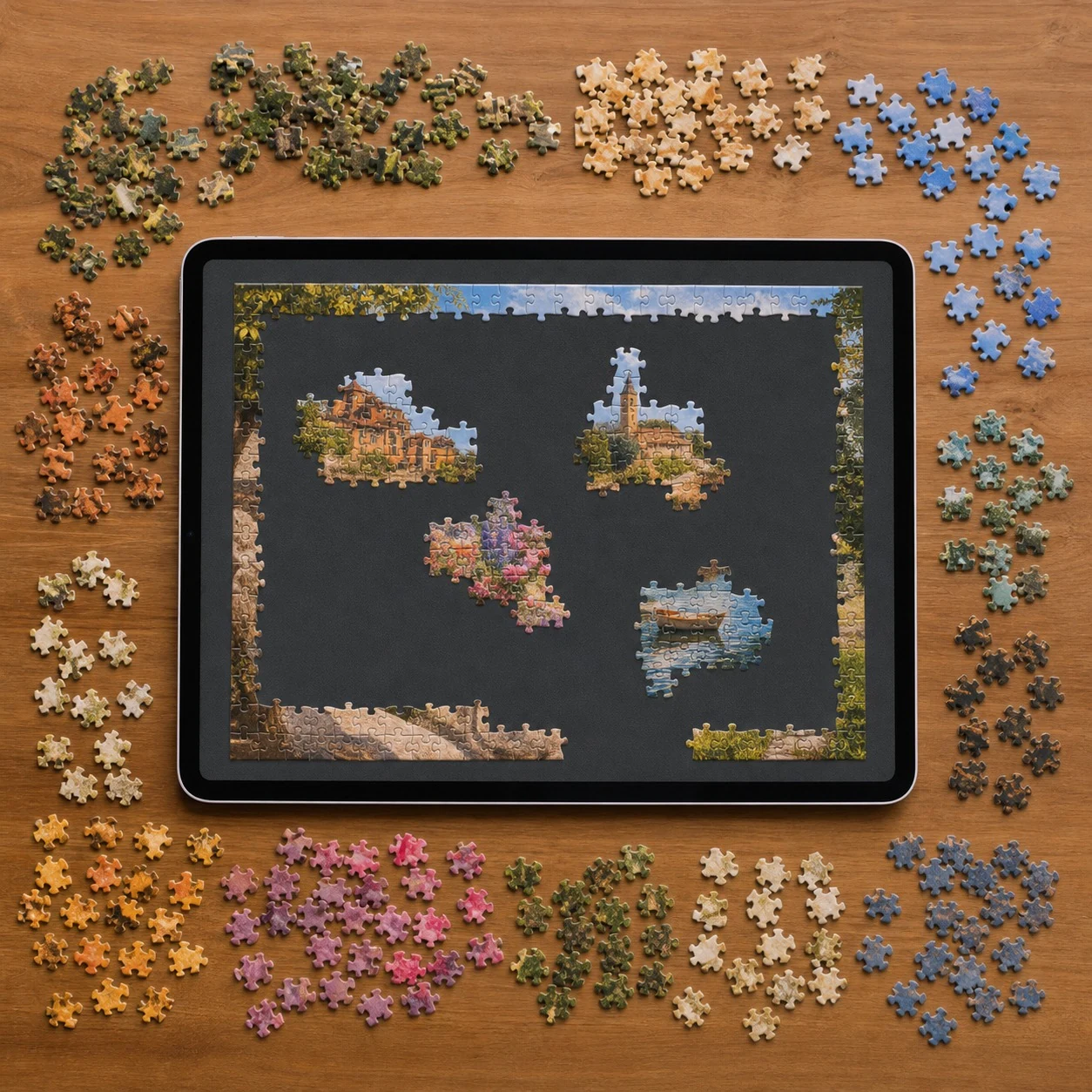
At this count, the pile has enough similar pieces that the player needs categories. Not perfect categories. Useful ones. Sky here. Dark tree texture there. Straight edges in one group. Pieces with textural lines in another. Strange shapes in a small "look at this later" area.
Online play changes this because screen space is limited. On a physical table, you can spread pieces across the room if nobody objects. On a screen, too much spreading becomes another kind of clutter. You need smaller groups and a willingness to zoom or pan with intention.
The trick is to build islands. Do not wait for the full border before connecting anything. If four pieces clearly belong to the same window, build that window. If a cluster of flowers has a distinct pink tone, let it become a small island. Later, those islands make the puzzle easier to navigate.
The [London Museum's dissected map record](https://www.londonmuseum.org.uk/collections/v/object-42820/a-new-dissected-map-of-the-world/) describes dissected maps as prototypes of modern jigsaw puzzles. Those early maps were educational because the picture had meaning: borders, regions, shapes, and placement. Modern online jigsaws still work that way. The image teaches you where to look if you give it enough structure.
What 2,000 pieces teaches
A 2,000-piece puzzle is not just "more jigsaw." It is a patience test.
The biggest danger is random fitting. When the puzzle is huge, every almost-fit starts to look tempting. The hand wants to test pieces because testing feels like doing something. That can turn a calm puzzle into a slow argument with the screen.
The better approach is to make the puzzle smaller before you try to solve it.
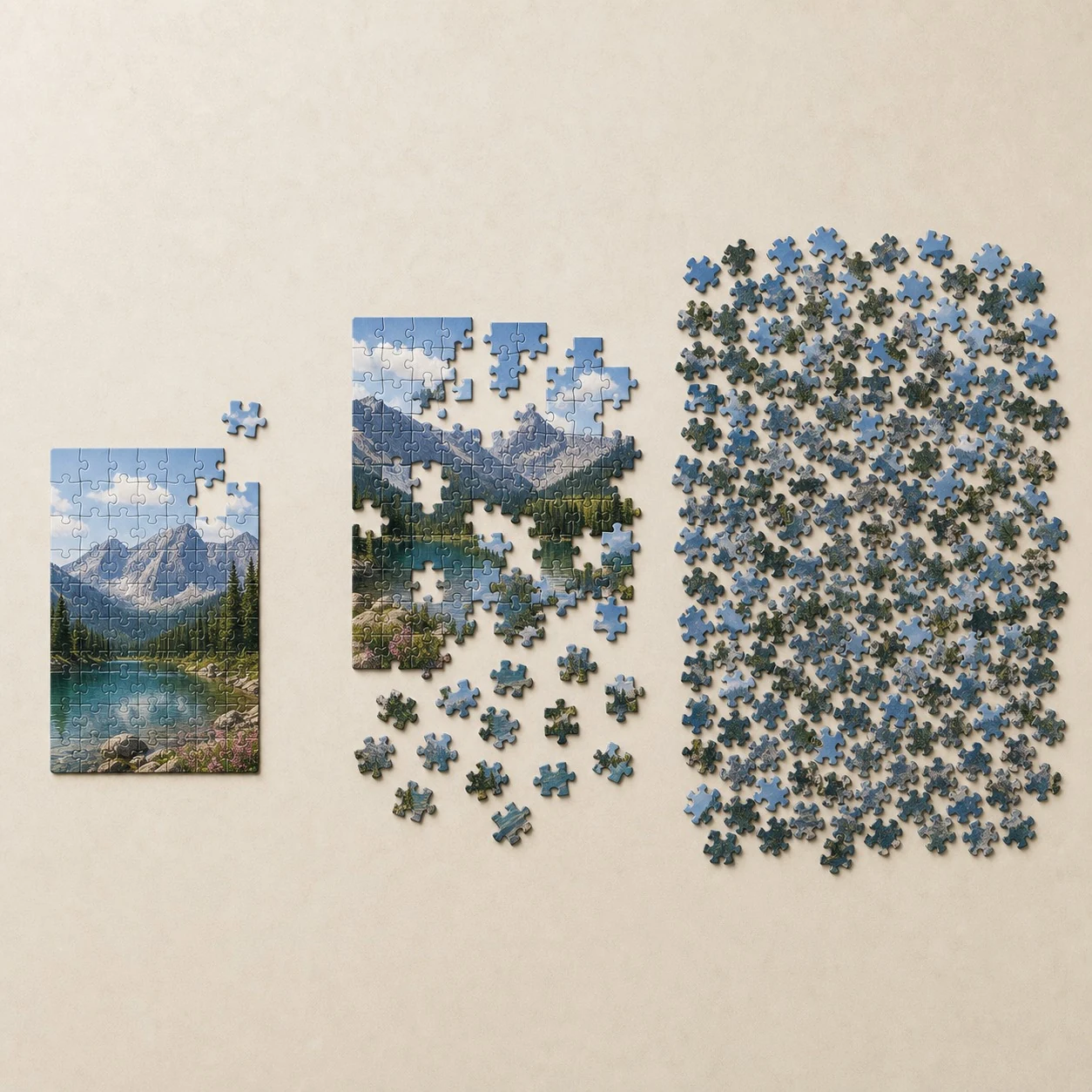
Start with broad sorting. Pull edges aside, but also separate major color families and repeated textures. Then choose one confident area and build there for a while. A 2,000-piece image cannot be solved all at once. It needs neighborhoods.
This is also where breaks matter. If two pieces almost fit and you have tested them three times, stop. The piece is not going to become correct through stubbornness. Step away for a minute, come back, and look for line direction, color temperature, or the shape of nearby gaps.
Large puzzles reward freshness more than force.
How image choice changes the count
Piece count does not act alone. A 500-piece puzzle with a plain blue ocean may be harder than a 1,000-piece puzzle with strong color sections. A 2,000-piece puzzle with clear architecture, faces, signs, and repeated but distinct textures may feel easier than a smaller image made of fog, snow, and pale sky.
Look for anchors before choosing.
Good anchors include faces, animals, buildings, bright objects, strong shadows, textural borders, and color changes. Weak anchors include empty sky, flat water, repeating leaves, blurry flowers, or large areas of the same fabric.
There is nothing wrong with hard images. They can be wonderful. But the piece count should match the visual information. If the picture is quiet, lower the count. If the picture has many clear zones, raise it.
The [Historic Geneva article on dissected maps](https://historicgeneva.org/recreation/dissected-maps/) notes that early jigsaw-type puzzles were cut maps used to teach geography. That origin is useful because maps are full of anchors: boundaries, coastlines, labels, and shapes. A modern puzzle image needs its own version of that clarity.
A simple way to choose your next count
Use this quick rule:
1. Choose 500 pieces when you want a finishable break.
2. Choose 1,000 pieces when you want a satisfying project.
3. Choose 2,000 pieces when you want a multi-session puzzle and do not mind sorting.
4. Lower the count if the image has too much sky, water, snow, grass, or blur.
5. Raise the count if the image has clear color zones and strong visual landmarks.
That is not a rigid system. It is a way to avoid choosing a puzzle based only on ambition. Nobody gets extra credit for opening a giant puzzle and abandoning it in irritation.
The count should fit the day
The best online jigsaw piece count is the one that fits your attention right now.
Some days, 500 pieces is enough. You sort, build a few anchors, finish the picture, and leave with the small satisfaction that makes jigsaw puzzles work. Other days, a larger puzzle is exactly what you want because the slow sorting feels better than another fast scroll through your phone.
Choose the count like you choose the mood.
If the puzzle starts feeling too noisy, the number was probably too high for the moment. If it ends too quickly and you still want more, go bigger next time. That tiny adjustment is where online jigsaw play becomes more personal.
The puzzle does not need to impress anyone. It just needs to pull you back to the picture, one piece at a time.