



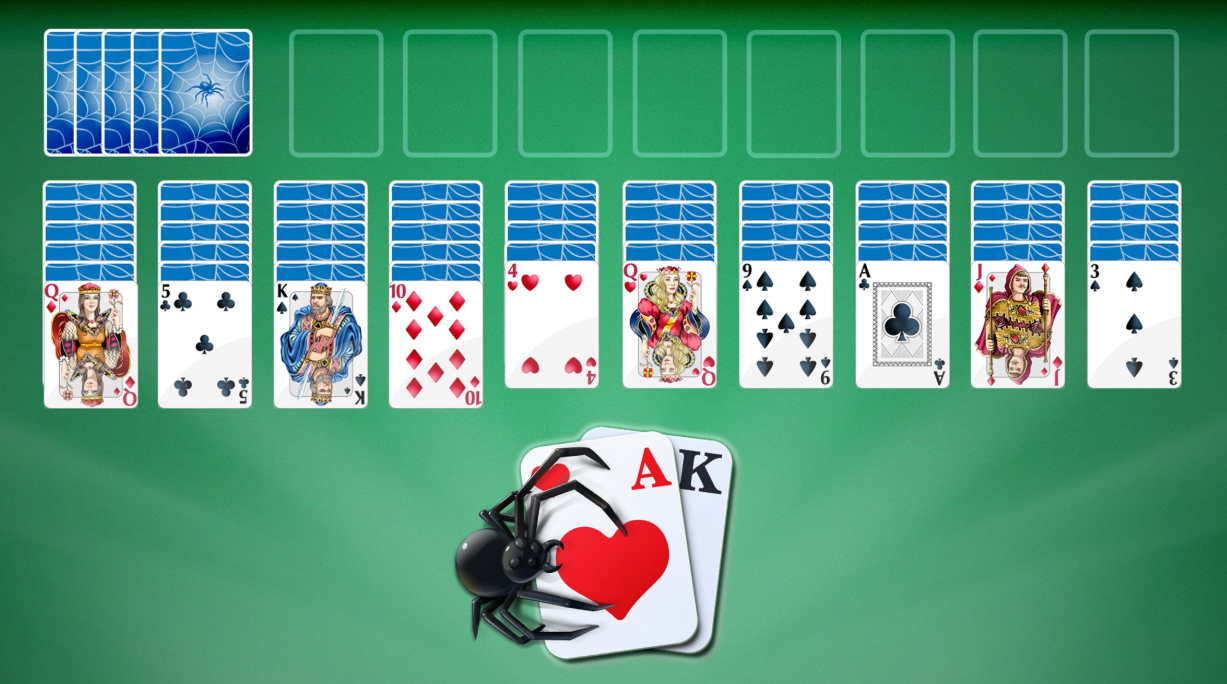
For millions of computer users worldwide, the sight of cascading cards and the satisfying click of successfully completing a suit is intimately tied to one game: Spider Solitaire. Often perceived as a timeless classic, its history is surprisingly modern, intricately woven with the rise of personal computing. This is the story of how a complex patience game evolved into a digital staple, offering a blend of strategy, luck, and endless hours of quiet engagement.
The origins of Spider Solitaire’s core mechanics predate computers by decades. It belongs to the broader family of "solitaire" or "patience" games, which became popular in Europe in the late 18th century. The specific rules of Spider—using two decks, building eight tableau columns, and the objective of assembling complete suits from King to Ace for removal—are believed to have emerged in the early 20th century. Its name likely derives from the game’s initial layout of ten tableau piles (like eight legs plus the body of a spider) or from the way cards are dealt in "webs" to the columns. For most of its early life, it remained a niche, physically cumbersome card game, known primarily to dedicated card game enthusiasts due to its significant table space requirement and lengthy playtime.
Spider Solitaire’s true genesis as a global phenomenon began not with physical cards, but with software. Its pivotal moment arrived in 1990 with the inclusion of "Spider" in Microsoft’s Windows Entertainment Pack for Windows 3.0. This collection of casual games was designed to help users practice mouse skills—clicking, dragging, and dropping. Spider, with its requirement for precise card manipulation and strategic column management, was a perfect fit. However, it was its integration into the operating system itself that cemented its iconic status.
The game reached its cultural zenith with Windows 98 and, more definitively, Windows XP in 2001. Pre-installed and freely accessible to hundreds of millions of users, it became the quiet companion of office workers, students, and home users. During meetings, phone calls, or moments of mental block, its green felt table became a digital refuge. The game offered four difficulty levels, from the beginner-friendly one-suit version to the intensely challenging four-suit variant, ensuring a wide appeal. Its design was minimalist and intuitive: the celebratory animation of a completed suit scurrying off the tableau provided a small but potent dopamine hit, a reward for patience and planning.
The development of Spider Solitaire did not stop with its Windows heyday. The 2000s and 2010s saw its mass proliferation across platforms. When Microsoft controversially removed built-in games from Windows 8 and later versions, a vacuum was created, filled by countless third-party developers. Spider Solitaire became a staple of web-based gaming portals, mobile app stores (iOS and Android), and social media platforms. These new versions introduced features the original lacked: daily challenges, undo limits, varying artistic themes, leaderboards, and intricate scoring systems. This transition transformed it from a static pre-installed application into a dynamic, community-connected gaming experience.
Today, Spider Solitaire enjoys a unique status. It is a bridge between generations—a game that boomers discovered on Windows XP and Gen Z downloads as an app. Its appeal lies in a perfect balance: it is cognitively engaging enough to require strategic foresight and memory (especially in the two- or four-suit modes), yet repetitive and luck-based enough to be meditative. It exercises the mind without the stress of a timed puzzle. For researchers, it serves as a simple model for studying problem-solving and probability.
From its obscure origins as a tabletop patience game to its reign as the unofficial pastime of the PC era and its current life as a mobile and online titan, Spider Solitaire’s journey mirrors the evolution of personal computing itself. It is more than a game; it is a piece of digital folklore, a shared experience of focus, frustration, and fleeting triumph that continues to captivate one deal at a time. In a world of high-octane video games, the quiet, persistent allure of building those eight descending suits remains, proving that sometimes, the simplest digital spaces can become the most enduring.