



Sudoku 17 clues looks like a dare. A nearly empty grid sits on the screen, and the first reaction is usually wrong in one of two directions. Some players think fewer given numbers must mean a cleaner, more elegant solve. Others look at all that blank space and assume the puzzle is impossible.
Both reactions miss the interesting part.
The number 17 is famous because it sits at the edge of what a classic 9x9 Sudoku can do. A valid Sudoku needs one unique solution. If too few starting numbers are given, the grid may have more than one possible finish, which means it stops being a fair puzzle and becomes a guessing problem.
That is why Sudoku 17 clues is a better story than a difficulty label. It is about how little information a puzzle can give while still having one answer.
If you like number puzzles on Easy Daily Puzzle, this is a useful idea to keep in mind before judging a grid by how empty it looks. You can also browse more number-grid articles through Easy Daily Puzzle Sudoku topics when you want another puzzle habit for a short break.
Sudoku 17 clues is about uniqueness, not bragging rights
Classic Sudoku has a simple job. As Nikoli's Sudoku page explains, the player places the numbers 1 through 9 so that every row, column, and 3x3 block contains each digit once. The rules fit in a few sentences. The consequences do not.
The 17-clue question asks something sharper: what is the smallest number of given digits that can still force one unique solution?
For a long time, Sudoku fans and mathematicians believed the answer was 17, but belief is not proof. In 2012, Gary McGuire, Bastian Tugemann, and Gilles Civario released the paper There is no 16-Clue Sudoku. Their exhaustive computer search found no valid 16-clue puzzle and proved that 17 is the minimum for a standard Sudoku with a unique solution.
Nature covered the result in January 2012 and noted the central claim plainly: Sudoku puzzles need at least 17 clues to have a valid solution. Nature later corrected one striking detail in the story, saying the authors used about 7 million hours of CPU time, not 700 million.
That correction is oddly helpful. It keeps the story human. Even the neatest puzzle fact can arrive through messy reporting, long computation, and a lot of checking.
Sudoku 17 clues does not mean the grid is automatically harder
Here is the trap: players see 17 clues and assume difficulty. That sounds reasonable. A puzzle with fewer starting numbers must give you less help, right?
Not always.
SudokuWiki's discussion of the 17-clue proof makes a useful point for solvers: clue count is not the same thing as grade. A sparse puzzle can still have a path of reasonable logic, while a puzzle with more starting numbers can be nasty if the useful relationships are hidden.
Think of it like a room with lights. Seventeen lamps placed well can reveal the doors. Thirty lamps placed badly can still leave the corner you need in shadow.
For a casual player, the lesson is simple. Do not count givens and decide how hard the puzzle is before you start. Look at where the clues sit.
Are they spread across the grid?
Do they give each region a foothold?
Do any numbers appear often enough to guide a scan?
Those questions matter more than the raw count.
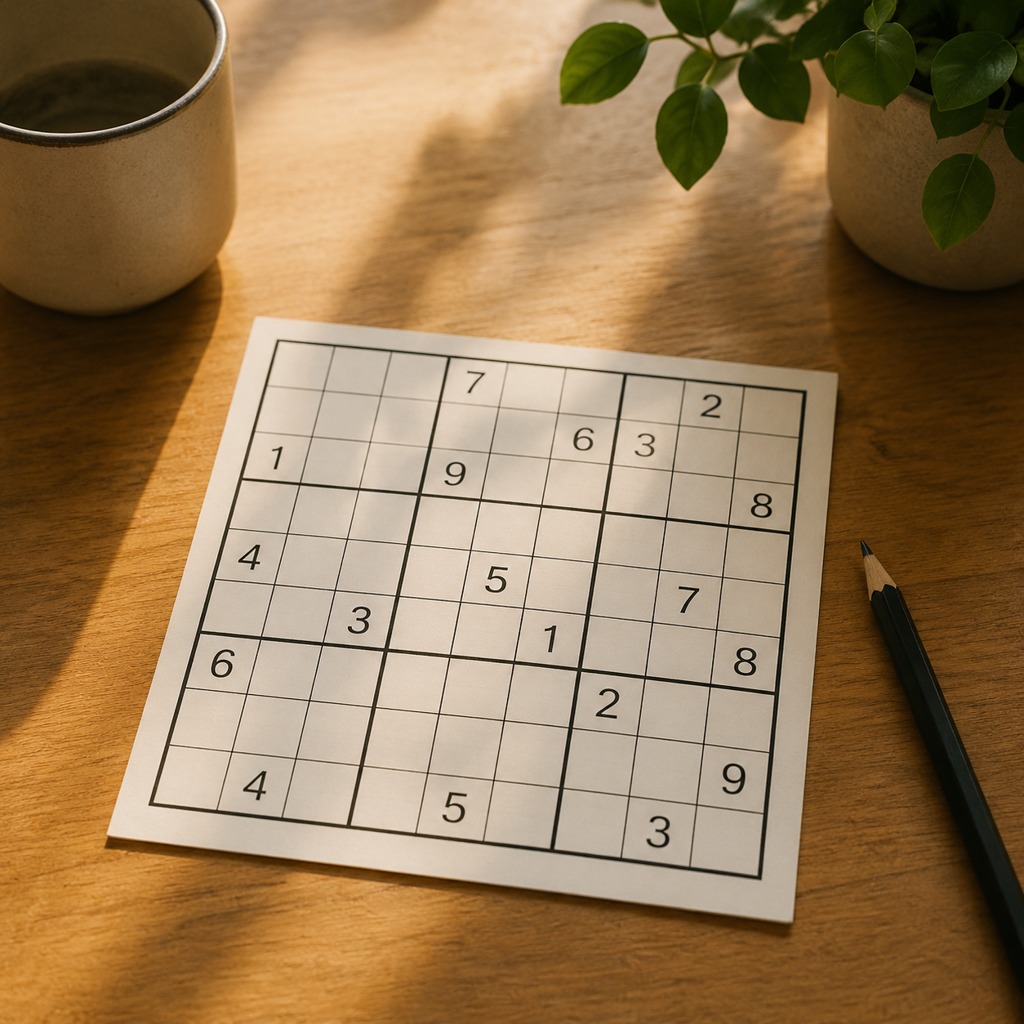
Why an empty-looking Sudoku grid can still be fair
A fair Sudoku is not fair because it looks friendly. It is fair because the solution is forced.
That difference matters when you meet a sparse grid. The blank cells are not the problem by themselves. The problem is whether the givens create enough constraints to make one path possible. A well-built 17-clue puzzle has very little visible information, but the information that remains is doing heavy work.
The first mistake is trying to solve the whole emptiness at once. That turns the grid into fog.
Start smaller.
Pick one number that appears two or three times. Check its rows, columns, and boxes. Ask where it cannot go. Then repeat that scan in the sections with the most structure. You are not trying to "beat" the 17 clues. You are trying to make one safe discovery.
Another good habit is to resist note clutter too early. Sparse grids tempt players to fill every empty cell with candidates. That can help later, but if you do it before your first real scan, the puzzle becomes a field of tiny numbers. The grid looks more informed, but your eyes have less to hold onto.
Use the first minute to read shape and distribution.
Then write notes where they answer a question, not where they merely express uncertainty.
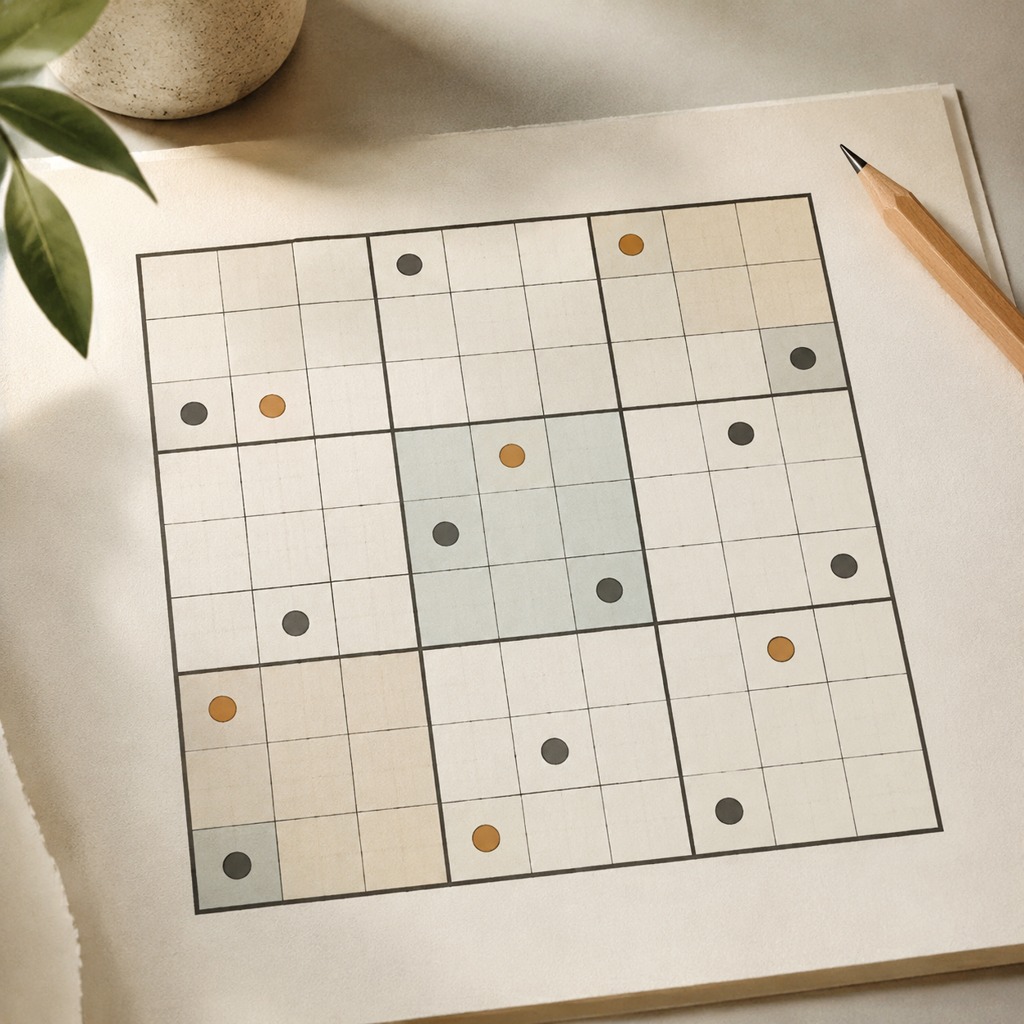
The puzzle-design lesson inside Sudoku 17 clues
Sudoku became a newspaper and browser favorite because the rules travel well. The digits do not need translation. A 9x9 grid looks familiar almost immediately. A player can open a puzzle, understand the task, and still spend ten minutes finding the next move.
Sudoku 17 clues shows the opposite side of that simplicity. Under the clean grid is a design problem: how little can the puzzle reveal and still be a puzzle?
That is not only a mathematician's question. It is also a reader's question. A good daily puzzle gives just enough to keep you curious. Too much information and the solve feels mechanical. Too little information and the page feels unfair.
The 17-clue boundary makes that balance visible.
It also explains why clue placement can feel more important than clue count. Two givens in the right boxes can cut off several false paths. A digit repeated in strategic rows can guide a scan. A symmetrical arrangement may look elegant but still has to prove itself through logic.
This is where puzzle history and puzzle practice meet. The grid became popular because it feels simple. It stayed interesting because simple rules can hide very exact design choices.
How to approach a Sudoku 17 clues puzzle without guessing
If you open a sparse puzzle, do not treat the empty space as a personal insult. The grid is not shouting. It is withholding.
Use a calmer routine.
1. Count nothing for the first 30 seconds.
2. Look for the digit that appears most often.
3. Scan that digit across rows, columns, and boxes.
4. Mark only candidates that answer a specific question.
5. After each placement, clean the affected row, column, and box.
6. If a path dries up, switch digits instead of guessing.
The important move is number 6. Sparse puzzles punish attachment. You may want a certain cell to work because you have stared at it too long. Let it wait. A different number may open the same area later with less drama.
This is also why Sudoku 17 clues can be good training even if you do not solve many true 17-clue puzzles. The habit transfers. You learn not to panic when a grid looks empty. You learn not to confuse "few clues" with "bad puzzle." You learn to ask what each given is doing.
That makes ordinary medium and hard puzzles feel less noisy.
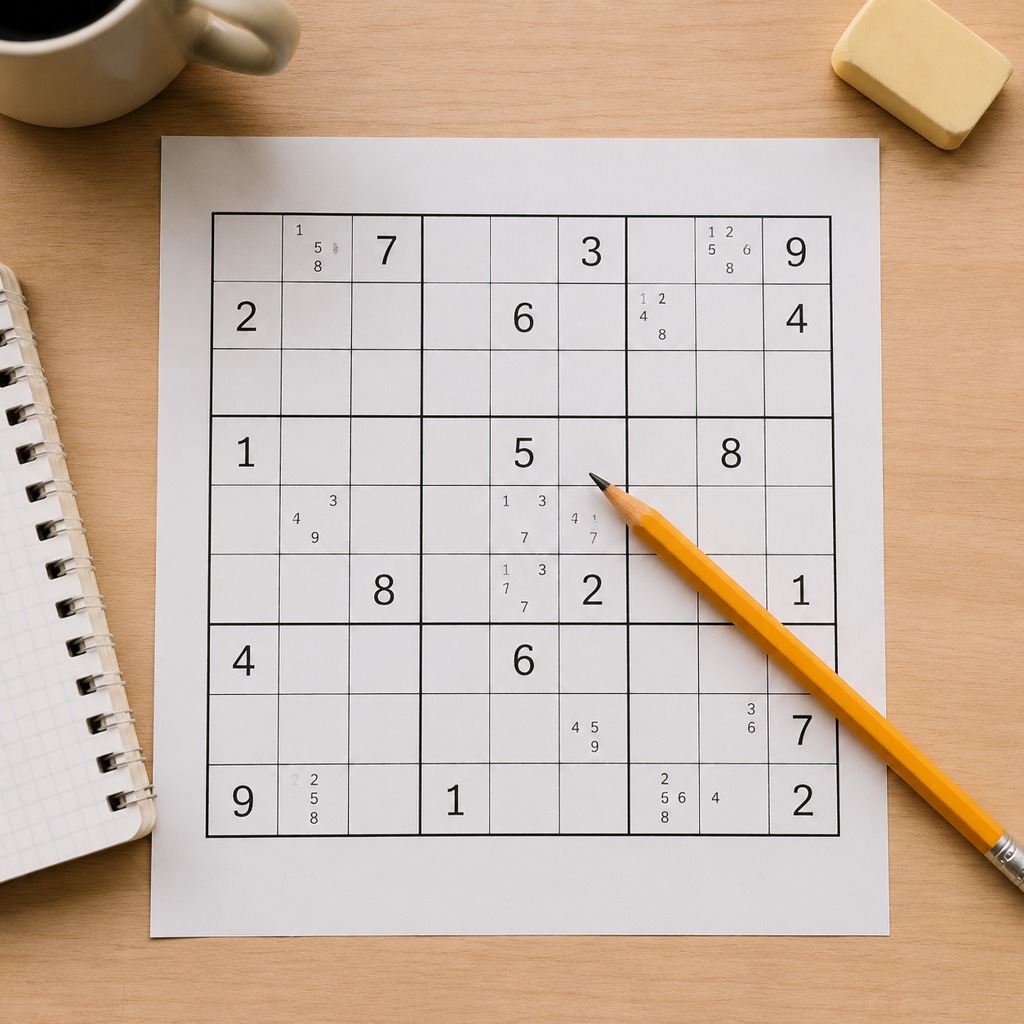
A better next grid with Sudoku 17 clues
Try this the next time you see a puzzle with a lot of blank cells. Before writing notes, read the givens like landmarks.
Which boxes have a useful spread?
Which number appears often enough to scan?
Which row or column is almost ready to speak?
That last phrase may sound a little dramatic, but it is accurate. Sudoku is quiet until a constraint starts talking. The player's job is to listen before filling the page with guesses.
Sudoku 17 clues is famous because it marks the minimum edge of a valid classic puzzle. For everyday play, its better gift is humbler. It teaches you to stop judging a grid by how empty it looks.
Seventeen givens can be enough. Thirty givens can still be trouble.
The count is only the opening scene. The solve begins when you notice where the clues are standing.