



Sudoku anti-knight rules make one familiar grid feel slightly haunted. You place a number, glance across its row, column, and box, and then remember the chessboard hiding underneath. A matching number cannot sit a knight's move away. Suddenly the quiet square two over and one down matters.
That is the charm of the variant. It does not throw away classic Sudoku. It adds one extra kind of distance.
If you already enjoy daily logic puzzles on Easy Daily Puzzle, anti-knight Sudoku is a good next step because the rule is easy to explain but surprisingly sharp in play. You can also browse more number-grid topics through Easy Daily Puzzle Sudoku articles when you want a slower warmup before trying a variant.
Sudoku anti-knight rules start with normal Sudoku
The base rule is still the one most players know: fill the grid so each row, column, and 3x3 box contains the digits 1 through 9 once. Nikoli's Sudoku page states the standard rule plainly, and that plainness is part of why Sudoku traveled so well. There is no arithmetic trick. You are not adding numbers. You are proving where each digit can live.
Sudoku anti-knight rules keep that foundation. A 7 still cannot repeat in its row. A 7 still cannot repeat in its column. A 7 still cannot repeat inside its 3x3 box.
The extra rule comes from chess. If two cells are separated by a knight's move, they cannot hold the same digit. A knight moves in an L shape: two cells in one direction and one cell sideways. Clarity Media's anti-knight Sudoku explanationh describes the same restriction: a digit cannot repeat a knight's move away from itself.
That sounds small until you try to scan a half-empty grid. In classic Sudoku, a placed digit blocks 20 visible peers: row, column, and box, with overlaps. In anti-knight Sudoku, the digit can also forbid matching digits in up to eight extra cells. Corners have fewer knight targets. Center cells have more. The middle of the board starts to feel louder.
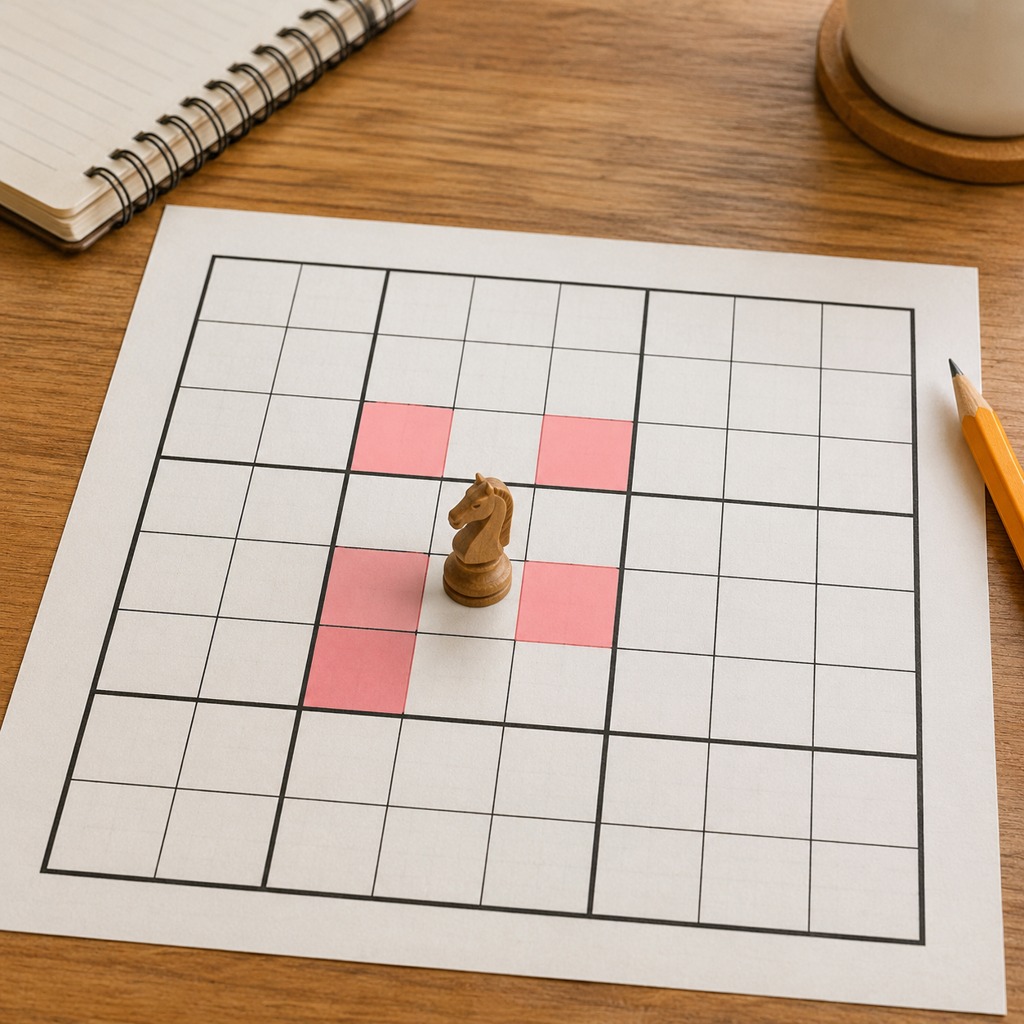
Sudoku anti-knight rules change the first scan
The first scan in a normal Sudoku often starts with the fullest row, column, or box. That still works. But Sudoku anti-knight rules reward a slightly wider glance.
Suppose a 5 sits near the center. In a classic grid, you check the row, column, and box. In anti-knight Sudoku, you also look at the cells a chess knight could reach from that 5. If one of those cells was your favorite place for another 5, it is gone. No debate. The rule has removed it.
This changes note-taking. Many casual players write candidates too early and then spend the next ten minutes cleaning tiny numbers. Anti-knight Sudoku punishes that habit because one placed digit can erase candidates that are not visually connected by row, column, or box. If you write notes before doing the knight scan, your notes become old quickly.
A better routine is simple:
1. Scan rows, columns, and boxes first.
2. Pick one digit that already appears several times.
3. For each placed copy of that digit, check its knight-move cells.
4. Only then write candidates in the most restricted area.
This routine is not flashy, but it keeps the grid breathable.
Why the center feels more dangerous
Anti-knight Sudoku has a funny geography. A corner digit may attack only two cells by knight move. An edge digit attacks fewer than a center digit. A central digit can touch as many as eight knight-distance cells.
That means the center is not just visually important. It is logically busy.
In a classic Sudoku, a middle cell already belongs to one row, one column, and one box. With Sudoku anti-knight rules, it also sends invisible warnings around the grid. If you place a number in the center too casually, you can block future positions you have not looked at yet.
This is why the variant feels different from simply making Sudoku "harder." It changes the shape of proof. A player who usually solves by box scanning may need to add a chess-like shadow scan. A player who usually starts with rows may find that a digit's best evidence sits diagonally away in an L shape.
For casual players, the practical lesson is not to memorize every possible pattern. Start with one habit: whenever you place a digit near the middle, pause and trace the knight moves from that digit before moving on.
That one pause catches a surprising number of bad assumptions.
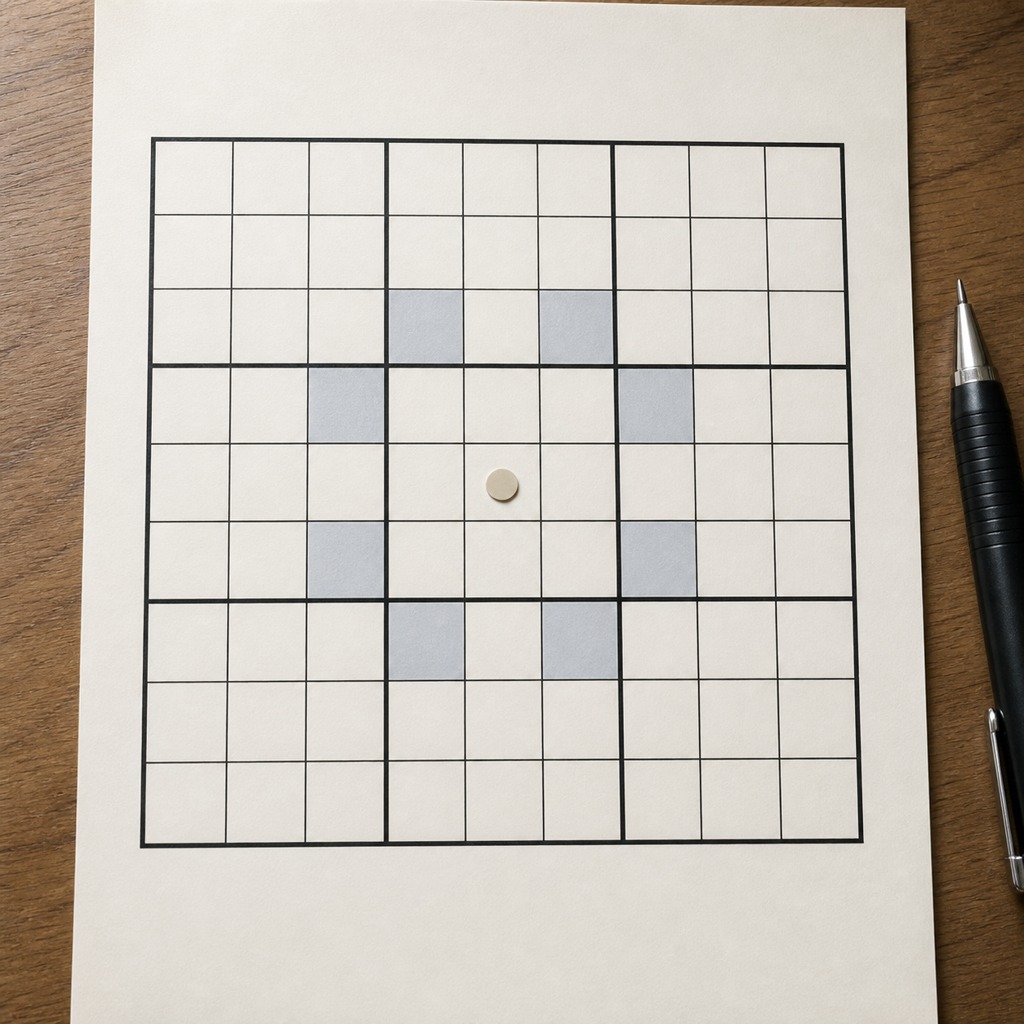
The mistake that makes anti-knight Sudoku messy
The common mistake is treating the knight rule like a decoration. A player reads it, understands it, and then goes back to solving as if the grid were normal.
The damage shows up later. A cell has two candidates. One candidate seems to fit the row, column, and box. The player writes it down. Ten moves later, that same digit is impossible because of a knight relation to a number placed earlier.
Nothing dramatic happened. The player just used the old map.
Sudoku anti-knight rules ask for a new map. Not a harder one, exactly. Just one with an extra layer.
Try this small test during a puzzle. Pick a digit that appears three or four times. Do not look for a solution yet. Instead, mark in your head where that digit cannot go because of knight moves. You may notice that a whole box has only one safe location left for that digit. That is the good kind of discovery: quiet, forced, and earned.
This is also why anti-knight puzzles can feel clean even with fewer given numbers. The extra restriction adds information. A grid may look open, but some digits are carrying more weight than they would in classic Sudoku.
How to practice without turning it into homework
Start with the digit that already has the most copies on the board. More copies mean more knight restrictions. The grid will usually give you more information from that digit than from a digit that appears once.
Then work box by box. Ask one question: where can this digit still live after row, column, box, and knight rules all speak?
Do not scan every digit forever. That turns a fun variant into paperwork. Spend one pass on the most active digit, place something if the proof is clean, and then let the new number change the next pass.
If you get stuck, look near the center. Central cells have more knight reach, so they often carry more restrictions. A center placement can remove candidates from several places at once. A corner placement is still useful, but it is quieter.
Anti-knight Sudoku also teaches restraint with guesses. A guess that looks harmless in classic Sudoku may break the chess layer. If a number is not proved by all four checks, leave it soft.
The variant is best when it feels like a new pair of glasses. The grid was always there. You are just seeing a different set of lines.
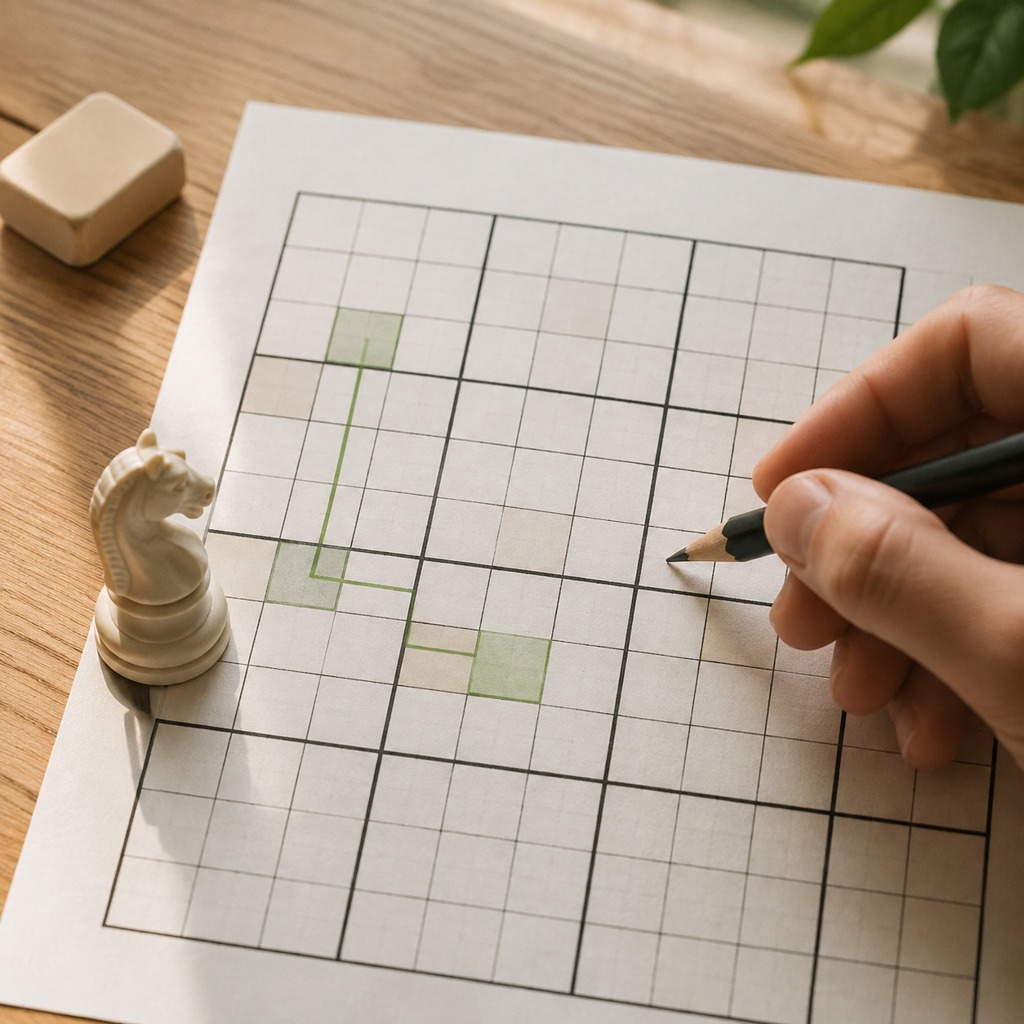
Why Sudoku anti-knight rules are worth a main-site article
Sudoku has survived because the rules are small and the situations are not. Nikoli describes Sudoku as simple to learn and rich in logic situations, which is exactly why variants work. A variant can add one rule and open a different style of thinking without asking the player to learn a new genre.
Sudoku anti-knight rules do that neatly. They borrow a chess move, but they do not turn the puzzle into chess. They make distance matter.
The next time an anti-knight grid looks empty, do not fill it with notes immediately. Place one digit in your mind, trace the L shapes, and watch a few cells disappear. The puzzle has started talking. It just uses a knight's move to do it.