



Sudoku center box pressure shows up before the puzzle feels hard. You open a fresh grid, your eyes jump around for singles, and the center sits there like a quiet intersection. It is easy to ignore because it rarely looks dramatic.
That is the mistake.
The center 3x3 box touches the middle row band, the middle column band, and four neighboring boxes. One number placed there can make the rest of the grid feel less random. One missing number there can explain why two other areas refuse to move.
Classic Sudoku rules are simple. [Nikoli's Sudoku page](https://www.nikoli.co.jp/en/puzzles/sudoku/) gives the clean version: place 1 through 9 so every row, column, and 3x3 block contains all nine digits. The center box follows the same rule as every other box, but it often gives a better first scan because it sits in the path of so many visual lines.
If you want to test the habit, open a puzzle on [Easy Daily Puzzle](https://easydailypuzzle.com/) and spend the first minute looking only at the middle before writing a single note.
Sudoku center box pressure starts with the crossing lines
The center box is not special because the rules change. It is special because your eyes can use it as a crossing point.
Look at the center 3x3 box. Then look across the middle row and down the middle column. Those two lines cut through the whole grid. If a digit already appears in the center row, it cannot appear again in that row. If it appears in the center column, the same restriction applies there. If the digit appears inside the center box, the box has already spent that number.
That sounds obvious until you slow down and actually scan it.
Many casual players begin by checking random empty cells. They ask, "What can go here?" The center-first habit asks a cleaner question: "Which numbers already put pressure on the middle?"
Start with one digit, not all nine.
Choose a number that appears two or three times around the center. Trace it through the middle row, the middle column, and the center box. You may not solve anything immediately, but you will usually find a cleaner route into the grid.
Sudoku center box pressure is mostly about reducing noise. The middle area gives you a place to begin before the whole board starts shouting.
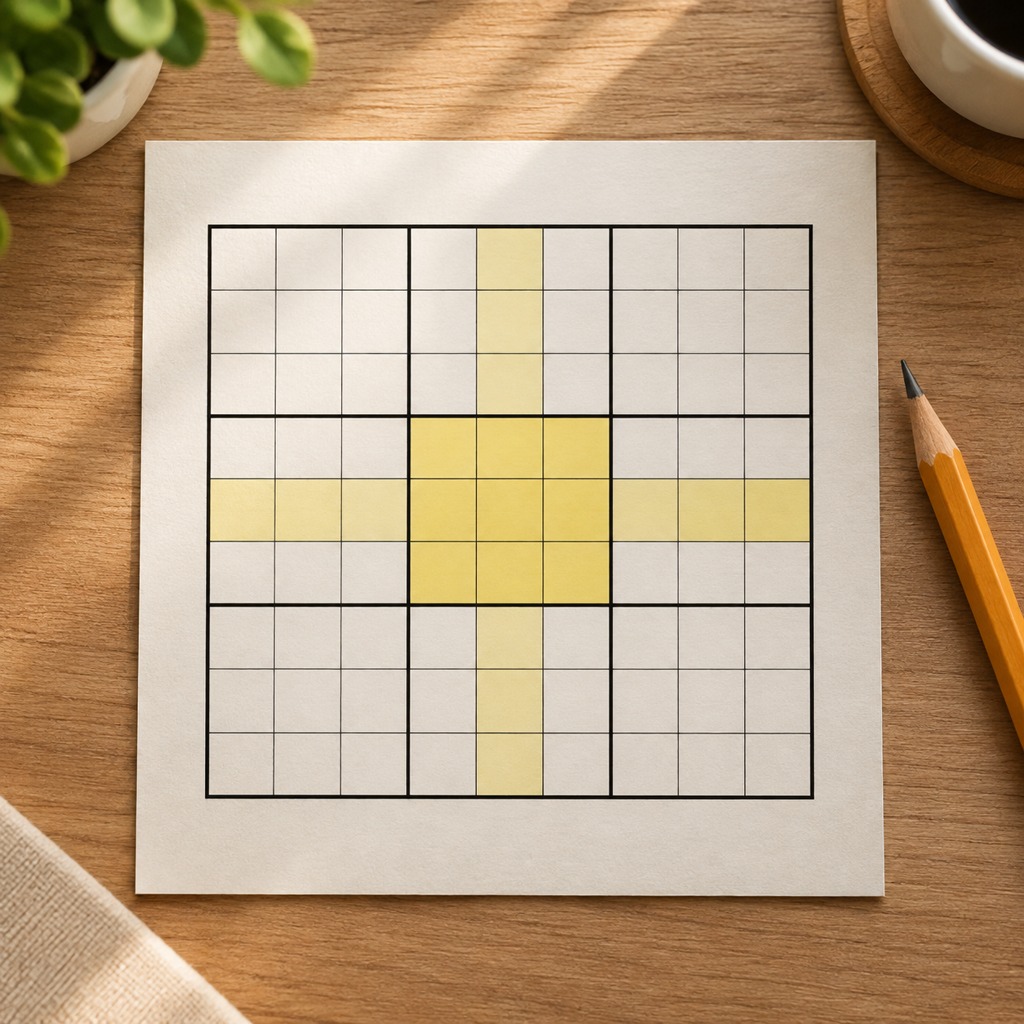
Why the center is easy to misread
The center box tricks people because it does not have an edge.
Corners feel safe. Top-left, top-right, bottom-left, bottom-right. Your eyes can hold those shapes quickly. Edges also feel simple because they sit against the border of the grid. The center has no border help. It is surrounded.
That makes it feel busier than it is.
When a player rushes, the center becomes a blur of empty cells and crossing lines. The natural reaction is to skip it and look for easier boxes. That is fine for a few seconds, but skipping the center forever can make the puzzle harder than it needs to be.
The center box often tells you which digits have already traveled across the grid. If 5 is in the upper middle area and another 5 is in the lower middle area, the center may have only a few safe places left for that digit. If 8 is missing from the middle row but boxed out by neighboring regions, the center scan may point to the next useful check.
The puzzle may still need work. This is not magic.
But it is a better first look than clicking through cells and hoping one of them gives you a number.
Use the center box before pencil marks
Pencil marks are useful. They are also noisy.
If you write every possible candidate too early, the center of the grid can turn into a tiny-number swamp. Suddenly the useful shape disappears under notation. Before that happens, give the center one clean visual pass.
Try this routine.
First, read the givens inside the center box. Say the missing numbers in your head. Do not write them yet.
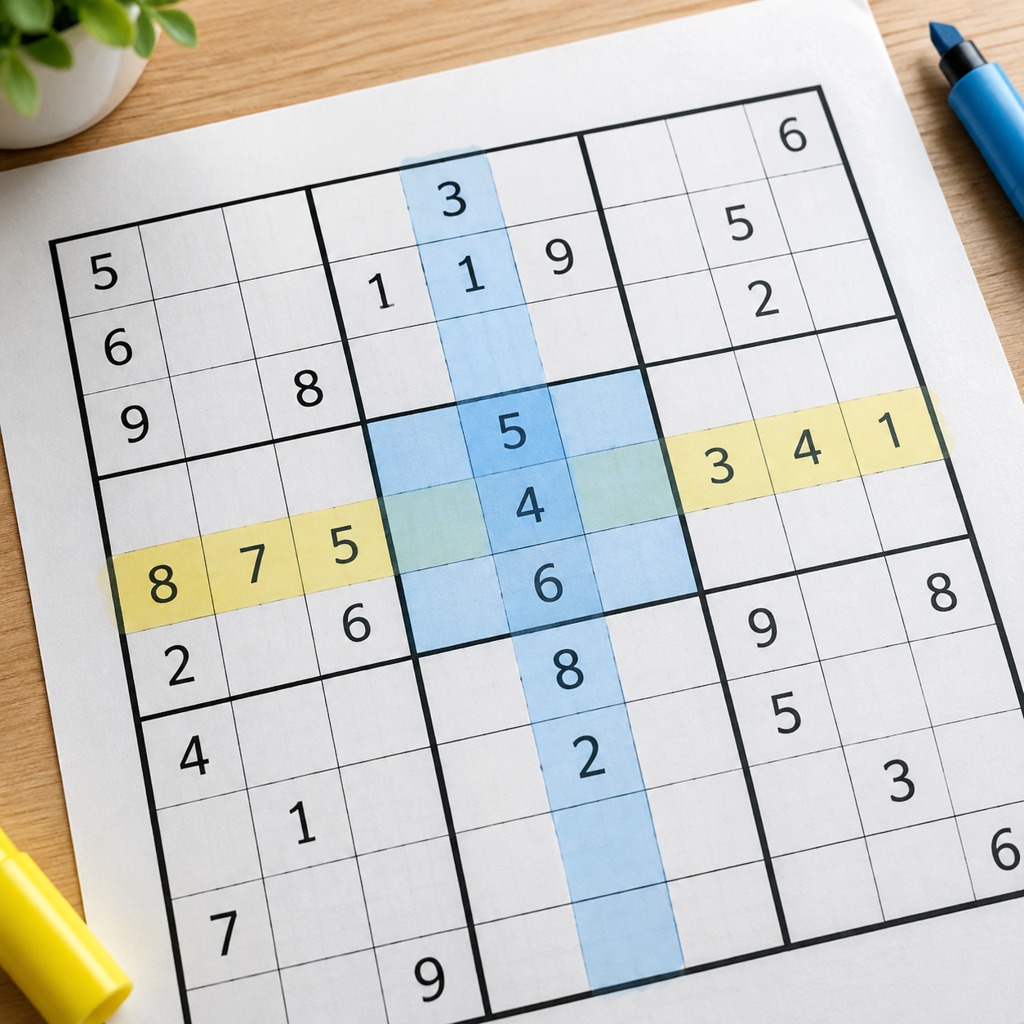
Second, scan the middle row from left to right. Notice which digits are already present. Then scan the middle column from top to bottom.
Third, pick one missing center-box digit and check the neighboring boxes that share its row band or column band.
Fourth, stop if you cannot prove anything. A failed scan is still useful because it keeps you from inventing an answer.
This works well because Sudoku is a game of proof, not personality. [Wikipedia's Sudoku overview](https://en.wikipedia.org/wiki/Sudoku) traces the puzzle through several historical and mathematical angles, but the daily solving experience is still simple: every number has to survive its row, column, and box.
The center scan is just a disciplined way to ask those three questions in one place.
What the middle tells a casual player
The center is a good early warning system.
If the center box has many givens, the puzzle may offer an obvious route through the middle. You can use those givens to test the middle row and column quickly.
If the center box is sparse, the grid may ask for patience. Do not punish yourself by filling it with notes immediately. Look at the surrounding four side boxes first. Sometimes the pressure comes from outside the center, not inside it.
If the center row or center column is nearly full, pause there. A row or column with six or seven numbers can often tell you more than a nearly empty box. This is where many solvers find a hidden single without calling it that.
If the center is crowded with tempting candidates, check whether one digit is trapped in a single line inside a neighboring box. That can create a locked-candidate style cleanup later.
The point is not to worship the middle of the grid. The point is to use it as a meeting place.
The grid has nine boxes, nine rows, and nine columns. The center lets several of those structures overlap in your field of view.
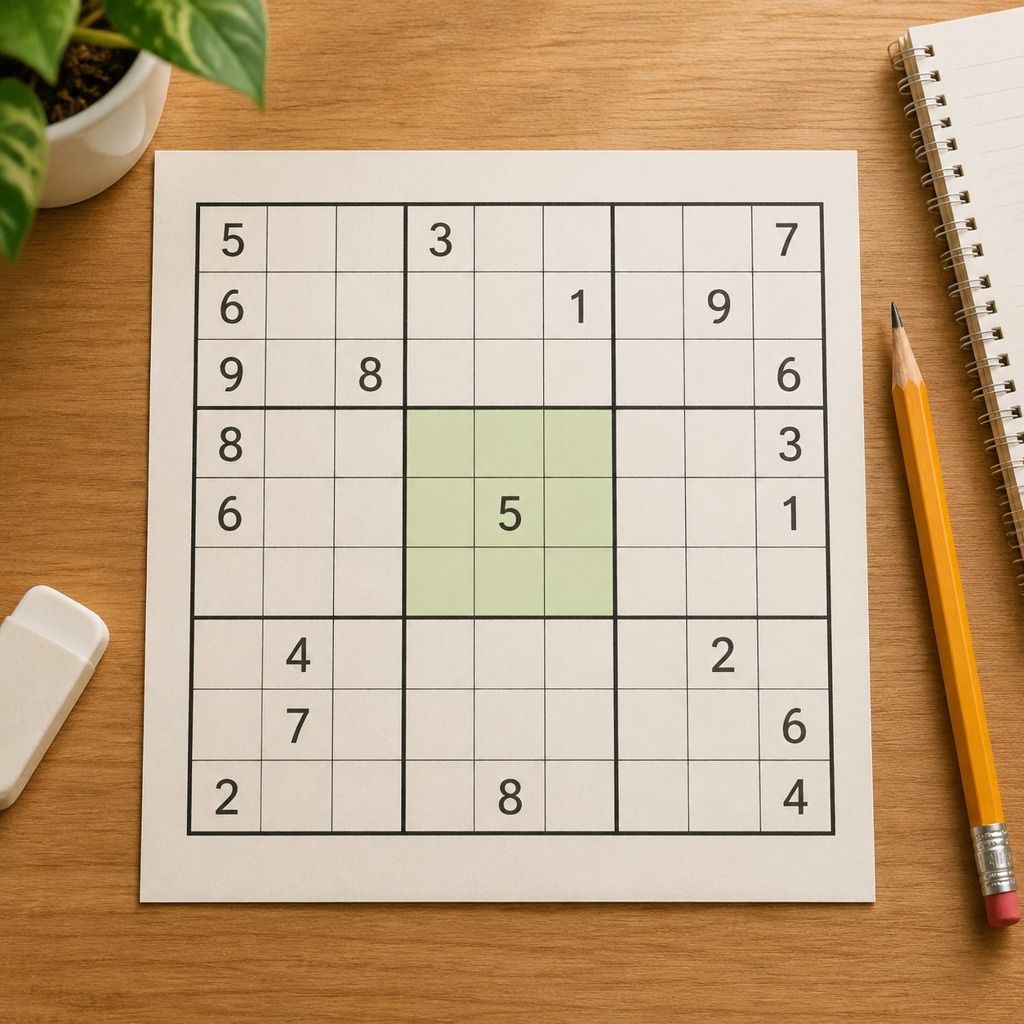
A 90-second center scan
Here is a practical drill for your next Sudoku.
Set a quiet 90-second limit. During that time, do not write pencil marks.
Look at the center box and list the missing digits.
Pick the digit that appears most often near the center.
Trace that digit through the middle row.
Trace it through the middle column.
Check whether the center box has only one possible place for it.
If not, move to the next missing digit.
This small drill trains your eye to scan by relationships instead of by panic. It also keeps the opening minute from becoming a guessing session.
After the drill, move normally. Fill singles if they are proved. Add notes if the board needs them. Skip the center if it has nothing more to say.
That last part matters. A good scan is not stubborn. If the middle stays quiet, go elsewhere.
Why this small habit keeps Sudoku readable
Sudoku center box pressure gives you one place to begin, and that is often enough.
Many Sudoku mistakes start in the first few minutes. A player writes too many notes, trusts one pattern too soon, or places a number because it feels likely. The center scan slows that down without making the puzzle feel like homework.
It gives your eyes a route: center box, middle row, middle column, neighboring boxes, then back out to the whole grid.
That route is small enough to remember. It is also flexible enough to use on easy puzzles, medium puzzles, and harder grids where the first obvious singles disappear quickly.
For more daily puzzle practice, browse [the Easy Daily Puzzle game library](https://easydailypuzzle.com/) or search for [more Sudoku articles on Easy Daily Puzzle](https://easydailypuzzle.com/?s=sudoku). Try one grid with the center-first scan and one without it. The difference is not always a solved number. Sometimes the reward is simpler: the grid stops looking like a wall and starts looking like a set of connected rooms.