



Solitaire first tableau read is the small pause most players skip. The cards appear, one or two obvious moves call for attention, and the hand moves before the eyes have really looked.
That first move can be harmless. It can also bury the best line of play.
In Klondike Solitaire, the opening tableau is not just seven piles. It is a map of blocked information. Some piles are shallow. Some are buried under face-down cards. Some face-up cards can move immediately, while others are valuable because they are sitting on top of hidden information.
[Bicycle's Solitaire rules](https://bicyclecards.com/how-to-play/solitaire) describe the tableau as seven piles that make up the main table. The same rules also show why uncovering face-down cards matters: once a blocking card moves away, the hidden card underneath can turn over and enter play.
That is the reason to pause.
Before you move the first red 7 onto a black 8, give the table one honest read. You can practice the habit on [Easy Daily Puzzle](https://easydailypuzzle.com/) by playing one deal where the first 30 seconds are for looking only.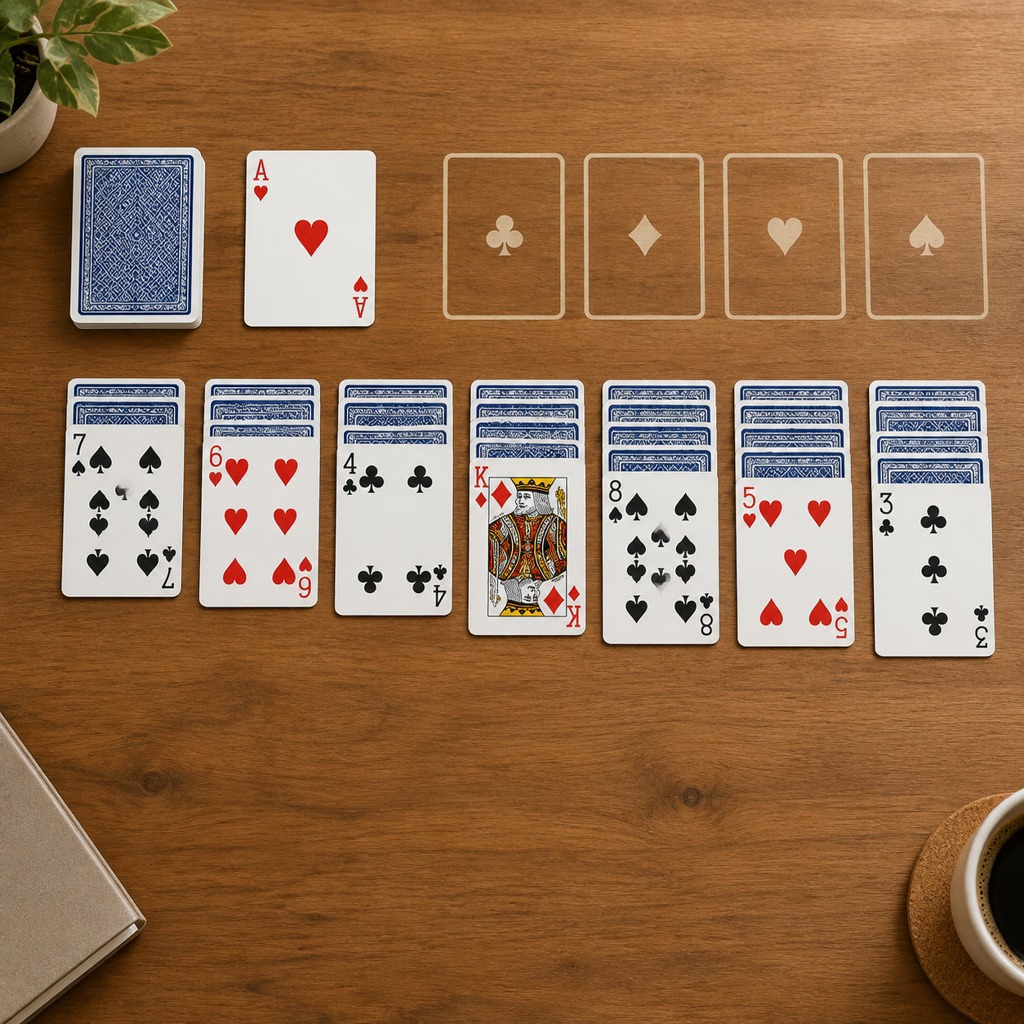
Solitaire first tableau read starts with the buried cards
The face-up cards are loud. The buried cards are where the game is hiding.
At the start of a standard Klondike deal, the first tableau pile has one face-up card. The last pile has one face-up card sitting above six face-down cards. That deep pile is not just bigger. It contains more unknown information.
So the first question should not be, "What legal move do I have?"
Ask, "Which move reveals the most useful hidden card?"
A legal move that uncovers a face-down card is usually more valuable than a legal move that only tidies the surface. Moving a 6 onto a 7 may look satisfying, but if it does not reveal anything, it may not be urgent. Moving a card away from a deep pile may be better because it gives you new information.
This is why the Solitaire first tableau read works. It turns the opening from a reflex into a short inspection.
You are not trying to solve the whole deal from the start. You are deciding which pile deserves attention first.
Count depth before counting moves
Most new players count possible moves. Stronger players count covered cards.
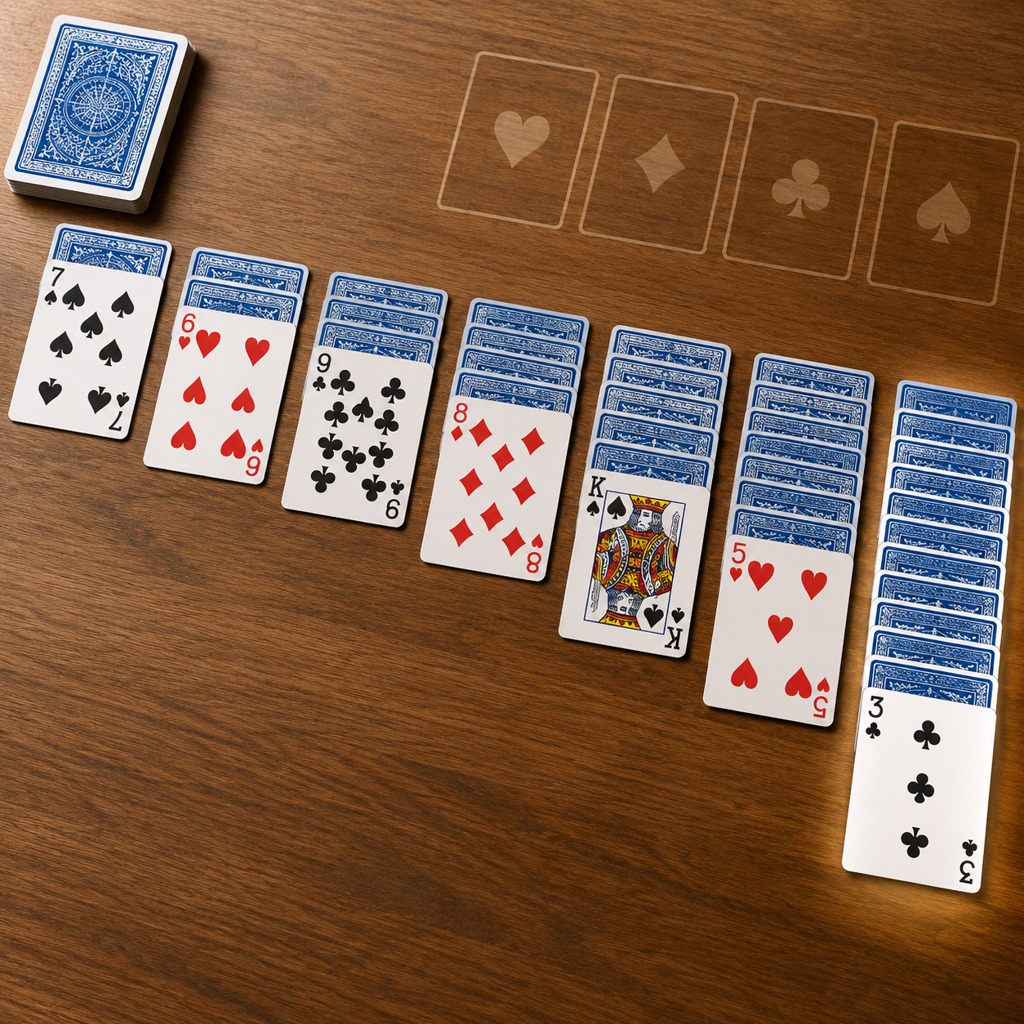
Look across the seven tableau piles before touching anything. Which pile is deepest? Which pile has only one covered card? Which face-up card is blocking the most unknown cards?
Depth changes urgency.
If a king sits over one face-down card, moving it may help, but the reward is small. If a 9 sits over five face-down cards and can move to a 10, that move may unlock far more of the game.
This does not mean every deep-pile move is correct. Sometimes the move breaks a useful sequence or spends a card you need elsewhere. But depth should be part of the opening read.
Think of each face-down card as a closed door. The first few moves should open doors, not rearrange furniture.
That phrase is a little blunt, but it helps.
Solitaire gives you many moves that make the table look cleaner. Clean is not the same as better.
Check aces without rushing every low card
When an ace appears early, move it to the foundation. That is standard play, and Bicycle's rules explain that foundations build up by suit from ace through king.
The harder question is what to do with the 2s, 3s, and 4s that follow.
A low card may be safe to send up. It may also be useful in the tableau for one more move. If a red 3 can sit under a black 4 and help uncover a buried card, sending it to the foundation too soon may cost you a reveal.
The Solitaire first tableau read should include low cards, but not as an automatic elevator.
Ask what the low card is doing right now.
Is it blocking a face-down card?
Does it help move another card?
Does putting it on the foundation open a pile?
Will it still be available later if you wait?
The answer changes from deal to deal. That is part of the appeal. Solitaire looks repetitive from a distance, but the opening tableau often asks a different timing question every time.
Read color lanes before building
Klondike building depends on descending rank and alternating colors. That makes the first visible red and black cards more important than they seem.
Before moving anything, look for lanes.
Do you have a black 10 and a red 9? A red queen and a black jack? A black 6 and a red 5?
These small pairs tell you where movement can happen. They also reveal which colors are missing. If you have several red cards waiting but no useful black card above them, you may need the stock sooner. If you have a clean alternating sequence available, you may be able to open a face-down card without touching the stock at all.
The opening read is not about memorizing every card.
It is about noticing whether the table already has a path.
Some deals begin with a generous path. Others begin with a blocked surface and force you into the stock quickly. The problem is that both can look similar if you start clicking immediately.
Take the few seconds.
Do not treat the stock as the first answer
The stock pile is tempting because it promises a new card. New cards feel like progress.
Sometimes they are.
But the stock can also distract you from a reveal that was already sitting in the tableau. If you flip the stock too early, you add another visible option before you have understood the old ones.
Use a simple rule for the first pass: check every tableau reveal before turning the stock.
That means scanning each legal move and asking whether it opens a face-down card. If the answer is yes, test that move mentally first. If no tableau move reveals anything useful, then the stock has a stronger claim.
This is especially helpful in draw-three games, where the waste pile order becomes its own puzzle. Once you start cycling, memory matters. The more you understand the tableau first, the easier it is to judge whether the stock card is actually helpful.
For more card-game practice and puzzle breaks, you can browse [Easy Daily Puzzle games](https://easydailypuzzle.com/) or look for [Solitaire articles on Easy Daily Puzzle](https://easydailypuzzle.com/?s=solitaire).
The first empty space deserves a second look
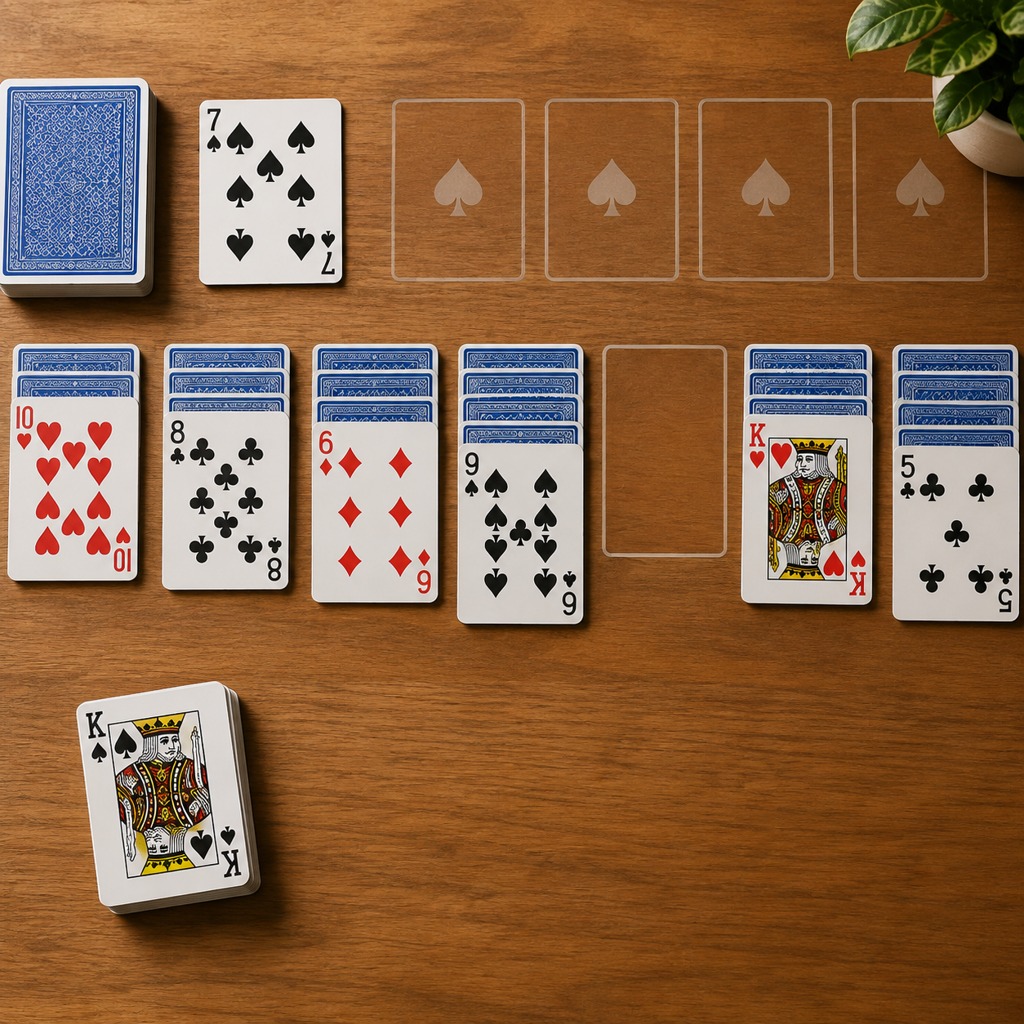
An empty tableau space is powerful because only a king can fill it in standard Klondike play.
That does not mean the first king should always move there.
Bicycle's rules note that a vacancy, or space, can only be filled with a king. The practical question is whether that king earns the space.
Before filling an empty lane, ask what the king opens.
Does the king move away from a pile with hidden cards?
Does the move let a queen-jack sequence follow?
Does it free another card that was stuck?
Or does it simply place a king into the only open lane because the game allowed it?
The difference matters. A king can create movement, but it can also clog the table. Once the king sits in that space, every card above it must build downward. If the king stack is weak, the empty lane may stop being useful.
This is where the first tableau read pays off later. If you noticed the buried-card depth at the start, you are less likely to waste the first space.
A 30-second opening routine
Try this before your next deal.
First, scan the deepest piles. Mark the piles with the most hidden cards in your mind.
Second, look for any move that reveals a face-down card.
Third, check aces and low cards, but ask whether a low card still has tableau work to do.
Fourth, read the alternating color lanes. Notice whether red or black is missing in the ranks you need.
Fifth, wait on the stock until the tableau has had a fair look.
That routine sounds slower than it feels. After a few games, it becomes one glance.
The point is not to make Solitaire serious. The point is to stop losing information in the opening seconds.
David Parlett's history of [patience and solitaire](https://www.parlettgames.uk/histocs/patience.html) is a useful reminder that these games have always been about arrangement under limits. You do not need a tournament clock for that to matter. A quiet card table and a browser screen ask the same question: what can you uncover before you run out of room?
Why this makes Solitaire feel less random
Solitaire will always have luck. Some deals are friendly. Some deals are stiff from the first flip.
A Solitaire first tableau read does not remove luck. It helps you spend your choices better.
Instead of chasing the first legal move, you learn to read the opening shape: buried depth, reveal chances, low-card timing, color lanes, stock need, and empty-space value.
That is enough to change the feel of a game.
The first move becomes less automatic. The stock becomes less tempting. The foundation becomes a goal, not a drain for cards you still need below.
Next time the cards land, pause before the first move. Look across the seven piles like you are reading a small map. The best opening is often already visible. It just does not wave.
Supporting image idea: a clean top-down Klondike layout before the first move, with seven tableau piles visible and the deepest pile subtly emphasized.