



Sudoku competition clock pressure changes the puzzle before the first number is written. The grid is still quiet. The rules are still familiar. But a timer makes every hesitation feel louder.
Most casual players will never sit in a championship hall, and that is perfectly fine. The useful part is not the trophy table. It is the way strong solvers protect their attention when time starts squeezing the room. If you play Sudoku on Easy Daily Puzzle , a little tournament thinking can make your daily grid feel sharper without turning it into homework.
Sudoku competition clock habits start before the puzzle
The World Puzzle Federation runs official Sudoku and puzzle events, including the annual Sudoku Grand Prix. Its 2026 Grand Prix schedule lists rounds hosted by teams from countries such as Turkiye, Slovakia, Thailand, Switzerland, Ukraine, Czechia, Hungary, and France. That international setup is a reminder that Sudoku is not only a newspaper pastime. It is also a timed mental sport with formats, rankings, and national puzzle communities.
At the World Sudoku Championship, competitors solve under strict time limits, often across multiple puzzle types. The championship has been held alongside the World Puzzle Championship since 2011, and the World Sudoku Championship record shows how global the field has become, with recent winners from countries including China, Japan, and the Czech Republic.
That sounds intense. For a daily player, the useful lesson is smaller: good solving begins before speed begins.
Competition solvers do not simply rush. They enter the grid with a plan. They know what they will scan first. They know when a puzzle is eating too much time. They know that panic makes the hand move faster while the brain sees less.
You can borrow that without ever timing yourself seriously.
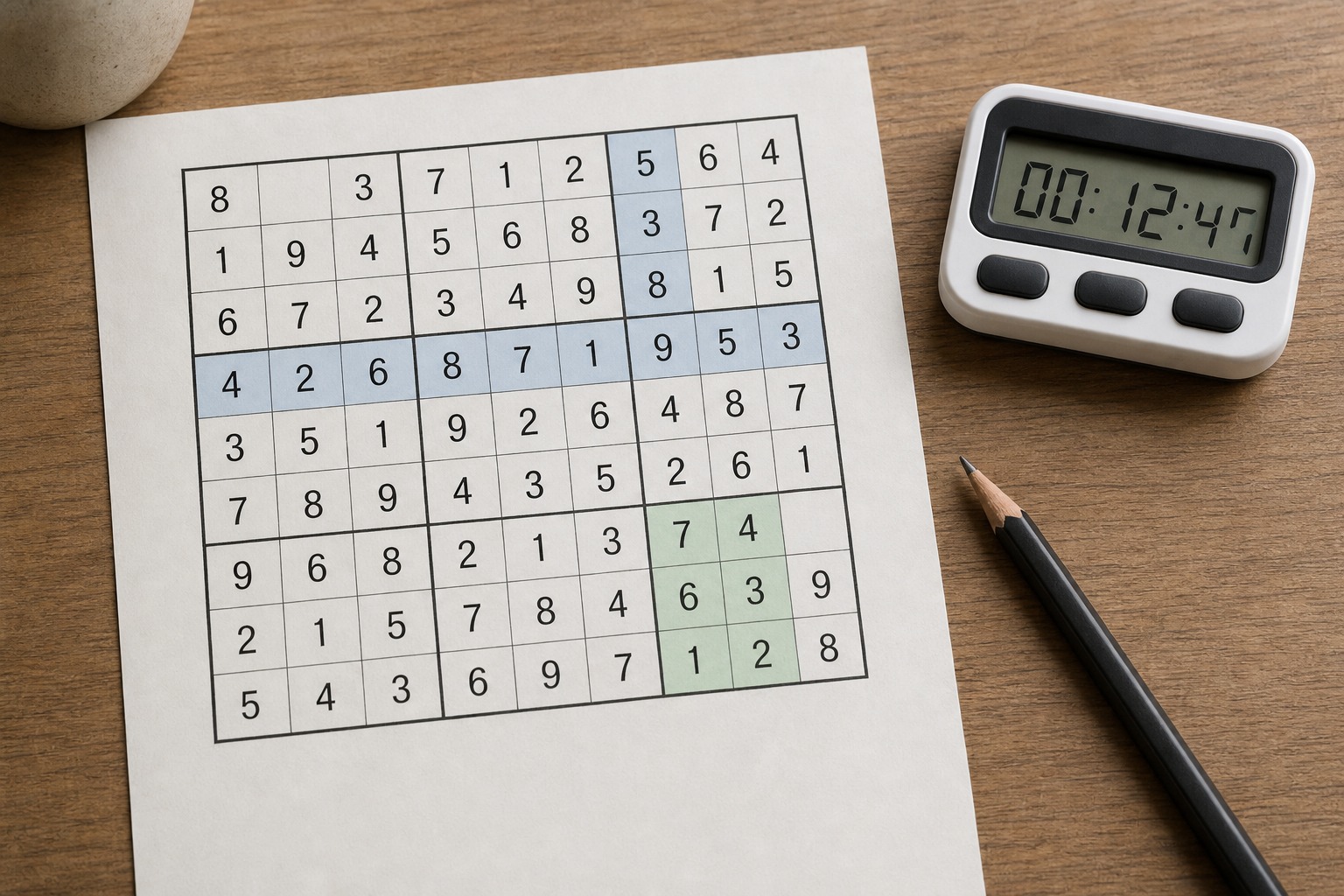
The 90-second opening scan
Before writing notes, give the grid a short scan. Ninety seconds is enough.
Look at rows with many given numbers. Look at boxes that already contain five or six digits. Look for digits that appear often across the whole grid. If 7 already appears in several places, scan where the remaining 7s can fit. If a center box is nearly complete, let that box lead.
This is not about solving the whole puzzle in the opening. It is about collecting the easy truth before filling the grid with noise.
Many casual players start notes too early. Notes can help, but they can also bury simple observations under tiny numbers. A sudoku competition clock punishes that habit quickly. If you spend the first minute writing every candidate, you may miss the obvious single that was waiting in the top row.
A better opening rhythm is:
Scan first.
Place any clear singles.
Only then write notes where they will actually reduce confusion.
That one change makes the puzzle feel cleaner.
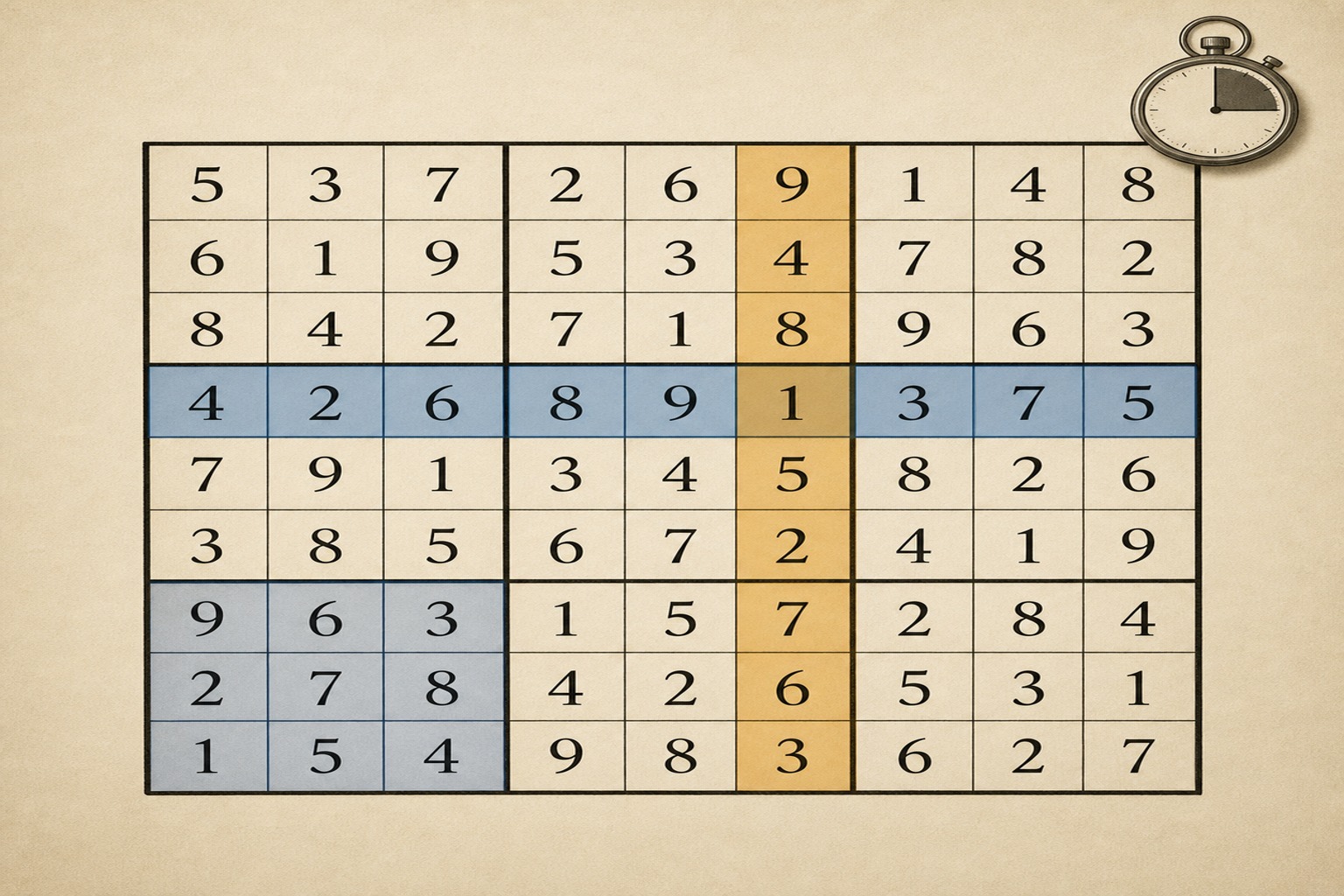
Skip faster, come back calmer
The biggest skill a timer teaches is not speed. It is leaving a stuck spot alone.
In casual solving, players often keep staring at the same box because it feels close. One missing number seems almost visible. The mind becomes stubborn. Five minutes disappear.
Tournament solvers learn that a stuck area is expensive. If a row is not giving you anything, move. If a pair is interesting but not ready, mark it and leave. If a corner feels messy, jump to another part of the grid.
This habit is useful even when there is no timer. Sudoku rewards rotation. A fact found in the lower right corner may unlock the row you abandoned at the top. The puzzle changes while you are away from it.
Try this rule: if you cannot explain your next move in one sentence, switch areas.
Not "I feel like something is here."
Use a real sentence: "This box needs 2, 5, and 8, and only this cell can take 5."
If you cannot say that, your next move may be guesswork. Move on.
The timer should make you honest, not frantic
A sudoku competition clock can be used gently. Set a five-minute timer for the first pass, not for the whole puzzle. When it ends, ask what you learned.
Did you find the easiest boxes?
Did you waste time on a pretty but useless pattern?
Did you write too many candidates?
Did one digit create most of the progress?
This makes the timer a mirror instead of a threat. You are not trying to prove you are fast. You are learning where your attention leaks.
For a daily puzzle routine, that matters more than finishing time. A player who notices their habits will improve naturally. A player who only chases the clock may become tense and sloppy.
How competition puzzles change the way you read variants
The World Sudoku Championship includes more than plain classic grids. Competitors often face variants that bend the familiar 9x9 rules with extra constraints. That is another lesson for casual players: the first job is always to understand the rules before trying to be clever.
Killer Sudoku, diagonal Sudoku, irregular regions, thermo lines, odd-even shading, and other variants all reward a calm rule check. Ask:
What is still normal Sudoku?
What extra rule creates the strongest restriction?
Where does that extra rule interact with rows, columns, or boxes?
That question keeps a strange puzzle from feeling like a wall. A variant is not random decoration. It is a normal Sudoku grid with one extra source of information.
If you want to explore more Sudoku formats, the Sudoku articles on Easy Daily Puzzle are a good place to keep moving between rules, habits, and quick play.
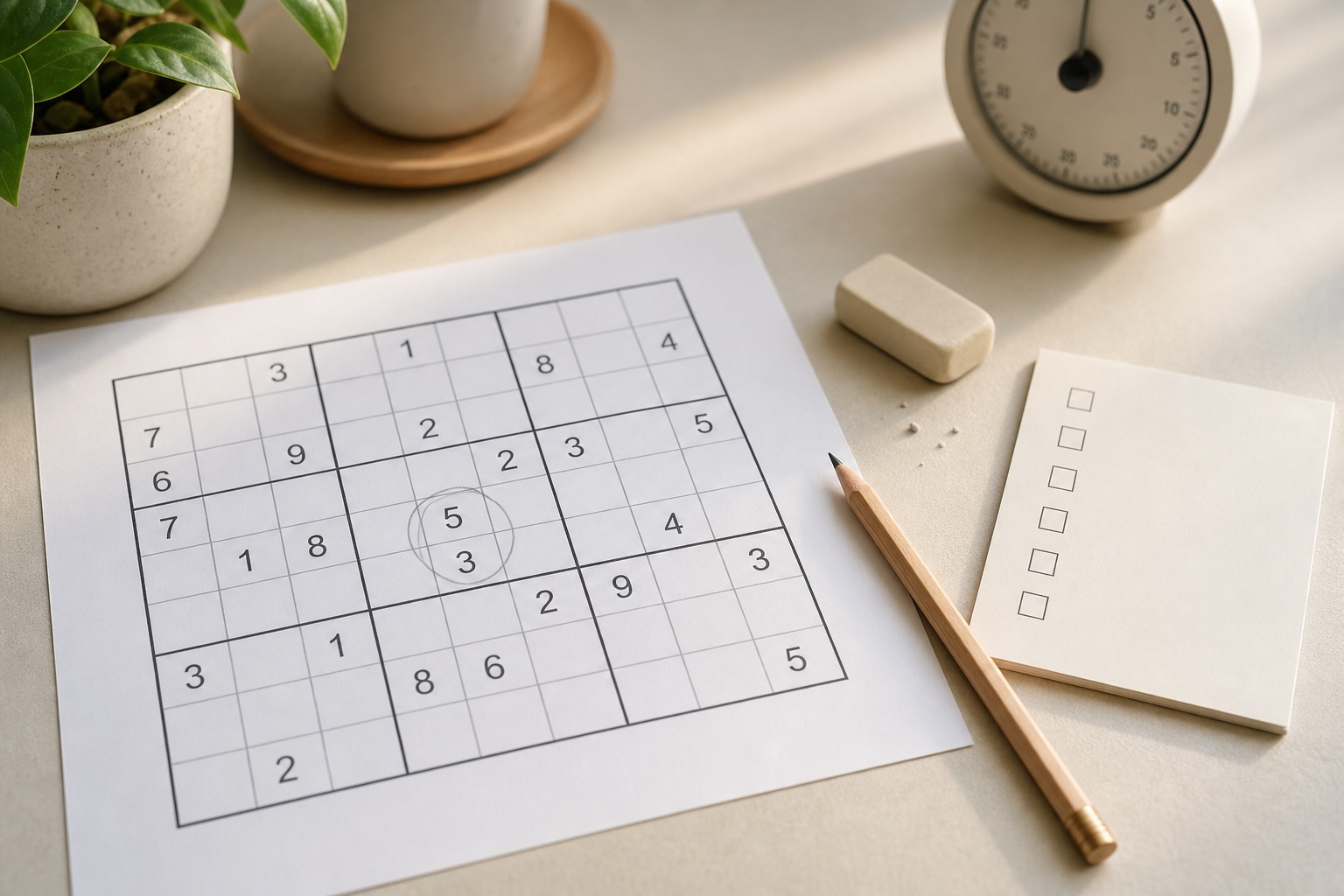
A casual version of the championship mindset
You do not need a scoreboard. Use the championship mindset like a small toolkit.
Start with a short scan.
Write fewer notes at the beginning.
Leave stuck areas sooner.
Return after another part of the grid has changed.
Treat mistakes as information, not drama.
The last point matters. Under pressure, one wrong digit can poison a grid. Strong players recover by checking structure, not by blaming themselves. Where did the contradiction appear? Which assumption created it? What can be rolled back?
That is a better habit for everyday play too. A Sudoku grid is not judging you. It is showing you the cost of each assumption.
Why this makes daily Sudoku more fun
The quiet joy of Sudoku is control. Each number reduces the fog a little. Timed solving can ruin that if it becomes pure pressure, but a light version of the sudoku competition clock does the opposite. It gives the puzzle a pulse.
Five minutes for the first scan.
One minute to review notes.
Thirty seconds to decide whether a stuck area deserves more time.
These tiny limits stop the mind from circling. They turn solving into a sequence of clean decisions.
The funny thing is that you may get faster when you stop trying to rush. You see more because you panic less. You skip better because you trust the grid to change. You write fewer notes because you let simple logic speak first.
That is what speed solvers can teach the rest of us. The clock is not there to make the puzzle less peaceful. Used well, it protects the peace by keeping your attention honest.