



Sudoku hidden singles often appear before a puzzle looks difficult. The grid is still half open, your pencil is hovering over the notes button, and one number is already waiting in plain sight. It is not obvious because the cell may still seem to have several possible answers. The trick is that the number has only one legal home in its row, column, or box.
That is the small move this article is about.
Nikoli's official Sudoku rules are short: place 1 to 9 in empty cells, and make sure each row, column, and 3x3 block contains all numbers from 1 to 9. That simplicity is why Sudoku travels so well. It also explains why a hidden single is so useful. You are not guessing. You are asking one narrow question: where can this one number still go?
If you want a fresh grid after reading, you can start from the Easy Daily Puzzle home page or browse more Sudoku practice ideas on Easy Daily Puzzle.
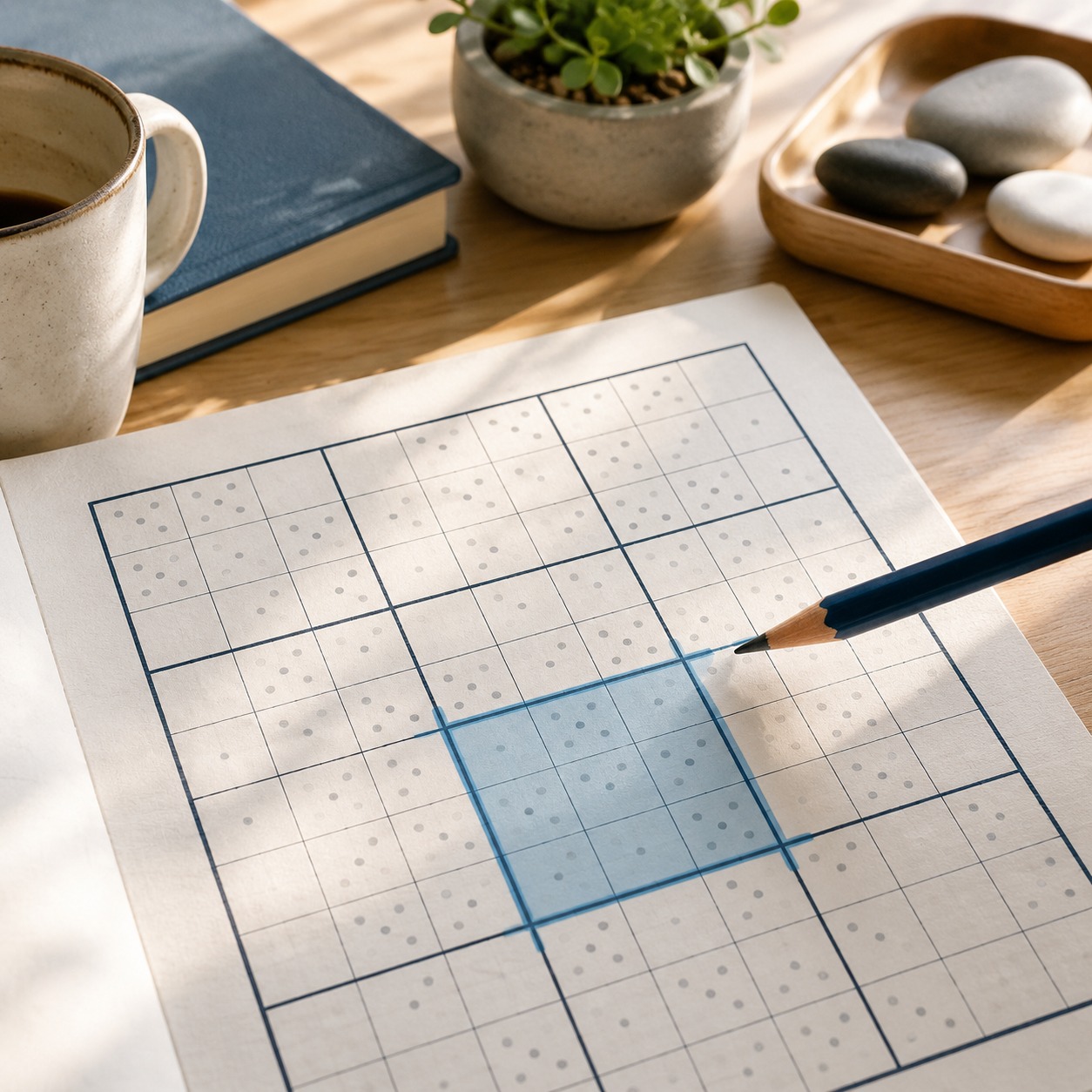
Sudoku hidden singles start with one house
A "house" in Sudoku means a row, a column, or a 3x3 box. Most beginners scan cells first. They look at one empty square and ask, "What can go here?" That is useful later, but it can be noisy early in the puzzle.
Sudoku hidden singles ask the question from the other direction.
Pick one house. Maybe the top-left 3x3 box. Then pick one missing number, such as 7. Now look across the row lines and column lines that touch that box. If every empty square is blocked except one, that last square must take the 7. The cell might also allow 2, 4, and 9 if you look only at its candidates. The 7 is "hidden" because the cell itself does not look forced. The house makes it forced.
Conceptis uses the same idea in its Sudoku technique explanations: after the blocked positions are removed, one square remains for the digit. That is the whole move. It feels advanced the first time you see it, then surprisingly ordinary once your eyes learn the pattern.
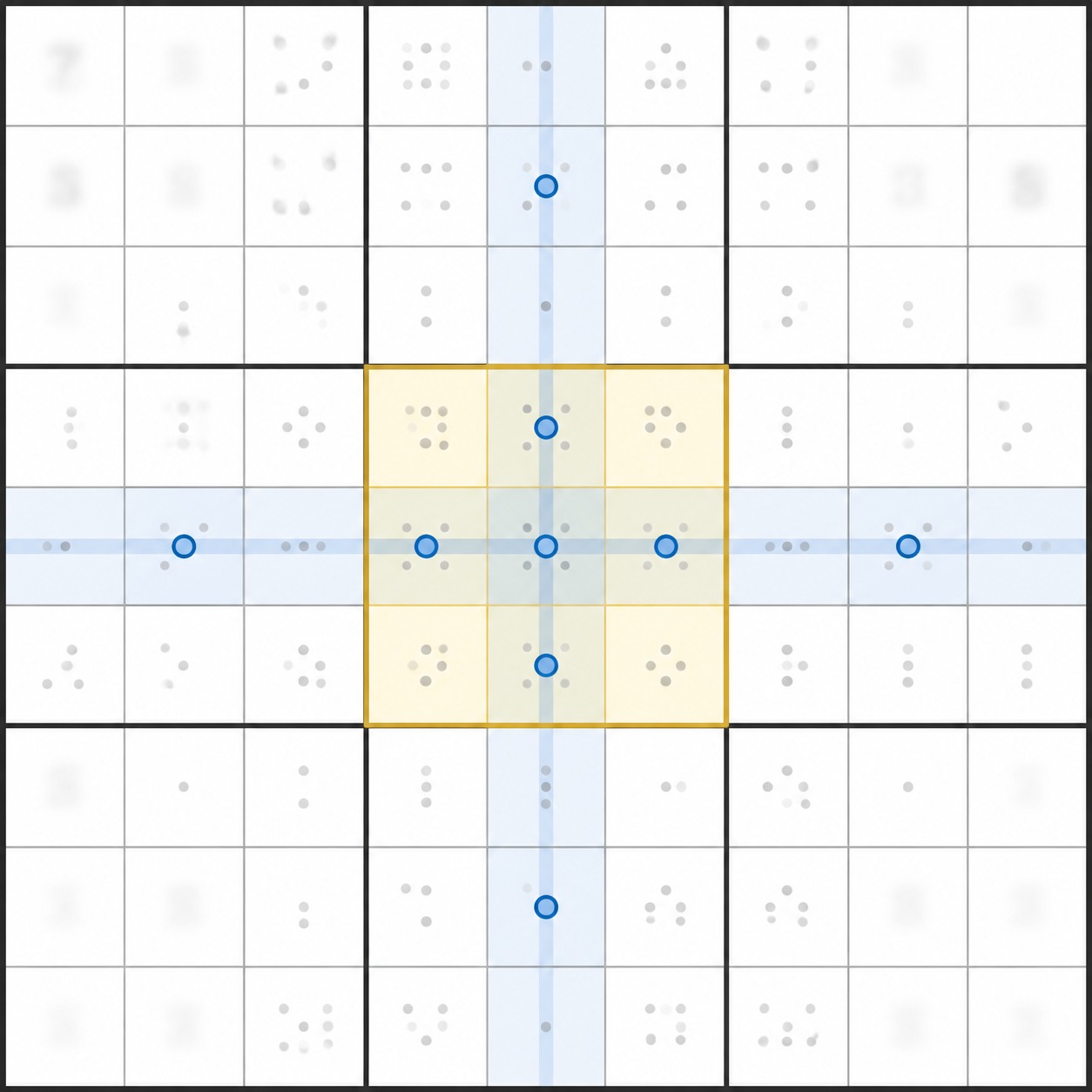
Why Sudoku hidden singles feel invisible
Hidden singles are easy to miss because they are not loud. A naked single shouts. If a cell can only be 5, the answer is sitting there like a coin on the table. A hidden single whispers from the group.
This is why many casual solvers make the same mistake. They reach for full notes too soon. They fill candidates into 30 empty cells, then spend the next ten minutes reading tiny numbers instead of reading the board.
Notes are not bad. They are just expensive. Every note you add becomes something you have to maintain. If you place a number and forget to clean the notes around it, the grid starts lying to you. Before that happens, hidden singles give you a cleaner first pass.
The best time to hunt for Sudoku hidden singles is usually after you have placed the obvious numbers but before you commit to a heavy note system. At that moment, the grid has enough information to talk back. Rows and boxes are partly shaped. Repeated digits start building walls. A number that looked free a minute ago may now have only one legal square.
A simple scan for Sudoku hidden singles
Try this routine on your next puzzle. It takes about 90 seconds, and it works best if you do it calmly rather than quickly.
First, scan the boxes with the most filled cells. A box with six or seven numbers already placed is a good hunting ground. List the missing numbers in your head. Do not write all of them down yet.
Second, take one missing number and check the rows and columns crossing the empty spaces. If a row already has that number, every empty cell in that row segment is blocked. If a column already has it, that column is blocked too.
Third, look for the last legal square. If only one empty cell in the house can hold the number, place it. If two or more cells remain possible, leave it alone and move to the next missing number.
That last instruction matters. A hidden single is a proof, not a hunch. If the number has two legal homes, you have found useful pressure but not an answer.
Here is the rhythm in plain language:
1. Choose a row, column, or box with plenty of filled cells.
2. Choose one missing digit.
3. Cross out blocked squares in your head.
4. Place the digit only if one square remains.
5. After placing it, rescan nearby houses before adding notes.
The box-first habit
Rows and columns matter, but boxes are often the friendliest place to learn Sudoku hidden singles. A 3x3 box gives your eyes a small target. You can see all nine cells at once. You can also use outside numbers to fence off several cells quickly.
Suppose the center box is missing 2, 4, and 8. You are checking the 8. One empty square is in a row that already contains 8. Another is in a column that already contains 8. The third empty square is not blocked. That square is the 8.
Nothing dramatic happened. No chain. No advanced pattern. You simply let the Sudoku rules squeeze the number until one place was left.
This is also why Sudoku hidden singles are a good bridge between beginner and intermediate play. You are still using the basic rule set, but your attention has changed. You are no longer treating each cell as a private question. You are reading the grid as a set of overlapping neighborhoods.
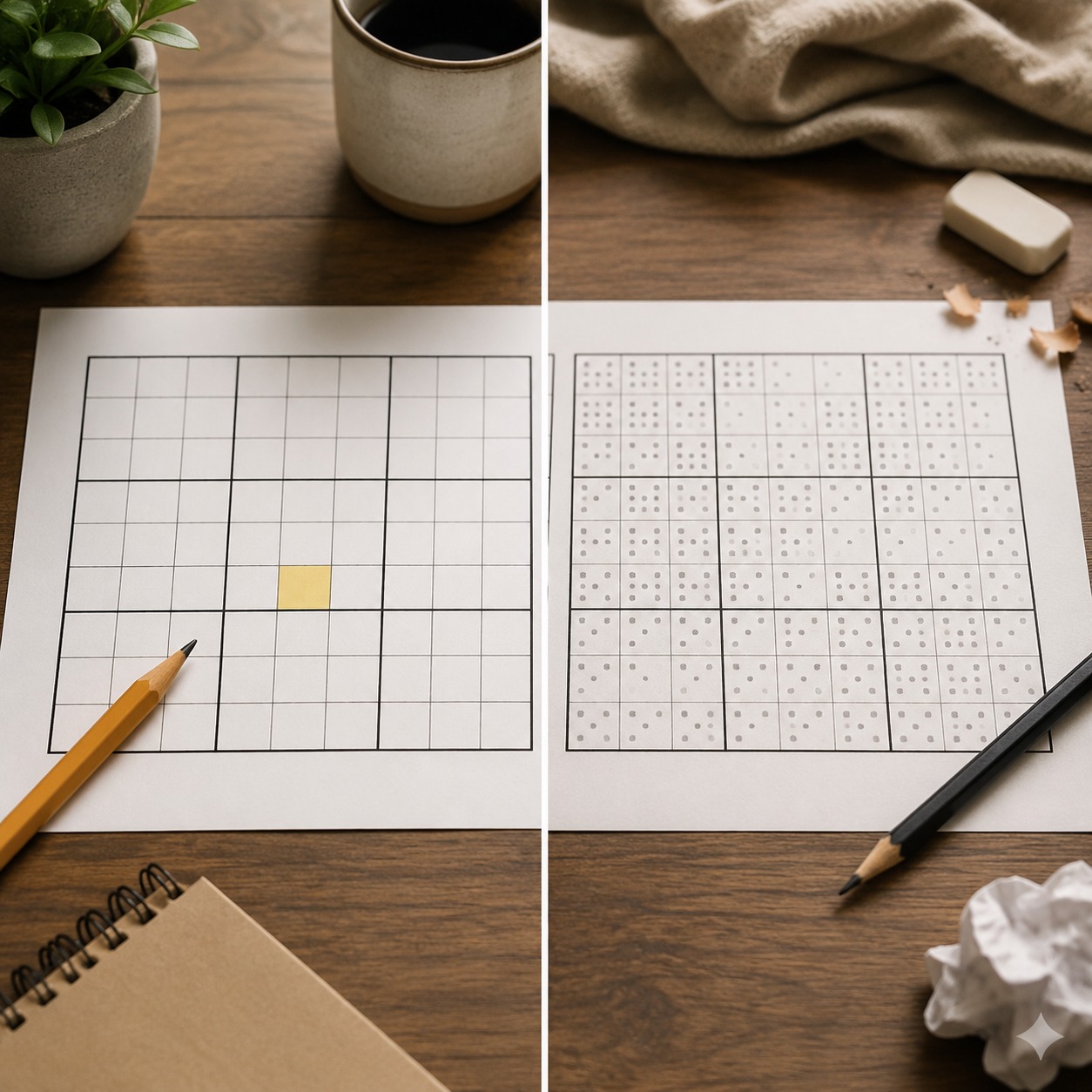
When notes help and when they get in the way
After a few passes, hidden singles become harder to see without notes. That is normal. The mistake is using notes as a substitute for looking.
Use notes after the first scan, not before it. Better yet, add light notes only where they solve a problem. If two cells in a box can both take 6, mark them. If a cell has five possible numbers, maybe leave it alone for now.
A small mistake to avoid
Do not place a hidden single just because a number "looks good" in a box. Check all three houses that touch the cell.
A digit must satisfy the box, the row, and the column. If the box says yes but the column already has that number, the move is illegal.
The habit I like is to say the proof silently before writing the number: "Seven cannot go there, there, or there. This is the only square left in the box." It slows you down by one second and saves several minutes of repair.
A better first five minutes
Sudoku hidden singles are not flashy, which is exactly why they belong in your first five minutes. They make the puzzle feel less like a wall and more like a conversation. You ask one number where it can still live. The board answers.
The next time you open a Sudoku, resist the urge to fill every tiny candidate right away. Pick the fullest box. Choose one missing number. Let the rows and columns do their work. If one square survives, you have your move.
Then move your eyes, not your ego, to the next house.