



Sudoku symmetrical clues are easy to miss because they do their work quietly. A player opens a grid, sees a scatter of given numbers, and starts solving. The pattern may feel balanced, but most players do not stop to ask why.
That balance is not random decoration. It is one of the small editorial choices that helped Sudoku feel more like a crafted puzzle and less like a page of numbers.
Try more daily puzzle games on Easy Daily Puzzle when you want a clean game break, or browse more Sudoku topics on Easy Daily Puzzle after this one.
Sudoku symmetrical clues came from puzzle craft, not decoration
Nikoli's own Sudoku background page says the puzzle was found in an American magazine as "Number Place" and introduced to Japanese readers in 1984. Nikoli also says that in 1986 it decided on a rule that clues should be arranged in a symmetrical pattern, and that the puzzle became a hit after that improvement.
That detail is worth pausing over. The rule did not change the basic Sudoku promise. Rows, columns, and 3x3 boxes still needed the numbers 1 to 9. The grid still required logic rather than arithmetic. Yet clue symmetry changed how the puzzle felt in the hand.
A symmetrical grid tells the player something before the first move: someone built this. The givens are not just sprinkled wherever the generator happened to leave them. They have shape.
That shape can be rotational, mirrored, or simply balanced enough that the eye accepts it. The exact construction method varies by puzzle maker, but the player-facing effect is similar. The grid feels fair before it proves itself.
Why Sudoku symmetrical clues change the first scan
The first scan is where many casual Sudoku solves are won or ruined.
If the player dives straight into notes, the grid can become crowded before it becomes useful. If the player spends a minute reading the givens, the same grid starts to show pressure: a number appearing twice in nearby boxes, a row that is almost ready, a column that has only a few open choices.
Sudoku symmetrical clues make that scan easier because the givens are visually calm. The eye can move around the grid without feeling that one corner is strangely dense and another is abandoned.
That does not mean every symmetrical puzzle is easy. It also does not mean symmetry guarantees quality. A puzzle can look pretty and still solve badly. But symmetry gives the constructor a frame, and a frame can make the opening experience smoother.
For a casual player, that matters. The first thirty seconds should not feel like staring at static. The grid should invite a scan.
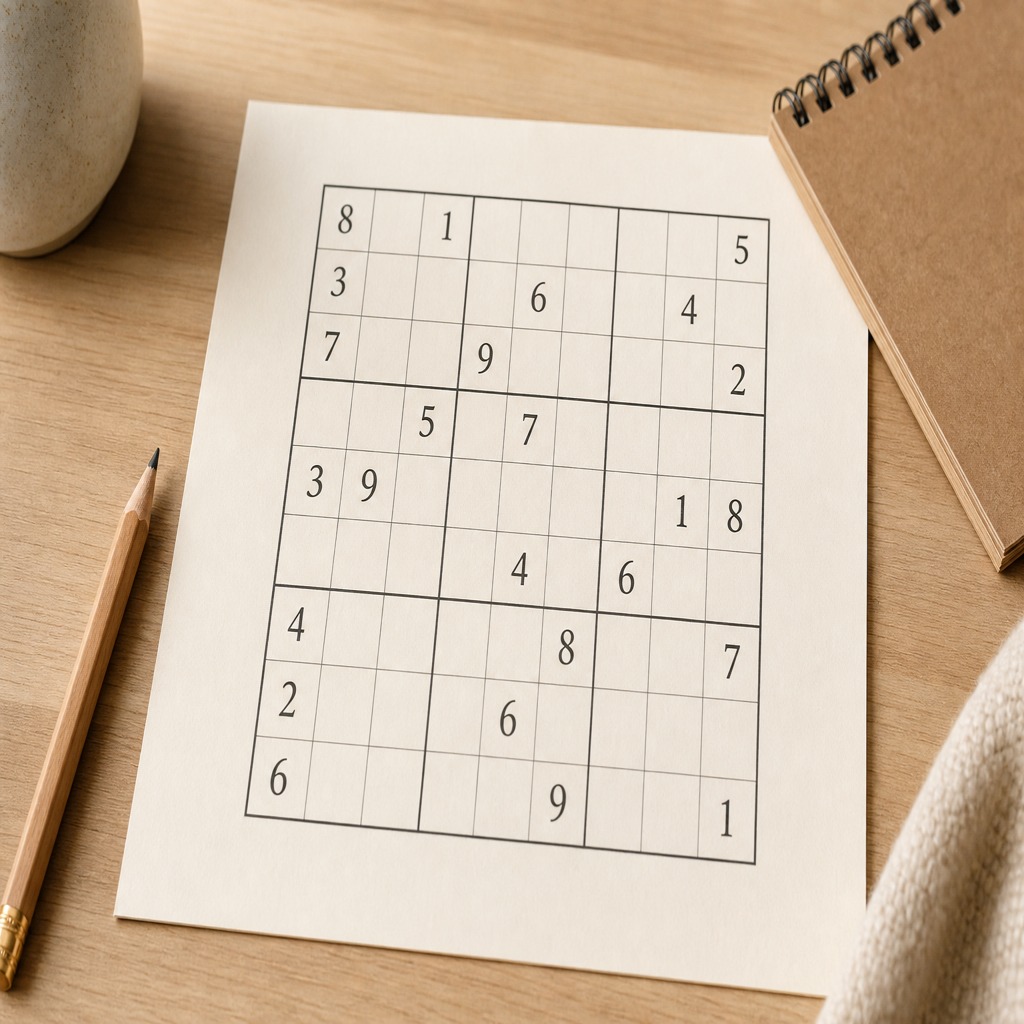
A small example of what symmetry teaches
Imagine the top-left box has a 7 in its upper row. Now imagine the bottom-right box has a matching given in a visually related position. The numbers themselves may not pair up in any useful way, but the visual rhythm makes the grid easier to read.
The player can move from corner to corner, then into the center, then around the middle bands. That habit is useful even when the symmetry is only visual.
Here is a simple routine:
1. Look across the top band before choosing a cell.
2. Check the matching lower band for repeated numbers.
3. Scan the center box early.
4. Mark only candidates that survive row, column, and box checks.
5. Return to the same pair of regions after each confirmed placement.
The point is not to solve by symmetry. Sudoku is still solved by logic. The point is to use the visual order as a reading path.
That is the part beginners often miss. They treat each empty cell as a separate problem. Stronger solvers treat the grid like a connected page.
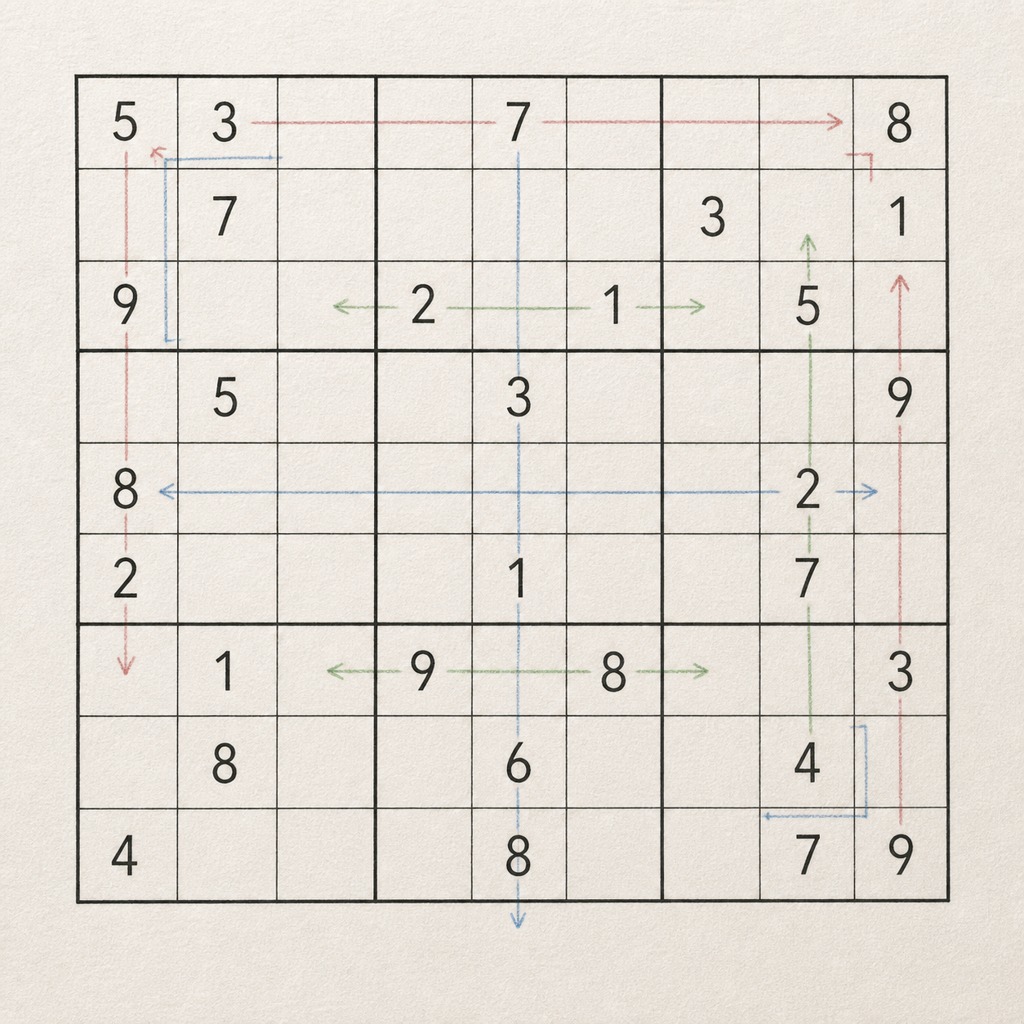
The trap: pretty does not mean solved
There is a small danger here. Once players notice symmetry, they may start trusting the pattern too much.
Do not do that.
A symmetrical grid can suggest where to look, but it cannot prove a number. The proof still has to pass the row, column, and box. If a 5 feels likely because the opposite corner has a 5, that is not logic. It is a hunch wearing a nicer shirt.
Use symmetry as a map, not as evidence.
This is especially important in medium and hard puzzles. A clean-looking puzzle may still hide pairs, locked candidates, or delayed placements. The balance of the givens can make the puzzle friendlier to enter, but the middle still asks for patience.
Start from the Easy Daily Puzzle homepage if you want to switch puzzle types after a Sudoku round. A jigsaw or card game can reset the eye before coming back to numbers.
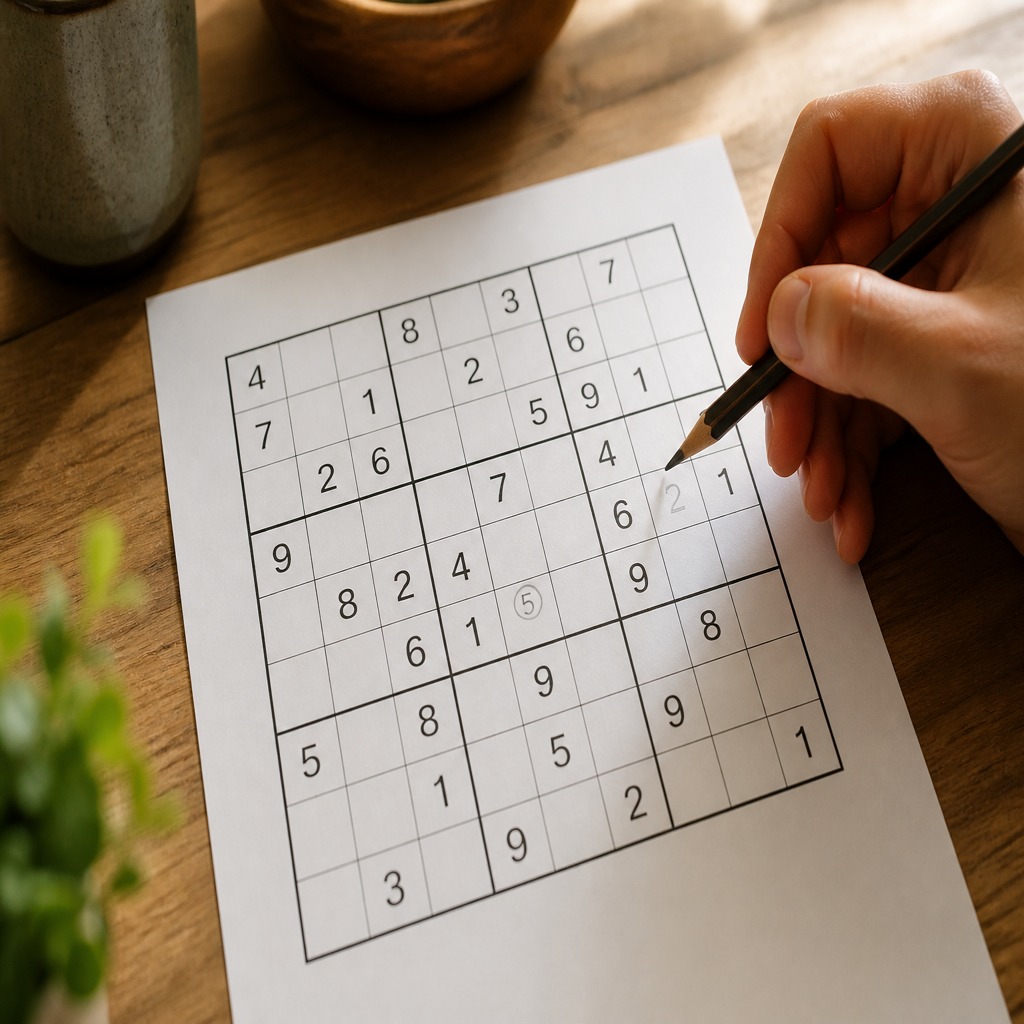
What Sudoku symmetrical clues mean for online play
Online Sudoku moves faster than printed Sudoku. There is no pencil to sharpen, no page to fold, no eraser dust. A player can open a grid and start clicking in a few seconds.
That speed is useful, but it can flatten the experience. If every grid becomes another quick tap session, the player stops noticing the craft.
Sudoku symmetrical clues bring a little of that craft back into view. They remind the player that a good puzzle is not only a solution waiting at the end. It is also a designed opening, a rhythm of information, and a sequence of small tests.
This is why the best first move may be no move at all.
Look at the givens. Notice whether the grid has weight in the corners, the center, or the side bands. Check the fullest rows. Let the puzzle show you where it wants to begin.
Then place the first number.