



Spider Solitaire is one of the most enduring card games pre-installed on Microsoft Windows. While the layout remains the same—two decks of 104 cards arranged in ten columns—the "Difficulty" setting fundamentally changes the nature of the game. Choosing between 1-Suit, 2-Suit, and 4-Suit is not merely a matter of quantity; it transforms the game from pure logic, to memory training, and finally, to advanced strategy.
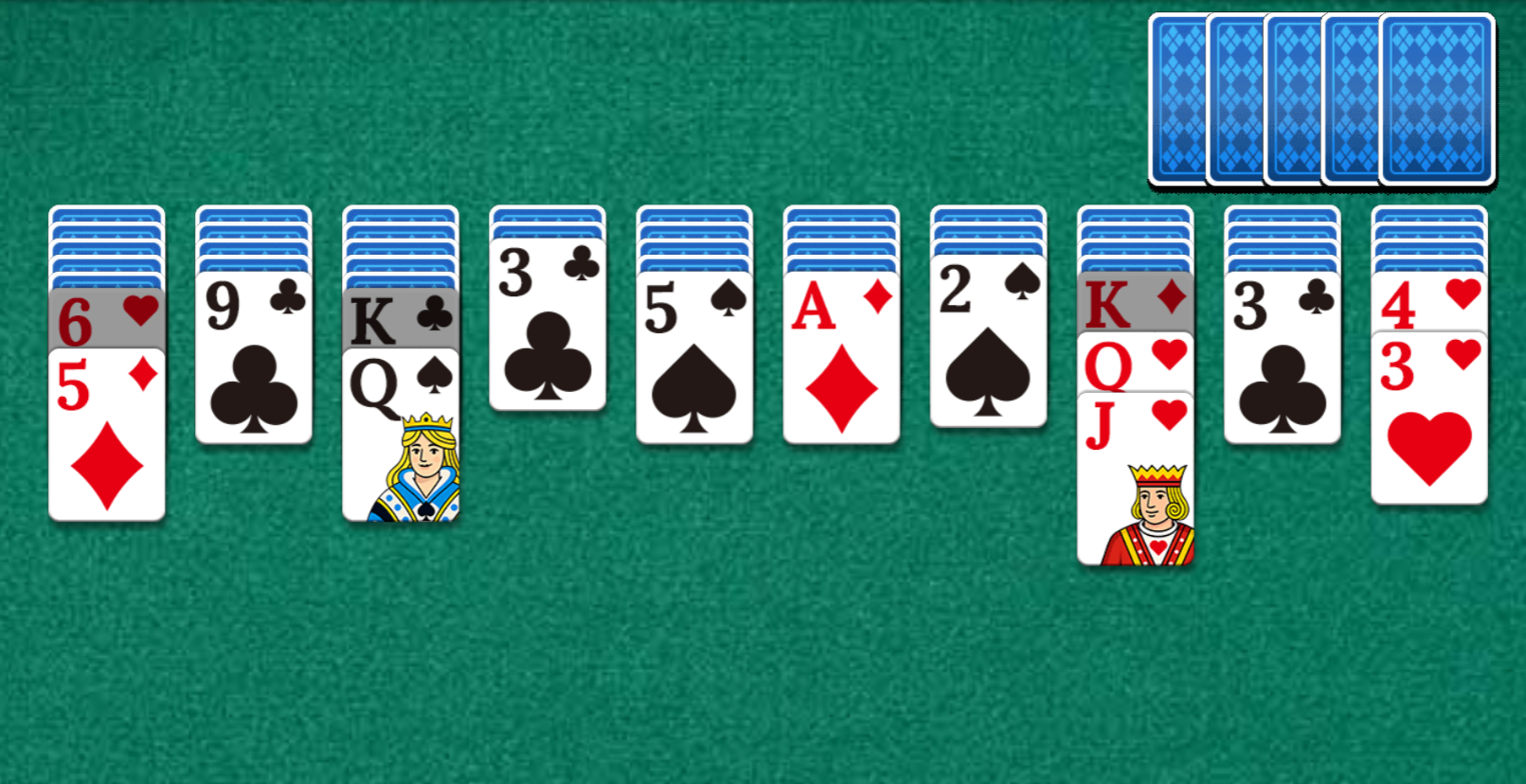
1-Suit (Beginner): The Domain of Certainty
Often played with Spades, this mode removes the core challenge of Spider entirely. With only one suit, every card is interchangeable. A 6 of Spades can be placed on a 7 of Spades, and a 6 of the same suit in another column behaves identically.
In this mode, the game is purely a test of sequencing. There is no wrong move regarding suit, only wrong moves regarding order. Players can focus entirely on exposing hidden cards and creating empty columns. Because there is no penalty for moving cards back and forth, 1-Suit Spider is almost always winnable with careful play. It serves as a "zen mode"—a relaxing exercise in organization rather than a competitive challenge.
2-Suit (Intermediate): The Introduction of Friction
By introducing two suits (typically Spades and Hearts), the game adds a layer of "incompatibility." A red 6 can no longer be placed under a black 7. This restriction creates friction.
Suddenly, building a complete sequence from King to Ace requires not just the right numbers, but the exact suit. Players must now manage two separate "pipelines." The psychological shift here is significant: players must learn to "save" cards. You might have a stack of Spades ready to clear, but if you use those Spades as temporary placeholders for Hearts, you pollute your own progress.
2-Suit is where the concept of "junk columns" is born. Players learn to sacrifice one suit to temporarily hold cards while they organize the other. It is the bridge between casual sorting and genuine strategy.
4-Suit (Advanced): The Psychological Puzzle
4-Suit Spider (Spades, Hearts, Clubs, Diamonds) is widely considered one of the hardest standard computer solitaire variants. While it appears to be a card game, it is actually a test of resource management.
With four suits, the game becomes a logistical nightmare. You are no longer simply building down; you are constantly calculating the "cost" of moving a card. Every move in 4-Suit Spider consumes an empty column or a free cell, and those are finite resources. The key difference is the necessity of "vacating." In lower difficulties, you build sequences to win. In 4-Suit, you often build sequences specifically to reclaim table space.
Furthermore, the 4-Suit game introduces the concept of "dangerous gifts." The stock (the deck in the bottom right) is no longer a helpful refresh; it is a potential disaster. Dealing 10 new cards in 4-Suit mode often buries your winning strategy under layers of incompatible suits, forcing the player to pray for luck.
The difference between these three modes is the difference between sorting, planning, and gambling. 1-Suit is a logic puzzle. 2-Suit is a memory game. 4-Suit is a war of attrition against the randomness of the draw. Mastering Spider Solitaire means understanding that while the rules remain the same, the difficulty lies entirely in how much friction you allow between the cards themselves.