



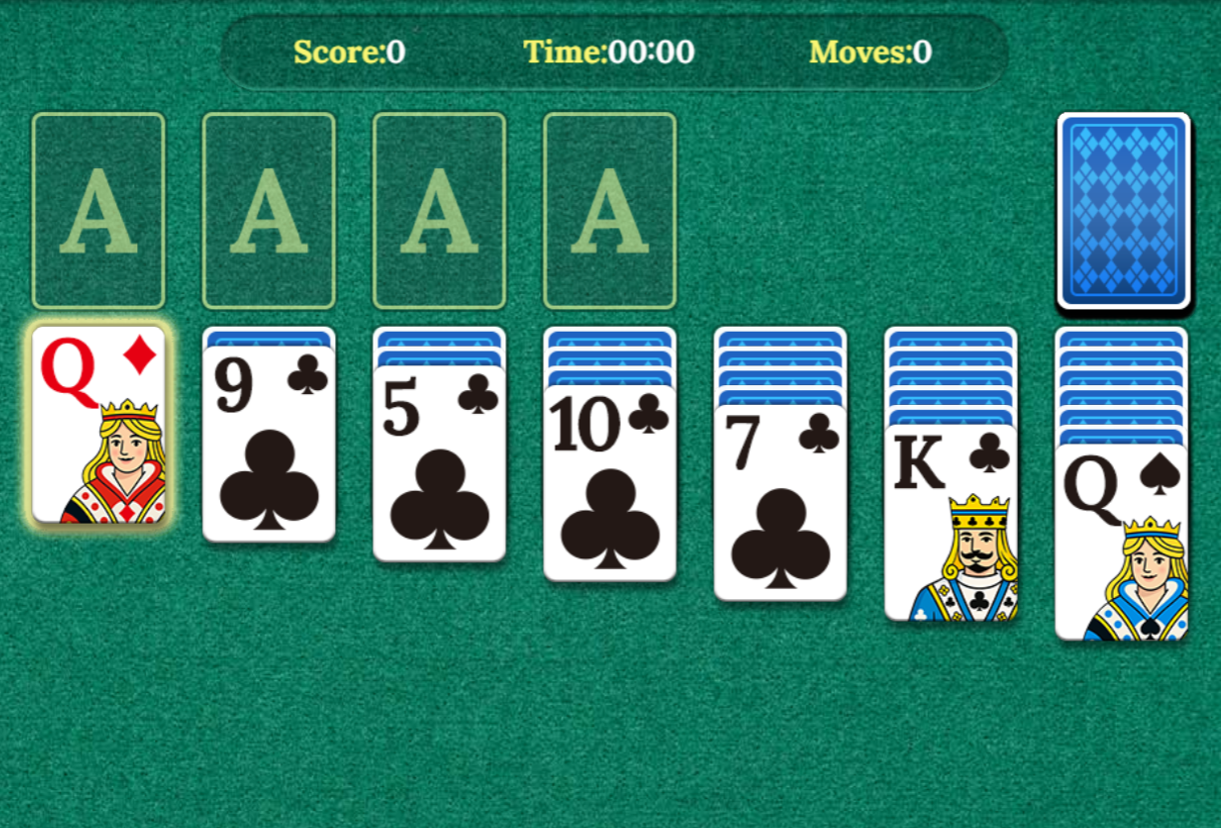
Solitaire, also known as Klondike Solitaire, is arguably the world's most famous single-player card game. Generations have passed time meticulously arranging and rearranging its 52 cards, chasing the elusive perfect game where all cards find their way to the foundation piles. This pursuit naturally leads to a deceptively simple question: Is every game of Solitaire winnable?
The short, and perhaps surprising, answer is a definitive no. Not every deal in classic Solitaire results in a theoretically winnable game. However, the full story is more nuanced, intertwining mathematics, computer science, and the specific rules one chooses to play by.
The Mathematical and Computational Reality
From a purely combinatorial perspective, the number of possible arrangements in a standard Solitaire deal is astronomically large. Crucially, the initial deal is a random subset of all possible permutations of the 52-card deck. There is no hidden mechanism guaranteeing a path to victory in every single one.
This has been confirmed not by theoretical proof alone, but through brute-force computational analysis. Pioneering software developers and researchers in the late 20th century, like Jim Horne, created Solitaire-solving algorithms. By analyzing millions of deals, these programs demonstrated that a significant percentage of games are "dead," meaning no sequence of legal moves can lead to a win, even with perfect play and foreknowledge of all cards.
Estimates vary based on the precise rule set, but a widely accepted figure is that between 80-90% of games are winnable under optimal conditions. This leaves a sobering 10-20% of deals that are impossible from the outset, doomed by an unlucky ordering of cards that blocks all critical paths to the foundations.
The Critical Role of Rule Variations
The win rate is highly sensitive to the specific house rules, which dramatically alter the game's difficulty and the solvability of individual deals.
- "Draw Three" vs. "Draw One": The classic Microsoft Solitaire default of drawing three cards at a time from the stock (with only the top card playable) is significantly more restrictive than drawing one card at a time. The "Draw Three" rule obscures access to cards deep in the stock, creating more unwinnable situations. The "Draw One" variant is more forgiving and has a higher theoretical win rate.
- Number of Passes Through the Stock: Allowing unlimited passes through the stock (as in most digital versions) increases winnability compared to the traditional rule of only one pass.
- Empty Tableau Space Rules: The rule for filling an empty tableau column is also critical. Most digital versions require it to be filled only by a King, which is standard. Some variants allow any card to fill the space, making the game much easier.
The Human Element: Skill vs. Luck
For the human player, the question of solvability is often academic. We do not have the perfect information or computational power of a solver. From our perspective, a game presents as a puzzle with an unknown outcome. A significant portion of losses are not due to a mathematically doomed deal, but to suboptimal play—missing a critical sequence, making an irreversible move too early, or mismanaging tableau spaces.
Therefore, while an omniscient solver might declare 85% of games winnable, the human win rate is far lower. A skilled player might win 40-50% of games in the "Draw Three" variant, with the rest lost to a combination of human error and genuinely unwinnable deals.
Conclusion: The Beauty in Uncertainty
Solitaire is a fascinating blend of skill and chance, set within a framework of strict logic. The fact that not every game is winnable is central to its enduring appeal. It transforms the game from a mere logic puzzle into a compelling challenge. The possibility of an unwinnable hand creates tension, realism, and a sense of humility—you are battling against the inherent randomness of the shuffle. The victory, when achieved, feels earned not just through clever play, but also through a fortunate alliance with the deck.
In essence, Solitaire mirrors a broader truth: not every situation in life has a perfect solution, but the effort to find one—to sort the chaotic into the ordered—remains a profoundly satisfying pursuit. The unwinnable games don't diminish Solitaire; they define it, making every new deal a fresh mystery waiting to be unraveled.